
A Solana-first stablecoin card with a free tier, real monthly limits and some unanswered questions
 Available in US
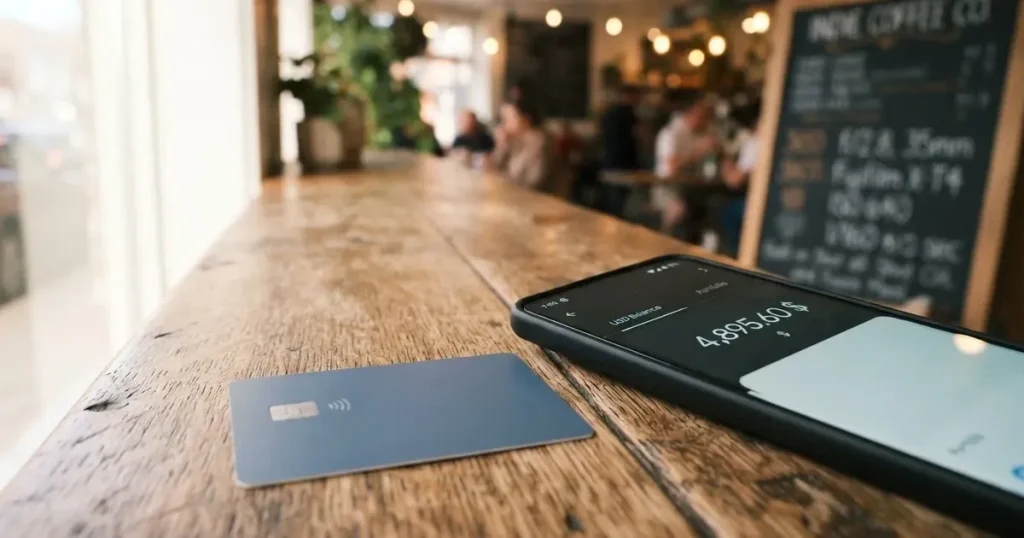
Xplace is one of those crypto cards that arrive with a neat pitch and a tier system, and the pitch is genuinely good: a free tier, a virtual card the moment you sign up, spending straight from a stablecoin balance on Solana, and Apple Pay and Google Pay built in rather than bolted on. It also costs nothing to hold the entry level, which is rarer in this category than the marketing pages suggest.
I scored it 7.7 out of 10. That is a good card, not a flawless one. It loses points on the boring things that decide whether a card is pleasant to live with: who exactly can get one, what a foreign-currency purchase costs on the tier you are actually on, and whether the support desk answers. The published fee table is also better than most competitors, and there is a genuinely useful detail for anyone converting a loan-flavoured spend into cashback.
The conditions described here are current as of October 28, 2026.
The verdict: 7.7 out of 10
Before anything else, here is how the score is built, criterion by criterion, so you can see where the card earns its marks and where it does not.
| Criterion | Mark | Why |
|---|---|---|
| Who can get it | 9 / 10 | The card itself does not publish a country list, but Visa acceptance runs to 160+ countries. The gap is not eligibility, it is that nobody publishes the actual list. |
| Cost | 8 / 10 | Basic is free, then $99, $249 and $999 a year. Card terms show 0% Foreign Exchange Fee, 0% Cross Border Fee and 0% Foreign Transaction Fee. Cash is not available at all. |
| Top-up options | 8 / 10 | BTC as cbBTC, ETH as wETH, SOL, JitoSOL, USDC, USDT and xStocks, all on Solana. |
| Reliability and complaints | 6 / 10 | Issued from Dubai by Pontech Group L.L.C-FZ, the card comes from Third National under a Signify Holdings programme. Reviews sit around 4.1 out of 5 on Trustpilot and 3.5 in Google Play, with recurring complaints about fees and support. |
| Everyday use | 7 / 10 | Virtual card instantly, physical card on Silver with Gold and Platinum promised, native Apple Pay and Google Pay. No ATM withdrawal at all. |
| Total | 7.7 / 10 |
Who does this suit? Someone who already lives on Solana, holds USDC or USDT there, and wants a card that spends that balance directly without a conversion detour. Someone who wants a free tier to try the card with nothing at stake, and who does not need a plastic card on day one. Someone who will pay a $99 or $249 annual fee for the higher spending limit rather than to get a metal object in the post.
Who does it not suit? Anyone who needs cash from an ATM — that is not a gap in the tier system, it is simply not offered. Anyone in a country the card does not serve and who cannot check that in advance, because the eligibility list is not public. Anyone who wants a card they can draw a credit line from without collateral, because the Credit mode here is a loan against your holdings with the risk that implies. And anyone who wants a metal card now: reviewers report being offered plastic in September 2026 with metal promised for October.
Will they give you the card
The honest answer is: probably yes, and the card will not tell you with certainty.
The card’s own pages say that “services are not available in all jurisdictions” and that Visa is accepted in more than 160 countries. That is where the official information ends. There is no country list. No eligibility test you can run before signing up, no clear statement about which citizenship or residence is required, and no published answer on documents, proof of address or minimum age beyond the phrase “register and verify”, which takes minutes.
Third-party sites fill some of the gap, and you should treat their figures as unofficial rather than confirmed by the card. One such site lists 162 countries as available and 34 as explicitly unavailable, naming Russia and India among them. The same page is careful to add something worth holding onto: the negative list does not prove that every unlisted country can actually be onboarded. So the two numbers are a useful ballpark and an unreliable promise.
What this means for you in practice is simple. If you are in a large, commonly served market, sign up and see. If you are somewhere less obvious, expect to find out by trying rather than by reading. Keep expectations modest on timing too — the KYC level structure is not stated anywhere, and neither is the processing time or the list of reasons an application can be rejected. “Register and verify” in minutes describes the happy path only.
How to get it
The signup itself is short. The card says “register and verify” takes minutes, and the virtual card activates instantly after sign-up. That is the part people care about, and it is genuinely fast.
The physical card is where the tier matters. Silver has a live physical card. Gold and Platinum physical cards are marked “coming soon”, so on those two tiers you would be starting with the virtual card and waiting. Delivery is quoted as 7 to 14 business days depending on the region — though a third-party site reported a 3 to 12 day window for the $99 Silver order, and the card’s own figure is the one to plan around.
What is not stated: which countries the physical card ships to, what delivery costs, and what a replacement card costs. The terms list “fees for Card issuance or replacement” as a category without attaching numbers to it, which means you are agreeing to a fee whose amount you have not been shown.
The card itself is a Visa. It comes in two forms, virtual and physical, and it operates in two modes: Cash mode spends your stablecoin balance, and Credit mode borrows against your holdings. Whether Credit mode borrows or simply spends depends on the mode you pick, and the difference matters for anything I say later about interest and liquidation. The currency the card holds is not stated — the card terms say the card association converts foreign-currency transactions into US dollars, which answers the question of how a foreign purchase settles, but not of what the account balance itself is denominated in.
For anyone reading this in a hurry: get the virtual card, use it for a fortnight, and only then decide whether the physical card and its annual fee are worth anything to you.
Fees: what it really costs
The headline numbers are unusually clean for this category, and the tier structure is where most of your cost decision actually lives.
| Fee or limit | Basic | Silver | Gold | Platinum |
|---|---|---|---|---|
| Annual fee | Free | $99/y | $249/y | $999/y |
| Monthly spending limit | $2,000 | $20,000 | $200,000 | $750,000 |
| FX on foreign purchases | Not stated | Not stated | Not stated | 0% |
| Cross-border fee | 0% | 0% | 0% | 0% |
| Foreign transaction fee | 0% | 0% | 0% | 0% |
| Cash withdrawal | Not available | Not available | Not available | Not available |
| Borrowing origination fee | None | None | None | None |
There is a genuine inconsistency to flag here, because it affects how much you should trust the table above. The card’s own terms show a fee table with 0% Foreign Exchange Fee on non-USD transactions, 0% Cross Border Fee and 0% Foreign Transaction Fee. But the summary page says only “0% FX on Platinum”, which reads as a tier-specific claim. An unofficial comparison published by a third party in August 2026 gives a tier-by-tier picture that matches the summary rather than the terms: Basic unconfirmed, Silver 0.5%, Gold 0.25%, Platinum 0%. Both cannot be right. If you are on Silver or Gold and you spend abroad, that difference is the whole cost of the transaction, so it is worth asking the support desk directly before you rely on either number.
Two other conversion points. The card advertises stablecoin spending with “no hidden spread”. And whatever tier you are on, the card association converts foreign-currency transactions into US dollars — so your home-currency cost of a purchase depends on how the exchange rate lands, even where the fee line is zero.
Now three everyday payments, with the fees that actually apply:
- A $40 lunch in your own country. No conversion at all, no FX fee, no cross-border fee. You spend the stablecoin balance and pay the network’s own transfer cost, which the blockchain charges rather than the card.
- A €30 hotel in Europe, on Silver. This is the ambiguous one. Under the card terms table, 0% Foreign Exchange Fee and 0% Foreign Transaction Fee, so you would expect no card-level conversion charge. Under the tier-by-tier unofficial figures, 0.5% on Silver, which on €30 is a small but real number. The card’s promise of “no hidden spread” is about the stablecoin side, not this.
- Anything that needs cash. “Cash advances and balance transfers are not available under these Card Terms.” That is not a fee question, it is a capability question, and it is the same answer on all four tiers. The card does not publish an ATM fee because there is no ATM function. Unofficial sources add that confirmed ATM fees, ATM limits, replacement-card fees and general daily limits are not published, with per-transaction limits reported at $3,000 on Silver, $10,000 on Gold and $25,000 on Platinum.
One more limit that is easy to miss. The card terms say your spending limit is generally set by Pontech Group L.L.C-FZ, and that the issuer may set additional limits and change them at any time. So the monthly figures above are ceilings, not guarantees.
Top up: how the money gets in
Top-up is where Xplace is most opinionated and, for the right user, most pleasant. Deposits accepted are BTC (as cbBTC), ETH (as wETH), SOL, JitoSOL, USDC, USDT and xStocks — every one of them on Solana. That single-network commitment is the card’s character in one line. If your crypto already sits on Solana, this is frictionless. If it sits elsewhere, you are making a transfer, and you are paying that network’s fee rather than the card’s.
Because everything lands on Solana, USDC and USDT behave in the way Solana transfers behave: fast, cheap, and irreversible. Irreversibility is the part to internalise. A transfer sent on a network the provider does not support, or to an address belonging to a different network, can be lost or need manual support recovery with no guarantee of outcome.
Withdrawal is presented in the language most people want to hear: “withdraw the moment you decide”, “no lock-ups”. The same pages temper it — withdrawals depend on protocol liquidity and may be temporarily limited during market stress. Withdrawal fees are not stated, minimum top-up is not stated, and fiat top-up options are not stated at all. If you were planning to load the card from a bank account, the card pages do not tell you whether that is possible.
One balance-management detail that is easy to overlook: the terms on card closure say only to surrender or destroy the card. What happens to any balance left on it at that point is not stated.
Paying with it every day
Day to day, this behaves like a normal Visa with a crypto balance behind it. Apple Pay and Google Pay are described as native, which means you are not hunting through a settings menu for a third-party wallet — the card goes into the wallet you already use. There are App Store and Google Play links on the site, though the official page does not show ratings there.
What that will not do is cover everything you pay for. The card points to a “Blocked Merchants” document, and the contents are specific rather than generic. Categories automatically declined include explosives, small arms, wire transfers, pawn shops, gambling and lotteries, money transfer services, escort and massage services, and political, labour and religious organisations. Named merchants include eToro, Skrill, Neteller, Wish, MoonPay and Wise, plus a “dynamic list” that implies the exclusions can move without notice. If any of your regular spending sits in that set — gambling being the obvious one, and money transfer services being the less obvious but more painful one for people with ties across borders — you should know this before you depend on the card day to day.
There is also a cardholder reason for the merchant to look twice. A card’s issuer identification number identifies the issuing institution and country, and merchants can apply extra scrutiny when that country differs from your billing address. A Dubai-issued card can read as foreign to a shop in another country, which is one reason some merchants decline cards like this regardless of the fee table. Address verification services also work less reliably on foreign-issued cards, which shows up as declines rather than as visible rules.
The rewards are tier-dependent and worth understanding precisely, because the split between the two modes catches people out. Cashback is paid in USDC to your wallet at settlement, and in Credit mode it runs 0.5% on Basic, 1% on Silver, 1.5% on Gold and 2% on Platinum. Cash-mode cashback is not stated. So whether you earn 1% or nothing on a given purchase depends on which mode is active, and that is not something the card highlights as clearly as it should.
On disputes, the terms are normal and the deadline is real: report any disputed charge or error no more than 60 days after it is posted. Chargebacks resolved in your favour are credited back to your Xplace account. Cash advances are unavailable, which removes one category of dispute entirely. And note that a declined authorisation can leave a hold on funds for several days, typically up to seven — a small thing that surprises people on their first week.
What can go wrong
Start with the company, because that is where most of the risk sits. The operator is Pontech Group L.L.C-FZ, in the Meydan Free Zone, Dubai, UAE, licence no. 2527237.01. The card is issued by Third National under a programme managed by Signify Holdings, Inc. And the site says plainly that it is not a bank, not a licensed lender and not an investment firm. That is the structure of a programme manager: it markets the card, and someone else holds the banking licence. It is a common structure and it is not a warning on its own — but it means the entity you have a relationship with is not the entity that issues the card or that holds any bank deposits.
The fund custody claim is the one thing genuinely in your favour, and it is worth reading carefully rather than skimming. The card states that “XPlace does not hold your funds” and “XPlace cannot freeze, seize, or move your funds” — a non-custodial claim, which means control of the crypto stays with whoever holds the private key rather than with the provider. That removes a whole category of risk. It does not remove the others: key loss has no recovery path, crypto transfers are irreversible, and there have been well-documented custodian failures in this industry at a scale that makes the point better than I can. What is not stated anywhere: two-factor authentication, in-app card freeze, spending controls, or insurance. Those are the standard safeguards you would want to see confirmed, and their absence from the public pages is a fair thing to ask about.
Now the complaints, because this is where the score lost most of its points. Trustpilot shows 4.1 out of 5 across 56 reviews for Xplace. That is a good score on its face. Reading the themes is the point, though: a September 2026 report of being offered a plastic card instead of the advertised metal card, plus an extra charge for the card, with the company saying metal launches in October; a September 2026 “hidden fees” review at two stars; slow support across August and September 2026; incoming SEPA transfers rejected without a reason in October 2026; and one person unable to add the card to Apple Wallet in September 2026. Google Play sits lower at 3.5 out of 5, with at least one scam claim. Support is advertised as “real support, 24/7, across every tier”, with an email and a Dubai phone number in the card terms, which is a reassuring thing to read right up until you are the one waiting.
The Credit mode is the part I would think hardest about, and I would rather you hear it from me than discover it. An unverified secondary guide describes Credit mode as a collateral-backed loan with interest and liquidation risk — which follows logically from how it is structured, since you are borrowing against holdings. The same guide says the Drift lending protocol was hacked, affecting users, and that Xplace moved to Kamino in May. An aggregator additionally mentions withdrawal lockups and slow support. These are third-party claims about a mechanism I would describe the same way regardless: borrowing against volatile collateral carries the possibility of losing the collateral if it falls. Official information on incidents is not stated, and no regulatory actions are listed.
One loose thread worth knowing about if you ever close the account. The international card terms published in October 2025 list penalty fees: up to $40 for late payment and $29 for a returned payment. That implies credit behaviour somewhere in the product, and it is worth reading the terms rather than assuming.
What to take instead
Three alternatives come up most often, and comparing them honestly is more useful than a ranking. Sponge scores 4.9, ether.fi 6.7, Anodos Card 7.2 — all below Xplace on my scoring, though the scoring criteria are mine and the reasons behind them differ.
| Xplace | ether.fi | Anodos Card | |
|---|---|---|---|
| Network and assets | Solana: BTC, ETH, SOL, JitoSOL, USDC, USDT, xStocks | Any supported token into the user’s Safe; coin and network list not stated | Ethereum, Polygon, Optimism, Arbitrum or others the issuer adds |
| Eligibility | No country list published; 160+ Visa countries | Listed jurisdictions only; if yours is not listed you cannot apply | 150+ countries with a few exceptions; explicit exclusion list by residence |
| Card cost | Free to $999/y | One free virtual card for Core; first card $10 in regional-pricing countries | Free, $9.99/mo Pro, $29.99/mo Elite |
| FX fee | 0% in card terms; unofficial tier figures up to 0.5% | 0.5% Core, 0.25% Luxe, none Pinnacle and VIP | 1.50% Free, 1.25% Pro, 1.00% Elite |
| Cashback | 0.5% to 2% in Credit mode, paid in USDC | 3% on tiered monthly ladders, paid in ETHFI | Not stated in the card terms |
| Cash withdrawal | Not available | ATM blocked in North Korea, Iran, Myanmar | Not stated |
Sponge, at 4.9, is the weakest of the three on published information. There is no country list, no stated card cost, no stated fees and no stated rewards. What it does have is a clear structure: a virtual card issued by Rain, a Visa Principal Member, funded by USDC collateral moved from the Sponge wallet with a card fund command, with an SDK mentioning base or solana as optional chains. If you want the simplest possible one-card-from-a-wallet arrangement and can live without knowing the costs in advance, it is worth a look — otherwise the absence of published numbers is the problem.
ether.fi, at 6.7, is the one with the most disciplined disclosure of the three, and in one respect it is the strongest card in this comparison: cashback of 3% on tiered monthly ladders, paid in ETHFI and locked for seven days. Its weakness is eligibility — it issues only in listed jurisdictions, and the site’s own wording is that if your jurisdiction is not listed you will not be able to apply. It also charges more on FX below the top tiers than Xplace’s own terms claim.
Anodos Card, at 7.2, is the interesting middle option. It publishes real FX numbers (1.50%, 1.25%, 1.00% by tier), a real price ladder, and an unusually explicit exclusion list — no cards for residents of Belarus, mainland China, Cuba, India, Iran, Iraq, Israel, Myanmar, Nepal, Nicaragua, North Korea, Russia, Syria, Turkey, Ukraine, Venezuela or Vietnam, plus enhanced review for Nigeria, Sri Lanka and South Africa, and spending blocked in seven countries. That last point is the practical advantage of listing your exclusions: you can check your own situation against it. It also states that users must attest they are not US citizens, with a separate US programme in 30 states, and it currently runs 0% APR on purchases. Its FX fee is the highest of the three, and rewards are not stated in the terms.
My read: if you are on Solana, Xplace is the better fit of the four. If you are in a jurisdiction that ether.fi names and you spend heavily, its 3% cashback is the single best rewards rate in this group. If you want a card whose blocked-country list you can read before you apply, Anodos is the most predictable.
Who I would recommend it to
I would recommend this card to a specific person, and I would hesitate for everyone else.
Recommend it if you already hold USDC or USDT on Solana and want to spend it without moving it first; if a free tier with a $2,000 monthly limit is enough to test whether you like spending from a crypto balance; if your usage is online and everyday rather than cash-heavy, given that no ATM withdrawal exists; and if you are comfortable with a card issued from a Dubai programme manager rather than a bank you have an account relationship with.
Wait on it if you need cash; if you cannot check your own country against any list because none is published; if you are likely to move substantial value and want published daily limits, which are not; if you intend to use Credit mode without reading how the collateral and liquidation work, because the useful description of it is a third party’s, not the card’s; or if you are drawn to the metal card specifically, since reviewers report plastic being offered while metal is promised.
And one small practical note that cuts both ways. Before you spend abroad, ask support which FX figure applies to your tier. It is a two-minute question that resolves the one genuine contradiction in the card’s own pricing, and it is worth more than any figure in this review if you travel.
Frequently asked questions
What is the Xplace card?
The Xplace card is a Visa payment card linked to a crypto account, offered in four tiers from free to $999 a year. It works in two modes: Cash mode spends your stablecoin balance directly, and Credit mode borrows against your holdings. A virtual card activates instantly on sign-up; a physical card is live on Silver, with Gold and Platinum marked as coming soon.
How does the Xplace card work in practice?
You deposit supported assets on Solana, then spend that balance through the virtual or physical Visa, or through Apple Pay and Google Pay, which are built in natively. Cashback in Credit mode runs 0.5% to 2% by tier and is paid in USDC to your wallet at settlement. The card cannot draw cash, because cash advances are not available under its terms.
Is Xplace a bank, and who actually issues the card?
No. The site says explicitly that Xplace is not a bank, not a licensed lender and not an investment firm. The operator is Pontech Group L.L.C-FZ in the Meydan Free Zone, Dubai, licence no. 2527237.01, and the card is issued by Third National under a programme managed by Signify Holdings, Inc.
Which countries can get the Xplace card, including Russia?
The card publishes no country list, only that services are not available in all jurisdictions and that Visa acceptance covers 160+ countries. Unofficial third-party figures list 162 countries as available and 34 as unavailable, naming Russia and India, while noting the negative list does not prove unlisted countries work. So the practical answer is: you find out by applying.
Does the Xplace card require KYC, and what documents?
Yes, registration involves verification that the card says takes minutes. Beyond that, the card’s public pages do not state which documents are needed, whether proof of address is required, the minimum age, or whether there are KYC tiers. No processing time or list of rejection reasons is published either, so the “minutes” figure describes the happy path only.
How much does the Xplace card cost, and is it free?
The Basic tier is free with a $2,000 monthly limit. Silver is $99 a year with $20,000, Gold $249 with $200,000, and Platinum $999 with $750,000. Borrowing carries no origination fee. The card terms show 0% Foreign Exchange Fee, 0% Cross Border Fee and 0% Foreign Transaction Fee, though an unofficial comparison gives 0.5% on Silver and 0.25% on Gold, contradicting that.
Can I withdraw cash or use the Xplace card in an ATM?
No. The card terms state that cash advances and balance transfers are not available under these card terms, which applies to every tier including Platinum. Third-party sources add that no confirmed ATM fees or ATM limits are published, because there is no ATM function to price. Plan on card payments, Apple Pay and Google Pay only.
What tokens and networks can I use to top up the Xplace card?
Deposits are accepted on Solana: BTC as cbBTC, ETH as wETH, SOL, JitoSOL, USDC, USDT and xStocks. The deposit fee, minimum top-up and any fiat top-up route are not stated. Because Solana transfers are irreversible, sending on an unsupported network or to another network’s address can mean lost funds needing manual support recovery.
Is the Xplace card safe, and does it hold my money?
The card claims to be non-custodial, stating that Xplace does not hold your funds and cannot freeze, seize or move them, which removes custodial counterparty risk. What is not stated is two-factor authentication, in-app card freeze, spending controls or insurance. Crypto transactions remain irreversible, and reviews of about 4.1 out of 5 across 56 on Trustpilot and 3.5 in Google Play mention hidden fees and slow support.
Can I earn cashback and add the card to Apple Wallet?
Cashback in Credit mode is 0.5% on Basic, 1% on Silver, 1.5% on Gold and 2% on Platinum, paid in USDC at settlement; Cash-mode cashback is not stated. Apple Pay and Google Pay are described as native. However, one September 2026 review reports being unable to add the card to Apple Wallet, so test the wallet connection early rather than at a till.
Credit and cashback card verdicts – cryptocardverdict
Content created by the «cryptocardverdict» team