
Cadmos card review — spending USDC and USDT from your own wallet, with a Visa in your pocket
 Available in US
If you already keep USDC or USDT in a self-custody wallet and you simply want a card that spends that balance at a coffee shop, Cadmos sits in an unusual corner of the market. It does not ask you to deposit your crypto with a custodian first, and the only funding networks it lists are the cheap ones. That combination is rare, and it is also the reason this review is worth reading past the headline: the same design choice explains what the card does well, and what it does not tell you at all.
Conditions are current as of October 28, 2026.
Verdict
I am giving the Cadmos card 7.0 out of 10. That is a respectable mid-table score for a crypto-linked card, and it reflects the fact that the product does the one thing it sets out to do — turning USDC and USDT from a self-custody wallet into a Visa payment — with very little friction. The score is dragged down by what Cadmos does not publish: there is no list of supported countries, no named card issuer, no licence cited in the terms, and several everyday numbers (issuance fee, ATM fee, card currency) that a careful reader has no way to verify before signing up.
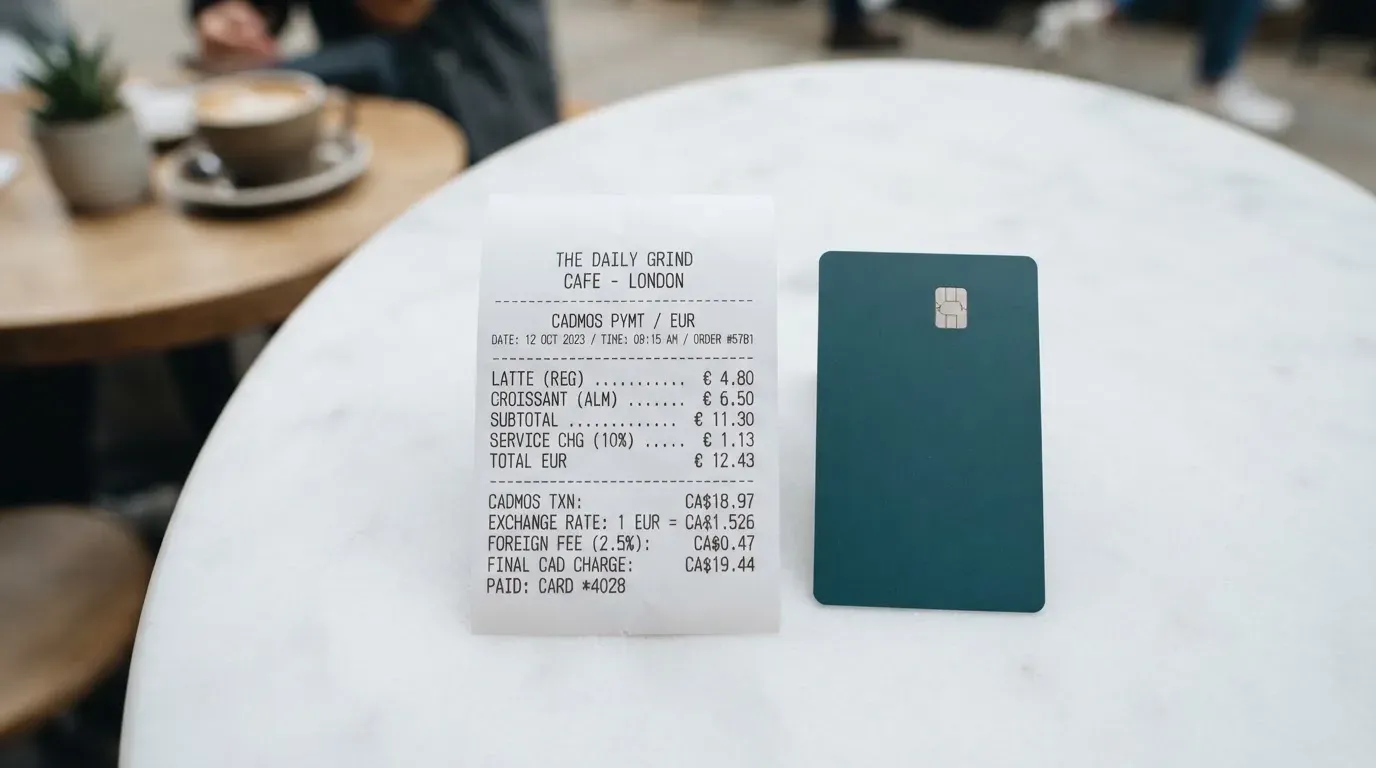
The card suits you if you already hold USDC or USDT in your own wallet, you live somewhere that the app accepts, and you treat the card as a thin layer over an existing crypto position rather than as a bank account. It does not suit you if you want a clearly regulated e-money product, a published fee schedule, or a card that is accepted in jurisdictions you can read about in advance. In particular, anyone who needs cash from an ATM, who wants to top up with euros from a bank, or who values a publicly listed licence should look elsewhere.
Here is how the score breaks down across the criteria I checked:
| Criterion | Mark | Why |
|---|---|---|
| Who can get it | 7/10 | The card does not publish a country list; the only carve-out the terms name is US-embargoed countries. |
| Cost | 7/10 | Premium is $0 a month with a 1.75% FX fee; issuance and crypto conversion fees are not stated. |
| Top-up options | 9/10 | USDC and USDT from a self-custody wallet, on Arbitrum, Solana and Tron. |
| Reliability and complaints | 6/10 | Cadmos LTD, Limassol, Cyprus, since 2021; no issuer or licence named, no public complaints found, wallet is self-custodial. |
| Everyday use | 6/10 | Premium supports Apple Pay and Google Pay; Standard supports Apple Pay; virtual/physical and ATM use are not stated. |
| Total | 7.0 / 10 |
Who can actually get the Cadmos card
Cadmos does not publish a list of supported countries. The terms only spell out the negative: you must not be in a country under a US embargo. Beyond that, eligibility is determined inside the app, on the order screen, and the only way to find out whether you can have a card is to open it, start sign-up, and see what the app shows for your country. That is a real gap if you are shopping without a smartphone in hand, and it is worth taking seriously before you commit time to the rest of the application.
There is also no stated rule on age or proof of address in the public terms; the card’s own copy says only that KYC depends on the product and is shown on the order screen. In practice you should expect to be asked for a government ID, personal information and a liveness check — that is what the order flow mentions — but the level of due diligence applied to your account is not described up front.
For most readers, the practical question is whether the app will accept them. If your country is under US sanctions, the answer is no. If it is not, the answer is “try the order screen”. If you need certainty before you sign up, you will not find it on the website.
How to get the card
Cadmos sells two products. Premium is a Visa Signature, and Standard is a Visa or a Mastercard, with the network shown in the app at order time. The card can be virtual or physical, and the card currency is not stated in the public terms. Delivery time is also not stated.
Sign-up works like this. You download the app, create an account, and reach the order screen, where you pick Premium or Standard and the KYC steps are listed. Those steps can include government ID, personal information and proof of liveness, but proof of address and the exact age requirement are not stated. The KYC depth for each tier is also not stated, so you should not assume a quicker path because you choose Standard.
There is no public indication of how long activation takes after KYC is approved, no published delivery window for the physical card, and no description of how a virtual card is delivered into a wallet. If you need a card in the next 48 hours, you have no way to confirm that from Cadmos’s own pages.
What the Cadmos card really costs
The headline is friendly. Premium is $0 per month, and the only published fee is a 1.75% foreign-exchange fee on its terms. For Standard, the public pages say costs are shown on the order screen and not published in advance, which means you need to be inside the app to see what you would pay.
That is roughly the extent of what you can read before signing up. The fees that the card does not publish, and that the rest of this section goes through, are: the issuance fee, the ATM fee, the crypto conversion fee, and the card’s settlement currency. The limits the card does publish are a $175,000 monthly spend cap for Premium; for Standard there is no wallet-balance or cumulative transfer cap from Cadmos itself, and card-level limits are set by the underlying programme and shown in the app.
| Fee or limit | Premium | Standard |
|---|---|---|
| Monthly fee | $0 | not stated (shown on order screen) |
| Issuance fee | not stated | not stated |
| FX / cross-border fee | 1.75% | per programme terms, no figures published |
| Crypto conversion fee | not stated | not stated |
| ATM fee | not stated | not stated |
| Monthly spend limit | $175,000 | no Cadmos cap; programme cap shown in app |
| Tier perks | Visa Signature, lounge access at 1,300+ lounges in 500+ cities, 24/7 concierge, Visa Airport Companion | none listed |
To make those numbers less abstract, here are three everyday payments and how the published fees apply. Take the usual case of paying for a €40 dinner in a country whose currency is the euro while your card is denominated in dollars: the 1.75% FX fee on Premium applies to the converted amount, so the FX slice on that meal is roughly €0.70. Take paying for a $50 online subscription in dollars with a card denominated in dollars: the published Premium fees do not name a domestic transaction fee, so the visible cost is zero on Cadmos’s side, plus whatever the network charges. Take withdrawing the equivalent of $200 from an ATM abroad: the ATM fee is not stated, the FX fee of 1.75% would add about $3.50, and the network may apply its own ATM acquirer fee on top — so the realistic floor is somewhere above $3.50, with the unknown ATM fee sitting on top.
The honest summary is that Cadmos is cheap where it has published a number, and it is silent where you would most want a number. If your monthly spend is small and the FX fee is your main concern, Premium is competitive. If you want to know the all-in cost before you order, the Standard product in particular gives you very little to read.
How to top up the card
Top-up is the cleanest part of the Cadmos design, and it is also the part of the product I find most clearly described. The card is self-custodial: you send USDC or USDT from your own wallet to the card, and the merchant is paid in fiat. The networks Cadmos supports for that transfer are Arbitrum, Solana and Tron, which are the cheap ones. The wallet balance stays self-custodial until a card top-up is approved, and Cadmos explicitly does not take custody of your digital assets or your fiat funds; you hold the recovery phrase.
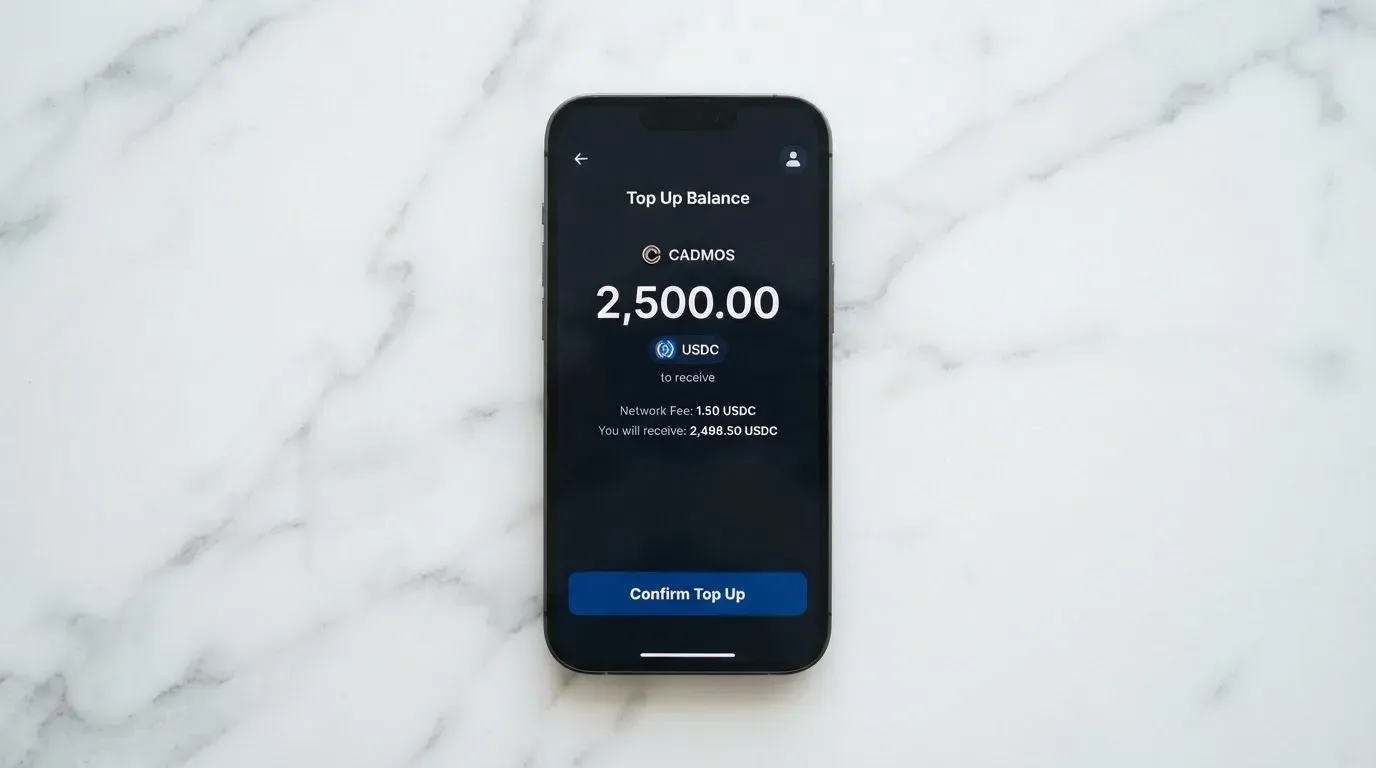
There are some practical points to keep in mind, because they are not in the marketing copy. There is no stated minimum and no stated top-up fee beyond the on-chain gas you pay to send the stablecoin. There is no stated support for funding by bank transfer, debit card or card top-up in fiat. Closure is by email, and Cadmos notes that closing the card does not freeze or move your digital assets, which is consistent with the self-custody model; how you would withdraw any remaining card balance in fiat is not stated. If you are used to topping a card up from a bank account, this product does not do that.
The three networks are also a deliberate choice. Arbitrum and Solana are cheap EVM-style and non-EVM chains; Tron is widely used for USDT. Sending USDC on Tron, however, is not the same thing as sending USDC on Ethereum: Circle stopped supporting USDC on Tron in February 2024, so the “USDC” you send on TRC20 is the Tether-style wrapped version that has its own liquidity profile. If you are topping up with USDC, be careful to use a network Cadmos lists and an asset on the same network. Sending the right token to the wrong address is the single most common cause of lost deposits in this category, and the network cannot recover it for you.
Paying with the card every day
Premium supports Apple Pay and Google Pay; Standard supports Apple Pay for both the Visa and Mastercard versions it offers, and Google Pay is not mentioned for Standard. Whether the card is virtual or physical, what currency it settles in, and which merchant category codes Cadmos blocks (for example, gambling MCC 7995) are not stated. A /download page exists in the app’s web presence; I did not read the ratings.
For rewards, Cadmos does not publish a cashback or points programme, and the company does not advertise one. The Premium perks that are stated are the Visa Signature package: lounge access at 1,300+ lounges in 500+ cities, a 24/7 concierge, and Visa Airport Companion. Whether you actually use those depends on how often you fly.
In everyday terms, the experience is the same as any other prepaid-style card. The merchant sees a Visa (or Mastercard) authorisation, the card balance is drawn down, and the issuer — whoever that turns out to be — settles in fiat. Because Cadmos does not say which issuer holds the programme, it is harder to predict how a specific shop’s payment system will treat the card. Foreign-issued Visa and Mastercard BINs are sometimes subject to extra scrutiny by merchant fraud systems, and Address Verification Service is generally unavailable for cards issued outside the US, Canada and the UK, so a foreign-looking BIN can occasionally be declined. That is a category effect, not a Cadmos effect, but it is worth knowing.
What can go wrong
A card review that does not spend a section on risk is doing you a disservice. The issues with Cadmos fall into three groups: transparency, custody, and category risk.
On transparency, the issues are concentrated. Cadmos LTD is a company registered in Limassol, Cyprus (registration number HE 457316), founded in 2021. The card’s terms do not name the issuer — that is, the bank or e-money institution that actually issues the Visa or Mastercard — and they do not name a licence under which the card programme operates. I searched for public complaints about Cadmos Pay and found none: no Trustpilot page, no Reddit complaints. That absence is reassuring in the short term, but it also means there is no third-party trail of how Cadmos has handled disputes, freezes, or programme changes.
On custody, the design is conservative for you, the user, and that is the point. Cadmos’s own terms say it does not receive, hold, safeguard, or acquire title to your digital assets or your fiat funds. The downside is that you hold the recovery phrase: lose it, and you lose access to the funds behind the card. Phishing, clipboard-hijacking malware that swaps copied addresses, and seed-phrase theft are the realistic risks in a self-custody model, and Cadmos cannot help you recover from any of them.
On category risk, the issue is that crypto cards as a class have failed before. The clearest recent precedent is FTX: Visa terminated its global agreements with FTX on 13 November 2022, and the FTX US debit card was wound down by its issuer. WaveCrest, a Visa card issuer that supplied several crypto card brands, was suspended by Visa in Europe in 2018, and every WaveCrest-issued Visa programme was closed. The lesson is not that Cadmos will fail; the lesson is that a card programme depends on the network’s continuing relationship with the issuer, and that relationship is not in your hands. If the programme is wound down, the typical pattern is a notice period, a stop on new loads, a stop on spending, and then a window to withdraw any remaining balance — but the length of that window, and whether it covers a fiat balance on the card, is set by the issuer and Cadmos does not tell you in advance.
For dispute resolution, the terms point to French law and the Paris courts, with a 30-day good-faith resolution step after written notice. The actual chargeback process for the card is not stated, so I cannot tell you how a disputed transaction would be handled in practice. Support contacts are [email protected], a Help Center inside the app’s Settings, and a phone line at +1 (845) 588-8434; Premium adds a 24/7 concierge reachable by email and WhatsApp.
What to take instead
If the gaps above matter to you — the missing country list, the missing licence, the missing issuer, the missing ATM fee, the missing rewards programme — the natural next step is to compare Cadmos against a few alternatives that do publish those facts, before you sign up.
The first is MetaMask Card, which I score 7.1 out of 10. It is a Mastercard, virtual card issued first, with a Metal upgrade at $199 a year. Sign-up is open in 45 listed countries and territories, including Andorra, Argentina, Brazil, Canada, Mexico, Germany, France, Spain and Uruguay; other regions join a waitlist. Proof of residency is required; citizenship rule is not stated; US and UK sign-ups are temporarily closed per the FAQ. The card spends directly from the connected wallet, on Linea, Base, Monad and Solana, with named tokens including mUSD, wETH, EURe, GBPe, USDC and USDT, and there is no foreign transaction fee (Mastercard’s rate is used). Cashback is paid in mUSD into a Money Account: 1% on Virtual, with Metal at 3% up to $10,000 spent and 1% after that. The headline contrast with Cadmos is the published list of countries, the published list of funding networks, and the published cashback. The trade-off is that MetaMask is custodial at the card layer and lists residency as a hard rule, while Cadmos is silent on residency and self-custodial on the wallet side.
The second is KAST, which I score 6.1 out of 10. KAST runs a residence-based list at KYC and only says “If your country isn’t listed, it means KAST is not available there”. It supports Virtual and physical cards (up to 10 per user), with Standard, Premium and Private tiers, and the account balance is in USD with stablecoin deposits converted 1:1 at 0% spread. Annual membership is $0 for Standard, $1,000 for Premium and $10,000 for Private, billed annually upfront, with a $1/month inactivity fee after 12 months and a $40 delivery fee for the Standard physical card. Stablecoin top-up is 0%, USD card spend is 0%, and non-USD FX is 0.5%–1.75% depending on residence, transaction country and programme. Cashback is 1.5% on the first $2,000 of monthly spend for Standard, 2% on the first $10,000 for Premium, 3% on the first $40,000 for Private. Where KAST clearly beats Cadmos is published fees, published limits, and published cashback; where it is weaker is the country list (only shown after KYC) and the much heavier annual cost at the upper tiers.
The third is TokenPocket’s TP Card, which I score 5.8 out of 10. It is a Visa or Mastercard debit card running on Arbitrum, with virtual Fiat24 cards (no physical card mentioned) in EUR24 and USD24 balances, available in a published list of European countries/territories for the Visa debit (including Germany, France, Spain and Switzerland) and a separate list for the Mastercard debit (including Australia, Canada, Hong Kong, Japan, Taiwan, New Zealand, Singapore, South Korea and the UK), with the Americas “planned for Q2 2025”. The card charges 1% on crypto deposits, with the stated intent of refunding the fee later through rewards or reduced transaction fees; FX fees are not stated, and extra fees can come from inter-institution settlement. The interesting trade-off with Cadmos is the published country list and the published network (Arbitrum); the trade-off against Cadmos is that TokenPocket charges a deposit fee where Cadmos does not publish one, and TokenPocket’s card is virtual-only.
| Card | Score | Funding | Published countries | Top published fees |
|---|---|---|---|---|
| Cadmos | 7.0 / 10 | USDC, USDT on Arbitrum, Solana, Tron | not published | Premium FX 1.75%; issuance not stated |
| MetaMask Card | 7.1 / 10 | mUSD, wETH, EURe, GBPe, USDC, USDT on Linea, Base, Monad, Solana | 45 listed (residency rule) | Virtual $0; Metal $199/year; cashback 1% / 3% up to $10,000 |
| KAST | 6.1 / 10 | USDT, USDC, PYUSD, RLUSD on Ethereum, Solana, Polygon, Arbitrum, Tron | shown at KYC only | FX 0.5%–1.75%; Standard/Premium/Private $0/$1,000/$10,000 per year |
| TokenPocket | 5.8 / 10 | Crypto from the TokenPocket wallet; network not in FAQ | published by card and network | 1% on crypto deposits; FX not stated |
Who I would recommend this card to
I would recommend Cadmos to a specific kind of reader. You already hold USDC or USDT in a self-custody wallet. You are comfortable with the responsibility of holding a seed phrase. You mostly want to spend stablecoins at point of sale, online and through Apple Pay or Google Pay, not to draw cash from an ATM. You live somewhere the app accepts, and you are willing to discover that by starting the sign-up flow. And you do not need a clearly identified issuer, a published licence, or a fee schedule to feel comfortable — you are judging the product on what it does, and on the fact that Cadmos does not take custody of your funds.
I would not recommend Cadmos if any of the following matters to you: a published list of supported countries; a named card issuer and a stated licence; clear published fees for issuance, ATM withdrawal and crypto conversion; cashback, points or other rewards on spend; bank-account top-up; or, in practice, a path to cash withdrawals. For each of those, MetaMask Card, KAST or a more traditional e-money card will be a better fit.
The single most important thing to check before you sign up is the order screen in the app. It will show you the country, the KYC steps, the product, the network and the card you are about to be issued. If anything in that screen surprises you, that is your one chance to back out before the card is provisioned.
Frequently asked questions
What is the Cadmos card?
The Cadmos card is a Visa (Premium, Visa Signature) or Visa or Mastercard (Standard) payment card that spends fiat, but is funded by USDC or USDT from a self-custody wallet on the Arbitrum, Solana or Tron networks. Cadmos does not take custody of the underlying crypto, and the merchant receives a normal card payment in fiat.
How does the Cadmos card work?
You send USDC or USDT from your own wallet to the address shown inside the Cadmos app on one of the three supported networks. Once the top-up is approved, the card balance is loaded and you can spend it with Apple Pay, Google Pay (Premium), or a physical card. Cadmos settles the merchant in fiat and does not hold your crypto.
Is Cadmos a bank?
No. Cadmos LTD is a Cyprus-registered company (reg. no. HE 457316) that operates the app and the card programme. The terms do not name the bank or e-money institution that actually issues the Visa or Mastercard, so it is not a bank, and the card is not a bank account.
Who owns Cadmos?
Cadmos LTD, registered in Limassol, Cyprus, founded in 2021. The card issuer, the licence under which the card programme operates, and the individuals behind the company are not stated in the public terms.
How do I top up the Cadmos card?
You send USDC or USDT from your own self-custody wallet to the address shown in the app, on one of three networks: Arbitrum, Solana or Tron. There is no stated bank-transfer or fiat top-up option, and the on-chain network fee is paid by you, not by Cadmos.
How do I add the Cadmos card to Apple Wallet or Google Pay?
Premium supports Apple Pay and Google Pay; Standard supports Apple Pay for both Visa and Mastercard versions, with Google Pay not mentioned. Add the card from inside the Cadmos app, using the standard wallet flow on your phone, and authenticate with the device’s biometric or passcode.
How do I withdraw money from a Cadmos card?
The terms do not state a card-balance withdrawal method. Cadmos closes the card by email, and closure does not freeze or move your digital assets — but how you move any remaining fiat balance on the card back to your bank is not described in advance, and you should assume you will need to contact support for that step.
Is the Cadmos card free?
Premium is $0 per month with a 1.75% foreign-exchange fee. Issuance, ATM and crypto conversion fees are not stated. Standard pricing is shown on the order screen rather than published on the website, so you need to start the order to see what you would pay.
Is the Cadmos card safe?
Cadmos’s terms state that it does not receive, hold, safeguard, or acquire title to your digital assets or your fiat funds, and that you hold the recovery phrase. The risk profile is the standard self-custody profile: you are responsible for the seed phrase, for phishing, and for sending the right token on the right network. I found no public complaints about Cadmos Pay, and the card issuer and licence are not named, which is the main safety concern at the programme level.
Is the Cadmos card worth it?
If you already keep USDC or USDT in a self-custody wallet and you want a Visa you can spend through Apple Pay or Google Pay, Cadmos is a credible option at 7.0/10. If you want a published fee schedule, a named issuer, a published country list, a cashback programme or ATM access, one of the alternatives above will be a better fit.
Wallet card verdicts – cryptocardverdict
Content created by the «cryptocardverdict» team