
Ecstasy card, looked at from the outside: who it suits, who it does not, and what is missing from the terms
 Available in US

Ecstasy is a Nigerian-built product, not a household name in the wider crypto-card market. The company behind it is Ecstasy Data Nigeria Limited, the card is a virtual VISA in US dollars, and the only path into it runs through an iPhone or Android app that converts USDT into Naira and then tops up a dollar wallet. That is, in a few words, the whole product. There is no physical card, no metal tier, no Apple Pay, no Google Pay and no ATM access. So the practical question for anyone reading this is narrow: does that very specific setup do what you need, and at what cost — when, in fact, the issuer does not publish a price list at all?
That is the question I want to walk through here, section by section, with the cards on the table. Some of what follows is the company talking; some of it is what is *not* said, which matters just as much for a financial product. If you only have a couple of minutes, the verdict at the top gives you the score and the short version; the rest of the page is the longer walk.
The conditions on this page are current as of October 28, 2026.
Verdict
Ecstasy scores 3.6 out of 10 in my review, and the breakdown explains why. The card does one thing — turn USDT into a virtual dollar VISA for online and subscription payments — and it is built around one audience: people in Nigeria who want to pay in dollars from a crypto balance. Outside that setup, almost nothing about the product is documented. Fees are not stated. The country list is not stated. The licences of the issuer and any banking partner are not stated. A handful of recent user reviews describe freezes after updates and login problems. So the score is not a verdict on whether the product works at all; it is a verdict on how little the public information lets you decide before you sign up.
Here is the full scorecard.
| Criterion | Mark | Why |
|---|---|---|
| Who can get it | 2 / 10 | Nigeria only as far as the page tells you; no country list, no citizenship or residence rule. |
| Cost | 5 / 10 | No fees, monthly charge or top-up fee are published at all. |
| Top-up options | 4 / 10 | USDT on TRC20 in, Naira out the other side, then a dollar wallet; networks and minimums not stated. |
| Reliability and complaints | 4 / 10 | Issuer named, licences not named; App Store 2.7 out of 5 from 9 ratings; reviews mention freezes. |
| Everyday use | 3 / 10 | Virtual USD VISA only; no physical card, no Apple Pay, no Google Pay, no ATM. |
| Total | 3.6 / 10 | A single-purpose Nigerian product with very little public disclosure. |
So who does this card suit? If you are in Nigeria, you hold USDT, and you specifically need a dollar card to pay for an online subscription or service in USD, the flow the app describes is plausibly the thing you want. If you are anywhere else, want a physical card, want to earn cashback, or want to know the fees in advance, this is not the card for you.
Who they will give the card to
Ecstasy’s public-facing material is built around a single country. The App Store and Google Play listings name the developer as Ecstasy Data Nigeria Limited, and the product description is built around the Nigerian context: the app converts USDT to Naira, and the card itself is a US-dollar VISA. The information I could read does not state a list of supported countries, and it does not say anything specific about residents or citizens of any country — including Russia or Belarus, which some readers will be checking for. Where the public page is silent, I am going to say so plainly, because guessing the other way is worse than not knowing.
The age policy is also not stated on the pages I read. Prepaid cards in this category are typically for adults (18+), but Ecstasy does not publish that rule itself. Likewise, the kind of identification the app asks for is described in general terms: the App Store privacy section says the app collects payment information, name, email, phone number, and photos or videos. That is the standard KYC shopping list — name, address, date of birth, an identity document, a selfie — but the issuer has not published what it actually does with that information, what it screens against, or how long it keeps it. If you want to know whether your country is on or off the list, the only honest answer is: I could not find a public statement of that list.
What this means for you in practice: if you are in Nigeria, the product is built for you, and the KYC and currency conversion make sense. If you are elsewhere, the absence of a public country list is itself a warning sign — both for you, because you cannot tell in advance whether you will be served, and for the company, because a regulated financial product usually publishes who it will and will not serve.
How to get the card
There is no public web sign-up flow that I could find. The path to Ecstasy starts on a phone: the app is on the App Store for iPhone and iPad, and on Google Play for Android. From there, the description in the store is the closest thing to a public walkthrough: download the app, sign up, convert USDT to Naira, fund a dollar wallet, and the virtual card is generated for online and subscription use.
A few things about the sign-up are not on the page at all. The first is the verification level. The product description does not state what tier of KYC you need, what counts as a complete application, or how long approval takes. The second is the card itself: Ecstasy offers a virtual dollar VISA only. There is no physical card, no metal tier, no separate business card. The third is delivery time, which is not really a question for a virtual card — the number is generated in the app — but the page does not say how quickly after sign-up that happens, either.
The app itself is the only piece of the public surface that has any kind of measurable reputation, and that reputation is thin. The App Store rating, read on 21 October 2026, is 2.7 out of 5 from 9 ratings, with the most recent reviews citing freezes after an update and login problems. The latest version listed is 2.8.2, dated 24 September 2026; the app was first released on 24 May 2023. The Google Play rating was not readable on the snapshot I checked. A third-party snapshot from mwm.ai (an unofficial source, not the same as the live store) gives 3.5 out of 5 from 54 ratings for an older version (2.7.7), which is a higher number but a different dataset, so I would not read it as a direct contradiction — only as evidence that more people rated it on Google Play than on the App Store.
What this means for you: the on-ramp is one app, in one direction, with no fallback if the app misbehaves. If you cannot install the app, you cannot use the product. If the app freezes on a new version, you have no other surface to lean on. That is the practical shape of the sign-up.
Fees: what it really costs
This is the section that is hardest to write honestly, because the answer is: I cannot tell you. Ecstasy does not publish a price list. The pages I read do not state the issuance fee, the monthly fee, the conversion fee, the FX fee, the ATM fee, or the daily and monthly limits. There is a fee table on the website somewhere, in the sense that a wallet has a “top-up, transfers and transaction history” page, but the values are not on the public surface I can see. So before you install anything, you have no way of pricing the card.
The costs table below is what I can put together from the public information, and you can see how much of it is empty.
| Fee or limit | Value |
|---|---|
| Issuance fee | Not stated |
| Monthly fee | Not stated |
| Conversion fee (crypto to Naira in app) | Not stated |
| FX fee (USD card purchases) | Not stated |
| ATM fee | Not stated (no ATM access — virtual card only) |
| Daily spending limit | Not stated |
| Monthly spending limit | Not stated |
| Card currency | USD (dollar card/wallet); Naira handled in the app |
Two or three everyday payments illustrate the problem. Imagine you want to renew a streaming subscription, for instance. With Ecstasy, you first convert USDT to Naira in the app at a rate the app sets; that conversion has a fee the page does not state. The Naira then has to be turned back into USD on the dollar wallet, which is itself a conversion the page does not price. Then the virtual card is used at the merchant. If the merchant is in the US, the card is denominated in USD and the FX fee is moot; if the merchant is anywhere else, an FX fee kicks in, and again the page does not say what it is. If you wanted to use a domestic Nigerian subscription in Naira, you would be paying for a card that is denominated in USD — so the FX fee would be the difference between the dollar and the naira at the moment of payment. There is no published number for any of that.
The on-chain cost is the one piece you can price yourself, because it is not Ecstasy’s fee. Sending USDT on TRC20 costs a small amount of bandwidth and energy on the Tron network, often burning a small amount of TRX; that is paid to the network, not to the issuer, and it is normally a fraction of a cent. If you sent USDT on Ethereum (ERC-20) instead, you would pay gas in ETH, and the cost can run into several dollars during busy periods. If you sent USDC instead of USDT, you would find that Circle stopped supporting USDC on Tron in February 2024, so “USDC on TRC20” is not a live option — the app appears to support USDT on TRC20, not USDC.
What this means for you in practice: a financial product with no published fees is a product you cannot compare. The cost of your subscription could be the rate, the conversion, the FX, all of the above, or none of the above — you will only find out by funding the wallet and trying a payment. That is not a reason to assume the worst, but it is a reason to test with a small amount first if you do decide to try it.
Top up: how to load the card
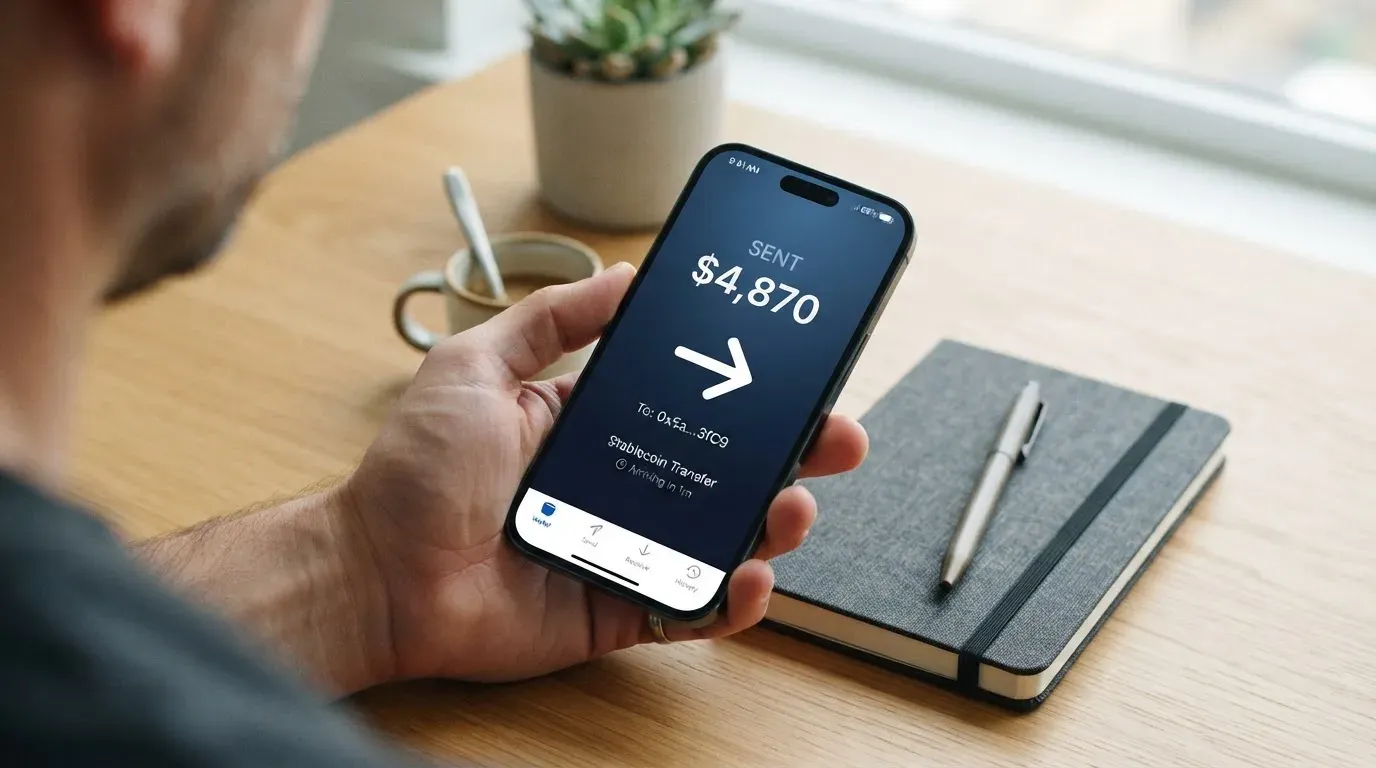
The funding flow has three steps, and the public information only really describes two of them. First, you send USDT on the TRC20 network to a wallet inside the app; the app then converts that USDT to Naira. Second, the Naira is used to fund a dollar wallet. Third, the dollar wallet is what the virtual VISA draws on. There is no published alternative: no bank transfer, no card top-up, no Apple Pay, no Google Pay.
A few practical details, with the same honest gap where the page does not say. The dollar wallet has a “top up, transfers and transaction history” page in the app, so it behaves like any other wallet — you can move money in, move money out, and look at past payments. Fees on that path are not stated. Minimums and maximums are not stated. The supported currencies on the dollar wallet are USD; the Naira side is handled in the app, not on the card. Withdrawals — meaning, getting your money back out of the wallet to a bank account or another crypto address — are not stated. So you cannot, from the public information, know whether you can pull money back out at all, and on what terms.
The biggest single risk on the funding side is the network choice. Crypto transfers are irreversible, and a USDT deposit sent on the wrong network — say, Ethereum’s ERC-20 instead of Tron’s TRC-20 — can be lost, or at best sit in a wallet nobody can access without manual support recovery, which the company has not promised. The app description names TRC20; if you are not sure which network you are on, check before you send. The same warning applies to anyone using a self-custody wallet: clipboard-hijacking malware that swaps the copied address is a real category of attack, so paste and check the first and last few characters of the address every time.
What this means for you: the top-up path is one crypto, one network, one direction, with no public pricing and no published withdrawal terms. If you are used to a card that takes a bank transfer or a debit card, this is a much narrower pipeline.
Paying with it every day
The card is a virtual VISA in US dollars, and that is the only form factor on offer. There is no physical card, no metal card, no metal tier. It is built for online and subscription payments, not for tapping at a coffee shop, because there is no mobile wallet. Apple Pay and Google Pay are not listed as supported, and tokenised payments depend on the issuer enabling them, which Ecstasy has not. There is no ATM access, because there is no physical card to put into one.
Two practical consequences flow from that. The first is that every payment is online, so the card runs straight into the usual online-payment friction: 3-D Secure challenges (Visa Secure on the VISA side), address verification (AVS — though AVS is mostly US/Canada/UK and rarely works for foreign-issued cards), and merchant policies on prepaid or “foreign” card BINs. Visa publishes the BIN, which names the issuer country; some merchants decline prepaid or foreign-issued cards as a matter of policy, regardless of the balance on the card. The second is that there is no offline leg. You cannot tap to pay for a meal, you cannot hand over a card in a shop, you cannot pull cash out for emergencies. If your use case is paying a Netflix or a SaaS bill, the design fits; if your use case is anything physical, the design does not.
The rewards side is thin but present. The app does have a referral programme, so you can earn by inviting other users. There is no published cashback rate, and the marketing material I read does not promise a percentage back on card spending. That is in stark contrast to many other cards in this category, which publish cashback, “earn on balance” rates, or category bonuses. The point is not that Ecstasy is worse because it is not paying you back; the point is that the only benefit on top of the conversion is the referral programme.
Dispute handling, the safety net for “I never got the goods” or “I was billed twice”, is not stated on the public pages. In the EU, chargeback rights are strong for credit cards and decent for debit cards; for prepaid cards the coverage varies and should not be assumed. In the US, debit card reversal rights come from Regulation E and credit card rights from Regulation Z, with prepaid-card coverage depending on the issuer’s policy. None of that is documented for Ecstasy, so if you need to dispute a charge, you are calling the developer, not a regulator’s published process.
What this means for you: a virtual-only, online-only, dollar-denominated card with no published rewards and no published dispute process. If your spend is online and in dollars, that is a workable shape; if any of those assumptions break, the card does not stretch to cover you.
What can go wrong
The single biggest risk on this product is information risk. The issuer is named — Ecstasy Data Nigeria Limited — and the developer website is ecstasynigeria.com, with a privacy policy at ecstasynigeria.com/privacy. The issuing bank, programme manager, regulatory licences, and registration details are not stated. In a normal crypto card, you would expect to see the licensed e-money institution or bank that issues the card under the network’s licence, plus a regulator and a licence number. None of that is in the public material I read. The App Store listing language is English; the support link in the store is described as “Apple billing support” only, with no separate developer support link.
The second risk is the company’s own track record, in the limited sense it can be measured. I did not find an Ecstasy page on Trustpilot, and there are no Ecstasy-specific complaint threads in the one search I ran. The App Store has 2.7 out of 5 from 9 ratings, with two recent reviews citing freezes after an update and login problems. The Google Play rating was not readable in the snapshot I checked, and a third-party snapshot from mwm.ai (an unofficial source, with an older app version) gives 3.5 from 54 ratings. None of this is a smoking gun. It is, however, a small and thinly rated surface: nine ratings on the App Store is not many, and the user reports are recent rather than from years ago.
The third risk is operational, and it applies to this card just as it applies to other prepaid crypto products. Card programmes can be wound down. Visa’s 2018 suspension of WaveCrest closed every WaveCrest-issued Visa programme in Europe at short notice, and in November 2022 Visa said it had “terminated our global agreements with FTX”, with the FTX US debit card programme wound down by its issuer. When that happens, the typical sequence is a notice period, then a stop on new spending and loading, then a request for users to withdraw remaining balances. Whether Ecstasy would handle that gracefully is not stated on the public pages.
The fourth risk is the custody risk that comes with any centralised product. Crypto transfers are irreversible, and the issuer is the custodian of the in-app Naira balance, the dollar wallet, and the conversion rate. Mt. Gox, Coincheck and the Ronin Network hack are the standard reminders that holding funds with a custodian carries counterparty and hack risk. Tether has said it disables tokens in wallets on the OFAC sanctions list and has frozen funds tied to illicit activity, so even stablecoins are not censorship-proof. None of that is specific to Ecstasy — but Ecstasy does not, on its public pages, say how it segregates customer funds, whether it insures them, or what would happen to your balance in a wind-down.
What this means for you: the risks are not unusual for the category, but the disclosures are unusually thin. A smaller, less-disclosed product is a higher-risk product, because there is less to lean on if something goes wrong. A practical rule of thumb: do not load more than you are willing to lose access to, and do not leave a balance sitting in the wallet longer than you need to.
What to take instead
If the Ecstasy shape does not fit — and for most readers outside Nigeria it does not — the rest of this market offers more documented, broader products. I have pulled together three alternatives that are useful comparison points, with the same honesty about what they do not say.
| Card | Score | Card form | Cost | Funding | Rewards |
|---|---|---|---|---|---|
| Ecstasy | 3.6 / 10 | Virtual USD VISA only | Not stated | USDT (TRC20) → Naira → USD | Referral only |
| CardFlow | 4.9 / 10 | Virtual USD Mastercard | “Creating a virtual card is completely free”; monthly fee not stated | BTC, USDT, ETH, Naira bank transfer | Not stated |
| HyperCard | 4.7 / 10 | Prepaid “HyperCard”, USD or EUR; network not stated | Not stated | USDT, BTC, ETH, converted to USD/EUR | Not stated |
| Card.fi | 6.6 / 10 | Virtual and physical, including metal; network not named; ships to “200+ countries” under a sanctions bar | Virtual Classic $49, Virtual Premium $249; no monthly/annual/inactivity fee; top-up 1.5% + $1 (Classic) or 1% (Premium); FX 3.5% (Classic) or 2.5% (Premium) | 32 coins across 5 networks (Ethereum, Base, BNB Chain, Solana, Kaanch) | Cashback 0.8–2% on spending, “up to 18%” on Metal balances |
CardFlow and HyperCard both lean into the same Nigerian / global-user niche as Ecstasy. CardFlow is a virtual USD Mastercard aimed at Nigeria and “Nigerians and global users”, with the explicit promise that creating a virtual card is free. The fees beyond that, the country list, and any rewards are not stated on the pages I read. HyperCard is a prepaid “HyperCard” in USD or EUR, with the App Store claiming acceptance in “more than 176 countries” (which is a network-acceptance claim, not an eligibility claim), and no fees or rewards stated.
Card.fi is the more international comparison. It ships to “200+ countries” with a sanctions bar on residents of countries that would prohibit the service; it has both virtual and physical tiers, including a metal option; it publishes its prices (one-time issuance fees from $49, no monthly or inactivity fees, a tiered top-up fee and FX fee); and it has the most fleshed-out rewards structure of the four, with cashback on spending and a variable rate on balances. The trade-off is that the headline prices are higher than Ecstasy’s silent prices, so the comparison only works once you can actually see Ecstasy’s fees.
What this means for you: if you are in Nigeria and your need is online, dollar-denominated, subscription-style spending, Ecstasy is one option of several. If you are outside Nigeria, or want a physical card, or want a published fee schedule, the alternatives are more openly documented. None of these is a recommendation to switch — the right card depends on what you actually spend on and where you live.
Who I would recommend this card to
Walking back through the page, the picture is narrow. The card works for a Nigerian user with USDT, looking to pay a US-dollar subscription online, who is comfortable with a small, lightly disclosed product. The fee is paid in the form of not knowing the fee in advance; the cost of convenience is trust in an issuer that publishes very little about itself.
If that is you, the practical advice is simple. Send a small USDT TRC20 test amount first, not your full balance. Watch the conversion rate and the dollar wallet balance before you scale up. Use the card only on merchants that bill in dollars, so you are not paying an FX fee you cannot price. Do not leave a balance sitting in the wallet — move what you need, use it, top up again. And read the privacy policy at ecstasynigeria.com/privacy yourself, because the App Store listing only tells you what categories of data the app collects, not what is done with it.
If that is not you — if you are outside Nigeria, want a physical card, want to earn cashback, or want a published fee schedule — the alternatives in the previous section are the place to start. Ecstasy is a single-purpose product built around a specific audience, and the score reflects that. It is not a card I would call a general-purpose answer for the wider crypto-card market.
Frequently asked questions
What is the Ecstasy card?
The Ecstasy card is a virtual US-dollar VISA issued by Ecstasy Data Nigeria Limited, available through an iPhone or Android app. The app converts USDT on the TRC20 network to Naira and tops up a dollar wallet, which is what the virtual card draws on for online and subscription payments. There is no physical card, no metal tier, and no ATM access.
How does the Ecstasy card work?
You install the app, sign up, send USDT to the in-app wallet, convert it to Naira inside the app, fund a dollar wallet, and the virtual VISA draws on that balance for online payments. The card only works online; there is no tap-to-pay, no mobile wallet, and no ATM. The flow is one-way in (USDT) and one-way out (online card spend), with no published withdrawal path.
Is Ecstasy a bank?
Ecstasy does not present itself as a bank. The public pages name Ecstasy Data Nigeria Limited as the developer and the issuer in Nigeria, but the issuing bank, programme manager, and any regulatory licences are not stated. In a normal crypto card, you would expect to see the licensed bank or e-money institution that issues the card under the network’s licence; that information is not on the public material I read.
Who owns Ecstasy?
The App Store and Google Play listings name the developer as Ecstasy Data Nigeria Limited, and the developer website is ecstasynigeria.com. Beyond that, ownership, parent companies, regulators, and licences are not stated in the public material I could read. If ownership and licensing matter to you, that is itself a reason to ask more questions before signing up.
Is the Ecstasy card available in my country?
The public pages do not publish a list of supported countries. The product is built around Nigeria, and the currency conversion is USDT to Naira. If you are outside Nigeria, you will not know whether the issuer will serve you until you sign up and try; the KYC process, the App Store privacy section, and the lack of a country list together leave that question open.
How do I get the Ecstasy card?
Download the app from the App Store (iPhone/iPad) or Google Play (Android), create an account, complete the in-app sign-up and verification, and the virtual card is generated. There is no public web sign-up, no physical card, and no separate application. The app’s reputation, on the App Store at least, is 2.7 out of 5 from 9 ratings, with recent reviews mentioning freezes and login problems.
Does the Ecstasy card require KYC?
The product pages do not describe the KYC process in detail. The App Store privacy section says the app collects payment information, name, email, phone number, and photos or videos, which is consistent with a standard KYC flow (name, address, date of birth, an identity document, a selfie). What the issuer actually does with that information, what it screens against, and how long it keeps it are not stated.
How do I top up the Ecstasy card?
Send USDT on the TRC20 network to the in-app wallet, convert to Naira, then fund a dollar wallet. The dollar wallet is what the virtual card uses. Fees, minimums, and maximums for that flow are not stated. Sending USDT on the wrong network — for example, on Ethereum’s ERC-20 — is a real risk, because crypto transfers are irreversible and recovery is not guaranteed.
Is the Ecstasy card free?
The public pages do not state a fee schedule. The issuance fee, monthly fee, conversion fee, FX fee, and ATM fee are all “not stated” on the material I read. The card is a virtual-only product with no ATM, so the ATM fee does not really apply, but the rest of the table is empty. The only cost you can price yourself is the on-chain TRC20 fee, which is paid to the Tron network rather than to the issuer.
Is the Ecstasy card safe?
The card sits in the same risk category as other centralised prepaid crypto cards: counterparty risk on the issuer, custody risk on the in-app balance, and the risk of a programme wind-down. The disclosures are unusually thin — no named issuing bank, no licence number, no published dispute process, and a small number of App Store reviews citing freezes. None of that is a verdict of “unsafe”, but it is a reason to keep balances low and to treat the product as one of the less-disclosed options in the market.
Virtual card verdicts – cryptocardverdict
Content created by the «cryptocardverdict» team