
A USDC-on-Mastercard card for the self-custody crowd, weighed on its real-world strengths and gaps
 Available in US
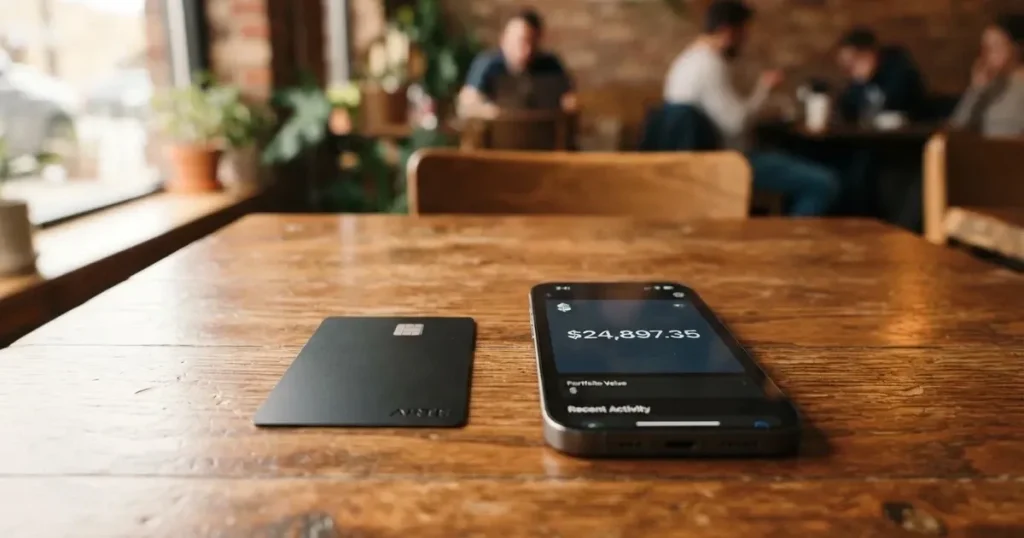
The Immersve card is a digital Mastercard that lets you spend a USDC balance at any shop that takes contactless or online card payments. The interesting thing about it is that the crypto never leaves your own wallet: when you fund the card, you transfer USDC to a smart contract, and at the moment you tap to pay, the system converts USDC to the merchant’s currency and the transaction goes through. If that self-custody model is what you are after, this card sits in a small group of options that genuinely work that way. Where it is less impressive is in the everyday details — the things that are not stated publicly, from monthly fees to ATM access to who actually issues the card.
The conditions described here are current as of October 28, 2026.
Verdict: 7.1 out of 10
Before we get into the details, here is how Immersve scores across the five criteria I looked at, and the total out of ten.

| Criterion | Score | Reason |
|---|---|---|
| Who can get it | 7 / 10 | Onboarding is live in 38 countries across the EU, Switzerland, the UK, Australia, New Zealand and several Latin American states, with the US planned for Q1 2026. A lot of the world is still outside the list. |
| Cost | 8 / 10 | The card itself is free to apply for and issue, and the pricing page says the service is offered at no cost to cardholders. The real costs are blockchain fees when funding and a foreign currency conversion fee that may apply on non-base spending. |
| Top-up options | 8 / 10 | USDC transfers to a smart contract on five networks (Algorand, Arbitrum, Base, Ethereum and Polygon PoS), converted to fiat at the point of sale. Only USDC is supported — there is no native USDT, no Bitcoin, no on-ramp from a bank. |
| Reliability and complaints | 7 / 10 | Licensed as AFSL 545925 in Australia and FSP1003031 in New Zealand, with smart-contract audits by Hashlock, Red4Sec and Coinspect. The Pera Card running on Immersve is issued by Monavate UAB, and the issuing bank is not named on the website. |
| Everyday use | 5 / 10 | It is a digital Mastercard with Apple Pay and Google Pay support. The app, physical card option, ATM access and reward structure are not described publicly. |
| Total | 7.1 / 10 |
The audience Immersve clearly targets is the self-custody wallet user paying with USDC in Europe or Australasia. If you keep your crypto in your own wallet, want it to stay there until the moment of payment, and live in one of the supported countries, the core mechanism is genuinely well aligned with that. If you are looking for a metal card, a travel card with rich FX rates, a cashback-heavy everyday card, or a US-only experience today, the gaps on this page will matter more.
Will they give you the card
The card is available to onboard from a defined list of 38 countries. I will list them in full because country rules are the most common reason someone reads a review like this.
Onboarding is supported in: Argentina, Australia, Austria, Belgium, Brazil, Bulgaria, Chile, Colombia, Croatia, Cyprus, Czech Republic, Denmark, Estonia, Finland, France, Germany, Greece, Guatemala, Hungary, Ireland, Italy, Latvia, Lithuania, Luxembourg, Malta, Mexico, Netherlands, New Zealand, Peru, Poland, Portugal, Romania, Slovakia, Slovenia, Spain, Sweden, Switzerland and the United Kingdom.
The card’s public pages say the United States is planned for Q1 2026, and the MENA region is to follow shortly after. Both of these are stated as plans, not confirmed launches, so if you are in the US or the Middle East today, you are reading about a card you cannot yet apply for.
A few practical things to keep in mind about this list. It is a list of supported onboarding countries, which usually means both your residence and the jurisdiction your identity documents come from. Outside the list, the application flow will not be open. The card is also not available everywhere that a card scheme is accepted, in the way a Visa or Mastercard debit card from a global bank might be — being able to onboard is the first gate, and the country list is the only one I can see published.
If you live in one of the listed countries, the next question is whether you can pass identity verification, which I will cover in the sign-up section below.
How to get it
The card is set up inside a partner app or dApp, not on the Immersve website as a standalone application. Immersve is the card-issuing technology; the front-end you actually use is whichever wallet or service has integrated it, for example the Pera Wallet app, which now surfaces a Pera Card running on Immersve.
The verification step is described on the card’s pages as “verify your identity” during card creation. The specific documents, the proof of address and the minimum age are not publicly stated. The verification stack includes KYC partners FrankieOne, Sumsub and Chainalysis. FrankieOne is a regional identity and AML provider, Sumsub is a global KYC vendor, and Chainalysis is a blockchain analytics firm used for sanctions and transaction-risk screening. That tells you the card applies standard KYC plus on-chain risk scoring, but the specific documents requested depend on the applicant and jurisdiction.
The card itself is a multi-use digital Mastercard that you can use online or in store after adding it to Apple Pay or Google Pay. A physical card, a metal version and a card currency are not stated for cardholders, so the working assumption today is digital-only, paid via a phone wallet. Delivery details, including any planned shipping of a physical card, are also not stated.
Because the card is a digital Mastercard tied to a phone wallet, the practical sign-up flow is roughly: install a partner app, create an account, complete identity verification, request the card, and once approved, add it to Apple Pay or Google Pay to start spending. Where exactly each step lives depends on the partner app, so the fastest way to confirm the current flow is the partner app you plan to use.
What it really costs
Immersve is unusually clean on headline fees, and unusually thin on the rest. Let me walk through both.
Because several fee categories are not stated publicly, the table below summarises what is known about the card’s costs, followed by an analysis of three everyday payment scenarios.
| Fee or limit | Value |
|---|---|
| Application / issuance | No charge |
| Monthly fee | Not stated |
| Annual fee | Not stated |
| Foreign currency conversion fee | May apply (rate not stated) |
| ATM withdrawal | Not stated |
| Daily spending limit | Not stated |
| Monthly spending limit | Not stated |
| Tier structure | Not stated |
| Card currency | Not stated |
| Funding | USDC, converted to fiat at authorisation |
| Blockchain transaction fee | Applies when funding the smart contract |
Now, three everyday payments to make this concrete.
Paying in a shop in your home currency, with a USDC balance that converts to the same currency. There is no application or monthly fee. The blockchain fee you paid when funding is already in the past. The foreign currency conversion fee is for non-base currency transactions, so a same-currency purchase should not trigger it. This is the closest you get to a free payment on this card, and the one Immersve is most clearly priced for.
Paying online in a different currency, say you are in the euro area and you buy something billed in US dollars. The base USDC-to-fiat conversion happens at the moment of authorisation, and a foreign currency conversion fee “may apply” — the rate is not stated. This is where most cards make their margin, and Immersve is no exception, but it does not publish the rate. If foreign-currency spending is a big part of how you plan to use the card, that is the number worth chasing down before you commit a meaningful balance to it.
Loading the card from your wallet, which happens before any of the above. You send USDC to the smart contract on one of the supported networks, and that on-chain transfer is the funding step. The blockchain network fee is charged by the network itself, not by Immersve, and the amount depends on which network you choose. On Ethereum the fee can be meaningful; on Base, Polygon PoS or Algorand it tends to be much lower. There is no minimum top-up published for cardholders, and no fiat on-ramp from a bank, so the only way to load is to send USDC.
Two practical notes on cost that fall out of the table. First, the foreign currency conversion fee “may apply” wording means you should expect it to apply on most non-base transactions, even if the rate is not public. Second, the absence of a published monthly fee, ATM fee, or limit is not the same as “free and unlimited” — it usually means the partner app or the issuer has the figure, and you see it at the point of use. The only way to confirm the numbers that matter to you is inside the app you are actually applying through.
How to top it up
The funding flow is the part of Immersve that is genuinely different from most crypto cards, so it is worth understanding on its own.
The card is funded in USDC, and only in USDC. You send USDC to a smart contract on one of five supported networks: Algorand, Arbitrum, Base, Ethereum and Polygon PoS. The system converts the USDC to fiat at the moment the transaction is authorised, so the merchant is paid in their local currency and you do not have to manage a manual conversion before each payment. There is no fiat on-ramp, no bank transfer, and no card-to-card top-up — the entry point is a USDC transfer from a wallet you control.
The cost of topping up is the blockchain fee for the transfer. The amount depends on the network: Ethereum fees vary with congestion and can be the most expensive option, Base and Polygon PoS typically sit at the low end, Arbitrum is in between, and Algorand has its own low-fee model. Choosing the right network for the amount you are sending is the single biggest funding decision you make.
What the page does not say is also worth being clear about. A minimum top-up is not stated, so technically any USDC amount should be accepted, but very small amounts will be eroded by the network fee. A fiat top-up is not stated, which means if you only have a bank account and no USDC, this card is not for you — you would need to acquire USDC elsewhere first. Withdrawal from the card back to your wallet is also not stated, so it is safer to treat the card as a one-way flow: USDC in, fiat out, no published way to reverse it.
Two practical tips while you are setting this up. First, always send USDC, and always on one of the five listed networks — sending a different token, or sending USDC on a network the card does not support, can mean the funds are lost. Second, send a small test amount the first time, so you can confirm the network, the address and the conversion before you commit a larger balance.
Paying with it every day
In day-to-day use, the card behaves like a regular digital Mastercard once it is on your phone. You add it to Apple Pay or Google Pay, and from there it works at any contactless terminal, in-app purchase, or online checkout that takes Mastercard.
The supported features are narrow but clear. The card can be added to Apple Pay and Google Pay; blocked merchant categories are not stated, so I cannot tell you whether gambling, crypto purchases or specific high-risk MCCs are allowed. Rewards, including any cashback or points programme, are not stated either. The app you use to manage the card is not the Immersve website, since Immersve cards are surfaced through partner apps and dApps; the partner you choose decides the app you live in.
Complaints and disputes are handled per country of residence. The card has a complaints page for Australia (/complaints/au), for the EEA (/complaints/eea), for the UK (/complaints/gb) and for New Zealand, Latin America and other regions (/complaints/nz). Chargeback time frames are not stated, and the actual procedure depends on your country, so the complaints page for your jurisdiction is the right place to start if something goes wrong.
A few things that come up in everyday use, but where the card is silent. There is no published list of blocked merchant categories, so you may find out a transaction is declined only by trying. There is no published reward structure, so do not expect cashback, points or staking yield as part of the package. There is no published support presence beyond a contact page — languages, hours and response times are not stated. For a card you intend to use heavily, those gaps are worth weighing.
What can go wrong
Most of the risk on this card is not Immersve-specific — it is the standard set of risks that comes with spending from a self-custody crypto balance — but a few Immersve-specific things are worth knowing.
The card is regulated in the jurisdictions it operates in. Immersve is a registered Financial Service Provider and reporting entity in New Zealand, with NZ FSP1003031, and holds AFSL 545925 in Australia. Regulation is described as in progress in Europe, Hong Kong, Singapore, the UAE, the UK and the US. The issuing bank is not named on the website, which is unusual: most card programmes publish the issuer. The Pera Card, which runs on Immersve, is named as being issued by Monavate UAB, but the broader Immersve programme does not name its issuer in the public materials I read.
The security model is conservative in the parts that matter. Funds are held in a smart contract rather than a pooled custodial account. Card data is handled through VGS, a PCI-compliant vault. The smart contracts have been audited by Hashlock, Red4Sec and Coinspect, three well-known blockchain security firms. The card is described as carrying the same risk as a normal credit or debit card, which is a careful way of saying it is not insured, and safeguarding of customer funds is not mentioned.
On the topic of complaints and incidents, the search I ran for “Immersve card reviews trustpilot reddit” did not return any Immersve results on 2026-10-21, and no Trustpilot page for Immersve was found. That is not a clean bill of health — a missing Trustpilot page can simply mean low volume — but it is the honest answer to “what do users say about this card”. The Pera Wallet support page, updated in October 2025, says the Pera Card (which is issued via Immersve) is in a Beta Phase in selected countries, which is consistent with a programme still being rolled out rather than fully mature.
A more general set of risks to keep in mind. Crypto transfers are irreversible, and a USDC transfer to the wrong network, or to an address from a token the card does not support, can mean the funds are lost. Stablecoins can depeg, even though USDC has held its dollar peg through the 2023 US banking scare. Self-custody means you alone hold the seed phrase, and a stolen phrase means a stolen balance — there is no central password reset. Finally, card programmes can be wound down — Visa’s suspension of WaveCrest in 2018, and the termination of FTX’s Visa agreements in November 2022, are the well-known precedents — so it is worth not parking more on the card than you are willing to move quickly if the programme changes.
What to take instead
The honest answer is that Immersve’s closest peers are not the heavy-reward metal cards; they are the small set of cards that spend from your own wallet. If Immersve’s gap in your country or feature is a problem, three alternatives are worth a look, and I have laid them out side by side below.
| Card | Score | Where you can get it | Card type | Headline cost | Funding |
|---|---|---|---|---|---|
| MetaMask Card | 7.1 / 10 | 45 listed countries and territories (e.g. Argentina, Brazil, Canada, Mexico, Germany, France, Spain, Uruguay); other regions join a waitlist. US and UK sign-ups temporarily closed. | Mastercard, Virtual issued first, Metal pre-orderable after approval; one card per user. Issuer Monovate, provider Crypto Life. | Virtual free, no annual or maintenance fee. Metal $199/year. Minimal per-transaction fee (amount not stated on the pages read); Mastercard rate used for FX, no MetaMask foreign transaction fee. | Spends directly from the connected wallet on Linea, Base, Monad and Solana. Named tokens: mUSD, wETH, EURe, GBPe, USDC and USDT (page says nine). |
| KAST | 6.1 / 10 | Country list shown at KYC and not published; restricted-locations list referenced but no countries named. Citizenship and ID also matter, not just residence. | Up to 10 cards per user: Standard Visa Platinum, Premium Visa Infinite metal, Private Visa Infinite gold plated. Account balance in USD. | Annual membership: Standard 0 USD, Premium 1,000 USD/year, Private 10,000 USD/year, all billed annually upfront. Extra virtual card 2 USD; Standard physical 0 USD card fee plus 40 USD delivery; inactivity fee 1 USD/month after 12 months. | Stablecoins USDT, USDC, PYUSD, RLUSD on Ethereum, Solana, Polygon, Arbitrum and TRON (app lists current networks); Terms say “currently USDT and USDC”, which conflicts with PYUSD and RLUSD. |
| TokenPocket (TP Card) | 5.8 / 10 | Visa debit in selected European countries and territories (e.g. Germany, France, Spain, Switzerland); Mastercard debit in Australia, Canada, Hong Kong, Japan, Taiwan, New Zealand, Singapore, South Korea, the UK and others; Americas planned for Q2 2025. | Mastercard/Visa debit on Arbitrum; Fiat24 cards are virtual (no physical card mentioned); balances in EUR24 and USD24. | NFT creation fee partly covered by TokenPocket, user pays “a small portion” (amount not stated). “Apart from these, TP Card does not charge any additional fees”. | Crypto deposits from the TokenPocket wallet; a 1% fee is charged when depositing, “to be refunded later via rewards, reduced transaction fees”. FX fee not stated; extra fees can come from inter-institution settlement. |
If you want a similar self-custody model with a richer rewards structure and are willing to live inside the MetaMask wallet, the MetaMask Card is the closest peer and scores the same 7.1. If you want multiple card tiers, a stronger FX schedule and the option of a metal card, KAST is the heavier programme, but the 1,000 or 10,000 USD annual fee and the unpublished country list are real trade-offs. If you already use TokenPocket and live in one of the listed European or Asia-Pacific markets, TP Card sits inside an app you may already have, with the lightest onboarding, but the rewards and FX details are thin.
A note on what these three do that Immersve does not. MetaMask Card publishes real cashback (Virtual 1%, Metal headline 3% with a footnote limiting 3% to the first $10,000 spent and 1% thereafter, plus a $FLY bonus via Blackbird). KAST publishes full cashback tiers (Standard 1.5% on the first 2,000 USD per month, Premium 2% on the first 10,000 USD, Private 3% on the first 40,000 USD) and a clear FX fee band of 0.5% to 1.75% depending on residence country, transaction country and card programme. TP Card’s published number is the 1% deposit fee, which is later refunded via rewards. If those published numbers matter to you, Immersve’s silence on the equivalent lines is the most useful single comparison.
Who I would recommend it to
I would recommend the Immersve card to a fairly specific reader. You keep your crypto in your own wallet, you hold USDC as your main spending stablecoin, and you live in one of the 38 supported countries — most likely somewhere in the EU, the UK, Switzerland, Australia or New Zealand. You are comfortable with a digital-only Mastercard and you plan to add it to Apple Pay or Google Pay rather than carry a physical card. You are not optimising for cashback, sign-up bonuses or a metal tier. You understand the smart-contract model: the funds are held in a contract, the card cannot lend, and you are responsible for the seed phrase behind the wallet that funds it. If that is you, Immersve is a clean fit, and the published score of 7.1 reflects that.
I would not recommend it if any of the following applies. You live in the United States, the MENA region, or any country not on the supported onboarding list — both are plans, not launches, as of the date of this review. You want a metal card, a physical card for in-person swipes, ATM access, or a clear published FX rate for non-base spending — none of those is on the public page. You want a heavy cashback programme — Immersve does not publish one. You are not comfortable with self-custody, or you do not hold USDC and do not want to acquire it elsewhere first. You want the issuing bank named on the card’s own pages — it is not.
The single most useful thing to do before you commit is to open the partner app you would use (Pera Wallet is the most prominent at the moment, but the front-end depends on the wallet you already trust), and read the screens for monthly fee, FX rate, limits, ATM access and the named issuer. The public marketing page is a good summary; the in-app disclosure is where the numbers that affect your wallet actually live.
Frequently asked questions
What is the Immersve card?
The Immersve card is a digital Mastercard that lets you spend a USDC balance at any shop or website that takes contactless or online card payments. The USDC is held in a smart contract and converted to the merchant’s currency at the moment of payment, while the underlying crypto stays in your own wallet until that point.
How does the Immersve card work?
You fund the card by sending USDC to a smart contract on Algorand, Arbitrum, Base, Ethereum or Polygon PoS. The card converts USDC to fiat at the moment the transaction is authorised, and the merchant is paid in their local currency. From the merchant’s point of view it is a regular Mastercard payment.
Is Immersve a bank?
No. Immersve is a card-issuing technology provider. In Australia it holds AFSL 545925 and in New Zealand it is a registered Financial Service Provider (FSP1003031), and the Pera Card on Immersve is issued by Monavate UAB. The issuing bank for the broader Immersve programme is not named on the website.
Who owns Immersve?
Immersve Pty Ltd operates the card and lists locations in Australia, New Zealand, the UAE, the UK and the US.
Is the Immersve card available in the United States?
Not yet. The card’s public page says the United States is planned for Q1 2026 and the MENA region shortly after, both as plans rather than confirmed launches.
How do I apply for the Immersve card?
You apply inside a partner app or dApp that has integrated Immersve — Pera Wallet is the most prominent at the moment. The flow is to create an account, complete identity verification, request the card, and once approved, add it to Apple Pay or Google Pay.
Does the Immersve card require KYC?
Yes. “Verify your identity” is part of the card creation flow. The KYC partners named are FrankieOne, Sumsub and Chainalysis, but the specific documents, proof of address and age threshold are not stated publicly.
How do I add the Immersve card to Apple Wallet?
The card is added through your partner app after the card is issued: open the app, find the option to add the card to a wallet, and follow the Apple Pay or Google Pay flow. From there it works like any other tokenised card on your phone.
How do I top up the Immersve card?
You send USDC from your own wallet to the smart contract on one of the five supported networks: Algorand, Arbitrum, Base, Ethereum or Polygon PoS. The blockchain fee for that transfer is charged by the network, not by Immersve, and the amount depends on which network you choose.
Is the Immersve card safe?
The card is licensed in Australia and New Zealand, the smart contracts have been audited by Hashlock, Red4Sec and Coinspect, and card data is handled through a PCI-compliant vault. The trade-off is the standard self-custody risk: you alone hold the seed phrase for the wallet that funds the card, crypto transfers are irreversible, and safeguarding of customer funds is not mentioned.
Wallet card verdicts – cryptocardverdict
Content created by the «cryptocardverdict» team