
Holding dollars in USDC and spending them like an ordinary Visa: the ZAR card, read closely
 Available in US
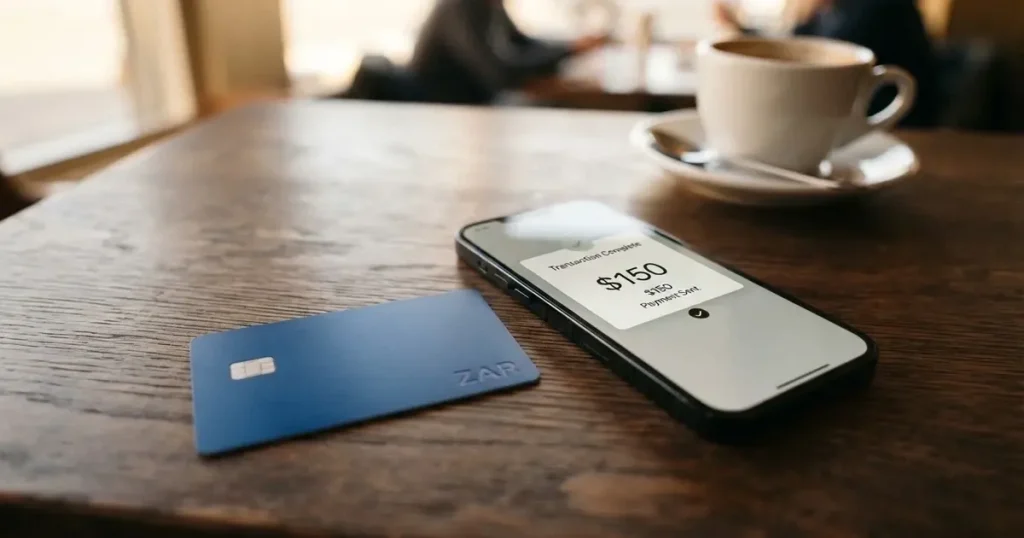
ZAR is a payment card that lets you spend dollars you already hold as a stablecoin, without necessarily having an ordinary bank card behind it. In practice it is a virtual Visa, denominated in USD, funded mainly from USDC on the Solana network, with a self-custodial wallet at its core and a Singapore fintech — Golden Age Dev Lab Pte Ltd — behind it. Apple Pay works. A physical plastic card does not yet exist. It is, in one line, a way to turn crypto you hold into something that behaves in a shop like a normal Visa card.
I scored it 7.3 out of 10. That is not a “best crypto card” score and not a “avoid” score. It is a card that does a narrow job well: it is genuinely cheap, it does not hide a monthly fee, it takes a crypto balance and turns it into everyday spending — but it is young, its plastic is still “coming soon”, its top-up channel is narrow, and several things a reader would want to know (the conversion fee, the ATM fee and allowance, the card issuer, the exact monthly cost) are simply not published. Who it suits: someone who already holds USDC on Solana, has a phone, needs a card number that behaves at merchants, and can live with a virtual-only Visa for now. Who it does not suit: someone who needs a physical card tomorrow, someone who wants to spend in their local currency without thinking about dollars, or someone who is uneasy about a fintech — not a bank — sitting between their crypto and their spending money.
Let me walk you through it the way I went through it, section by section, so you can see exactly what I checked and where I stopped.
Conditions are current as of October 28, 2026.
Verdict: 7.3 out of 10
The single sentence that best describes the ZAR card, in my words, is this: it is a virtual, US-dollar Visa that you feed with USDC and then spend like any other card, and its strengths and weaknesses both come from being exactly that and nothing more. If your money is already in USDC and you want a card number for daily life, the value proposition is real and the price is unusually low. If your money is not yet in USDC, or if “card” to you means plastic in your wallet, this is not the tool for you yet.
Here is the score criterion by criterion, the numbers as I have them:
| criterion | score | why |
|---|---|---|
| Who can get it | 8 / 10 | The site says “100+ countries” and the App Store says 110+, with no published list; the terms exclude Russia and Belarus explicitly, alongside Iran, Iraq, China, Japan, Vietnam, Venezuela, and ZAR may refuse service in certain other locations. |
| Cost | 9 / 10 | Opening an account and the virtual cards are free and there are “no foreign fees”; the plastic is paid for by country, but the monthly fee is not disclosed. |
| Top-up options | 5 / 10 | Right now only USDC on Solana is accepted; other stablecoins are converted to USDC; a bank transfer is also listed. |
| Reliability and complaints | 7 / 10 | Operated by Golden Age Dev Lab Pte Ltd (Singapore), dollars from Circle, banking by SSB (Member FDIC); the card issuer is not named; no complaints found; the App Store rating is 3.9 out of 5 from 44 ratings. |
| Everyday use | 6 / 10 | Virtual Visa in USD, Apple Pay present, ATM withdrawals claimed; the plastic is “coming soon” and Google Pay is not confirmed. |
| total | 7.3 / 10 | A cheap, narrow, workable crypto card; young, virtual-only, and honest about fees but silent on several. |
Will they give you the card?
Short answer: probably, if you are over 18, not under sanctions, and not in one of the excluded places — but the exact list is not published, so “probably” is doing real work in that sentence.
The website says “100+ countries” and the App Store listing says 110+ countries, and neither publishes a country list. The Terms are more careful: they say ZAR may refuse service in certain locations, and they name Russia and Belarus explicitly, together with Iran, Iraq, China, Japan, Vietnam and Venezuela — a list the terms themselves describe as non-exhaustive. Two things follow from that. First, the “100+”/“110+” figures are marketing shorthand, not a guarantee; the binding rule is the terms. Second, because the exclusion list is explicitly open-ended, being outside the named countries is not the same as being inside the accepted ones — ZAR reserves the right to say no in other places too. On the question people actually ask, “is ZAR card available in my country,” the honest answer is: check the app and the terms, because the card does not hand you a definitive public list.
One more nuance people miss. The terms do not say whether eligibility follows your citizenship or where you live. If you are a citizen of one of the excluded countries but resident elsewhere — or the reverse — the card’s public pages do not resolve it. Similarly, users must be 18 or older and not subject to sanctions. So the three gates are: age, sanctions status, and location, and the location gate is the one with the most ambiguity.
How to get it
Getting the card is a standard sign-up-and-verify flow, but with one structural feature worth knowing up front: there is only one verification level, not a tiered ladder, and the account can be suspended.
ZAR requires KYC/AML for bank connectivity and for the card services themselves — that is not optional paperwork you can skip. Identity verification is handled by Plaid, and both passports and driver’s licences are accepted. There is PEP (politically exposed person) screening, the 18+ age rule applies, and the Terms say the account may be suspended for fraud, legal requirements, or a breach of the terms.
Two things are not stated, and I would rather tell you that plainly than fill the gap with an assumption. First, proof of address: the card’s public pages do not say whether it is required. If you have moved recently or your address is hard to corroborate, ask before you commit. Second, the card describes only a single KYC/AML requirement — there are no published verification tiers and no published processing time — so I cannot tell you “it takes one day” or “it takes a week,” because the card does not say.
The card itself comes in two flavours that are not yet equal. Virtual and physical Visa cards are both described, but the physical card is “coming soon,” and delivery details are not stated. So today, realistically, you are applying for the virtual one.
Fees: what it really costs
This is the strongest part of the card. Opening an account is free, the virtual cards are free, and ZAR advertises “no foreign fees.” What you cannot do yet is compute a full monthly cost, because several numbers are not published.
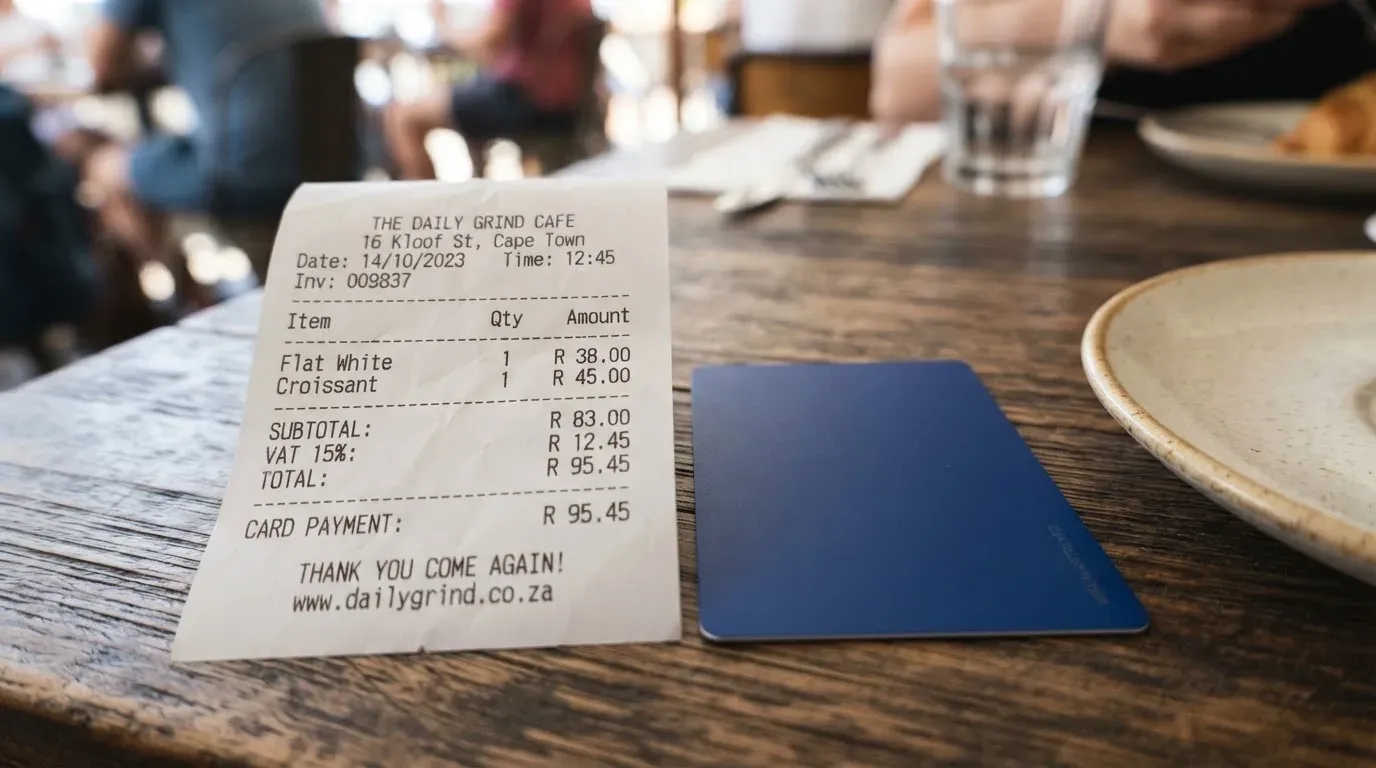
Here is every fee and limit I could confirm, with the card’s own wording where it matters:
| fee or limit | what the card says |
|---|---|
| Account opening | Free |
| Virtual card issuance | Free |
| Physical card | Paid; the fee depends on the country (not stated per country) |
| Monthly fee | Not stated |
| Foreign transaction fees | “No foreign fees” |
| Conversion fee | Not stated (fees are shown before you confirm) |
| Card currency | USD (“Spend and save in USD”) |
| ATM withdrawal | Withdraw dollars as local currency from ATMs worldwide; fee and allowance not stated |
| Daily transaction limit | Set at registration, depending on currency, payment method and the KYC/AML assessment; no amounts published |
| Tiers | Not stated |
What does this mean for a real week of spending? Three everyday payments, and which fees touch them:
- A coffee bought online in a country that isn’t the US. The Visa exchange rate applies at the network level, and ZAR says “no foreign fees” on top of that; the conversion fee itself is not stated, so the only number you get is the rate, not the full cost. Apple Pay tap-to-pay is supported, so this is the smoothest path.
- A monthly subscription in USD. This is the card at its most comfortable: you are spending USD from a USD balance, which is exactly what the card was built for. No currency layer, no conversion fee line to worry about.
- Taking cash out of an ATM abroad. The App Store says you can withdraw dollars as local currency from ATMs worldwide, but both the fee and the allowance are not stated. Treat the cash-out rate and allowance as unknowns until you see them in the app, not as free.
Two honest caveats about money leaving and coming back. The Terms say the account can be closed at any time, but all funds must be withdrawn first — and withdrawal fees are not stated. And ZAR says fee changes are announced one week ahead, which is a courtesy worth having, not a guarantee that costs will not rise.
Top up: getting dollars in
The top-up story is the card’s narrowest flank, and it is worth internalising before you sign up. Right now the Terms accept only USDC on the Solana network. If you hold another stablecoin such as USDT, it may be accepted but it is converted into USDC; and the Terms warn plainly that sending on the wrong chain may lose your funds. The site, alongside the USDC route, also lists a bank transfer and cash at a merchant.
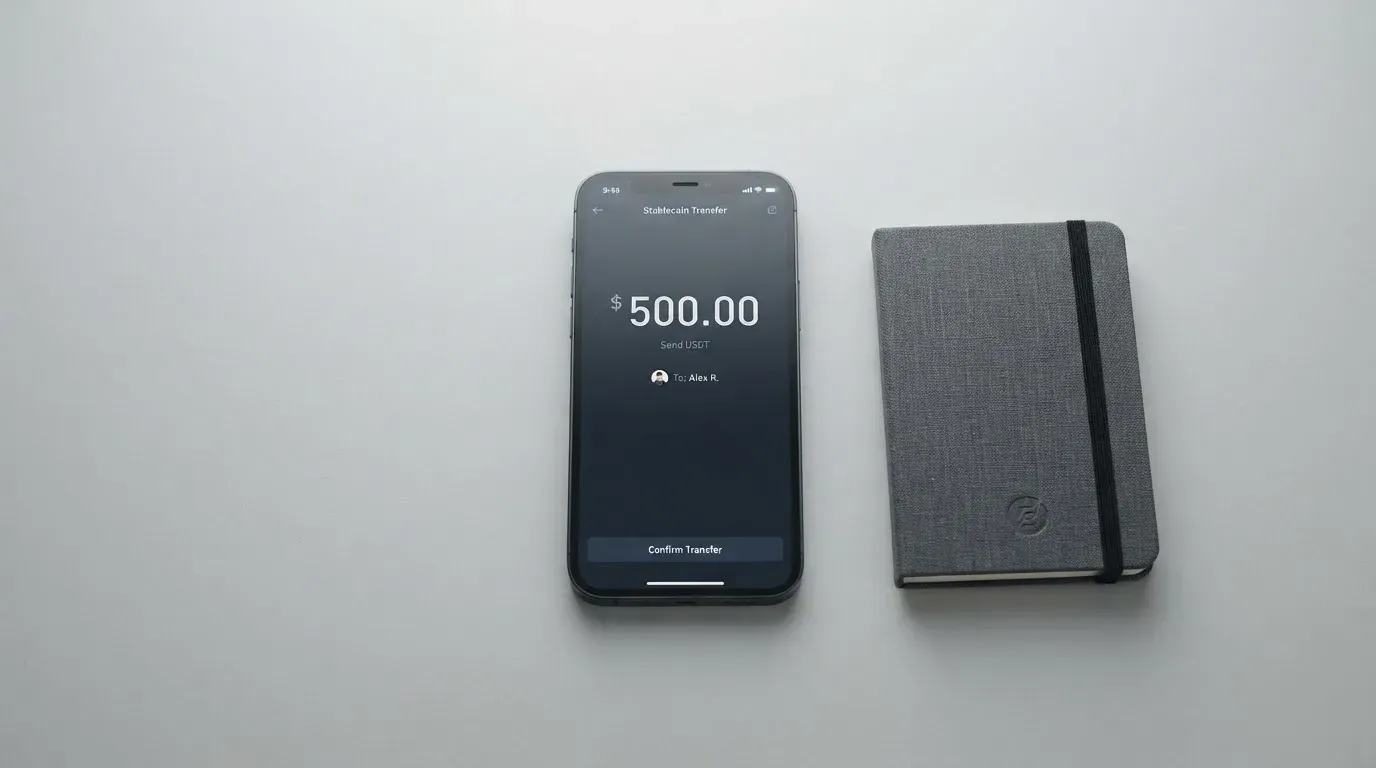
So there are effectively two doors: crypto in, or ordinary money in by bank transfer (and cash at a merchant). That is not a bad design — it is just a specific one. If your USDC sits on Ethereum or Tron, you must move it or convert it yourself first; a transfer sent on a network the card does not support can be lost or need manual support recovery with no guarantee. That is a general property of blockchain transfers, not a quirk of this card, but it lands harder on a card with a single supported chain.
On costs: bank transfer fees vary by method, and the promise that “you’ll always see the fee before you confirm” is the good kind of promise — you find out before you commit, not after. Two things remain not stated: the stablecoin minimum top-up and the network fee. The network fee, remember, is charged by the blockchain for your deposit, not by the card. And if you close your account, all funds must be withdrawn first, with fees not stated — so treat “I might exit” as something to price before you enter.
Paying with it every day
Daily use is where the card is honest about what it is: a virtual, USD-denominated Visa you tap with your phone. Apple Pay tap-to-pay is supported per the App Store, and the site lists Tap to Pay as enabled. A physical card is “coming soon.” Google Pay and any blocked merchant categories are not stated.
Everyday use gets 6 out of 10, and the reason is mostly the two gaps above: no plastic, no confirmed Google Pay. If you are the phone-wallet type — Apple Pay in your pocket — that gap barely exists. If you need a card that a shop slides into a reader, or a physical card for travel, you are waiting on the “coming soon” plastic.
The apps are on iOS and Android. The UK App Store listing shows 3.9 out of 5 from 44 ratings, which I read on 2026-10-21; the Google Play rating I did not read. Three-and-a-bit out of five is not a red flag on its own, but it is not an enthusiastic endorsement either, and a small number of ratings is a small sample.
One under-the-hood detail about how disputes are handled, because it tells you where the card’s trust model points. For disputes arising from the smart contract, the oracle, the API, the backend, or access to your account, resolution is automated and happens inside the app — and for those categories you waive litigation and arbitration, with Singapore courts named for everything else. That means the card’s own systems are the first and often only forum for anything that goes wrong with the contract side of things. The chargeback process for an ordinary disputed purchase — the everyday “I was double-charged” case — is not stated, and that is a gap you should ask about if chargeback protection is important to you.
What can go wrong
I looked for incidents, complaints and red flags, and here is the honest picture: I found no official incidents and no ZAR reviews in search results, and no Trustpilot page for ZAR. That is reassuring as far as it goes, but it is also what you would expect from a young card with a small rating sample — absence of complaints is not the same as a track record.
The real risk is structural, and it lives in the company’s own description. ZAR is a “fintech company, not a bank,” operated by Golden Age Dev Lab Pte Ltd under Singapore law, with Singapore courts named for disputes. The dollars are issued by Circle, and banking is by SSB (Member FDIC). The card issuer is not named — and for a card, the issuer is the institution you would normally hold accountable, so not knowing it is a genuine gap. The Terms also say ZAR is “not a money services business,” with no licence numbers shown.
On your money, the Terms say the software is a self-custodial wallet and “we do not custody or control your funds,” while the footer notes that customer funds are held at SSB in custodial accounts, FDIC-insured up to $250,000 per depositor — and explicitly, that this insurance does not protect against ZAR’s failure. Those two statements are not contradictory, but they are easy to over-read. The self-custody claim is about the wallet and your keys; the FDIC line is about a custodial account at a partner bank; and the $250,000 is insurance against a bank’s failure, not against this fintech collapsing. Read both, and you have the honest picture.
A few more things to weigh. Card programmes do get shut down — the FTX debit card was wound down after Visa terminated its global agreements in November 2022, and a Visa issuer that supplied several crypto card brands was suspended in Europe in 2018. Programme closures typically mean a notice period, then spending and loading stop, then you are asked to withdraw what is left. You are not promised any of that will happen to ZAR; I am telling you the category’s history so you keep your exit in mind, especially given that withdrawal fees are not stated. And a card’s usefulness is partly its bin: merchants can look up that a card is prepaid or foreign-issued and apply extra scrutiny or decline it, and prepaid/foreign authorisations can leave a hold on your funds for days. None of this is ZAR-specific wrongdoing — it is the category’s texture.
Support runs through [email protected] and [email protected]. There is no published news page or incident log to speak of.
What to take instead
ZAR is not the only way to hold crypto and spend it, and it is worth seeing it beside the alternatives — not to pick one for you, but so you know what you are trading away. The two closest comparisons:
International Visa Card (scored 6.7 / 10). A U.S.-issued Platinum Visa, virtual, paying in USD; the physical is “coming soon,” like ZAR’s. This one is far stricter on who it serves: the account is not available to residents or legal registrants of Belarus, mainland China, North Korea, Cuba, India, Iraq, Iran, Israel, Myanmar, Nepal, Nicaragua, Russia, Syria, Turkey, Ukraine, Venezuela, Vietnam, with FATF grey-list countries reviewed case by case, and purchases blocked in a further set of countries — and it applies by residence or registration, not citizenship. On money: virtual issuance is $5 one-time, no maintenance fee, with plans Classic free, Pro $9.00/month and Max $19.00/month; card use in USD is free on all plans, but foreign currency carries “Visa exchange rate + 2% FX fee.” Deposits of USDC or USDT into the USD account are free, and USD, EUR, SEPA, SWIFT and FedNow deposits are also supported. No cashback is stated.
UNi Card (scored 6.1 / 10). A multicurrency card on the Mastercard network, spending from the UNi.Global balance; physical-versus-virtual is not stated and who can get it is not stated. The fee story is the cleanest of the three: “no annual fee or foreign transaction fee,” assets converted at live OTC rates with “no hidden exchange fees.” It also advertises “Spend-to-Earn rewards” up to 3%. But it tells you far less about funding on the card page, and its score is the lowest.
Morse (scored 7.5 / 10) actually scores above ZAR, and is worth a look. Its card is “fully virtual for now” — a Visa prepaid debit spending from a balance in any currency. On fees it is blunt: “zero foreign exchange fees or markups,” the real-time Visa rate, conversions at the real rate “with no markup,” and paying with the card, online and contactless, is free. Funding is the broadest of the four: debit card, stablecoin transfer and Account Details (USD, EUR, MXN, COP; BRL needs a Brazilian CPF), with USDC, USDG and EURC via Solana free and other tokens or blockchains carrying a fee, and Bitcoin, USDT and Ethereum also accepted; the wallet is self-custodial. Against that, eligibility is by residence (18+, “a resident in a supported country,” over 140 countries for the app), and a long list of places — including the UK, Australia, Singapore, Japan, Thailand and others — are closed-beta, needing an invite code; the card page does not publish the supported-country list. Its issuance and monthly fees are “not stated” beyond a note that fees may apply.
So the honest trade is this: ZAR is the cheapest and least fussy on the basics, but it is the narrowest on funding (one stablecoin, one chain) and the least transparent on a few numbers. Morse buys breadth — many funding rails, any-currency balance, no FX markup — at the cost of an invite-code gate in many countries and unpublished fees. The International Visa is the most rule-bound on who it serves and layers a 2% FX fee on foreign spend, offset by a free Classic plan and one-time $5 issuance. UNi is the simplest on fees with rewards attached, but the least forthcoming about eligibility and funding.
Who I would recommend it to
I would hand this card to three kinds of person. First, someone who already holds USDC on Solana and wants a clean Visa number to spend it from — the card is a good fit for them today. Second, someone in a country where an ordinary bank card is awkward to obtain or hard to open, who can meet the age and sanctions rules and whose country is not on the excluded list. Third, someone who lives in their phone with Apple Pay and does not need plastic for the next several months.
I would not hand it to someone who needs a physical card now, who wants to spend in their local currency rather than dollars, who plans to top up mainly by bank transfer and cares about a published monthly fee, or who is uneasy about a non-bank fintech with an unnamed card issuer holding their spending money in a custodial account. For those people, one of the alternatives above — or an ordinary bank card — is the calmer choice.
Frequently asked questions
What is the ZAR card?
ZAR is a payment card that lets you spend money you hold as crypto, without necessarily having an ordinary bank card behind it. In practice it is a virtual Visa denominated in US dollars, funded mainly from USDC on the Solana network. A physical plastic card is described but still “coming soon.” It is run by Golden Age Dev Lab Pte Ltd, a Singapore fintech, and it is not a bank.
How does the ZAR card work?
You hold USDC in a self-custodial wallet, and ZAR converts or holds it as a USD balance that a Visa card number spends from. It behaves much like a prepaid card: you top up a balance, and the card can only spend that balance. Apple Pay tap-to-pay is supported. In practice you top up with USDC on Solana, then spend in USD anywhere a Visa card is accepted, online or in person.
Is ZAR a bank?
No. ZAR describes itself as a fintech company, not a bank, and its terms say it is not a money services business, with no licence numbers shown. The dollars come from Circle and banking is provided by SSB, a Member FDIC. Your customer funds are held at SSB in custodial accounts, FDIC-insured up to $250,000 per depositor, but that insurance does not protect you against ZAR itself failing.
Is the ZAR card safe?
There is no simple yes. It uses a self-custodial wallet — “we do not custody or control your funds” — but customer funds also sit in a custodial account at a partner bank, and the card issuer is not named. The App Store advertises “Bank-Grade Security” and there are typical safeguards such as app-based 2FA, freeze and spending limits. I found no official incidents and no complaints, but that is also just what a young card looks like.
Who can get the ZAR card?
Users must be 18 or older, not subject to sanctions, and not in an excluded location. The site says “100+ countries” and the App Store says 110+, with no published list. The Terms exclude Russia and Belarus explicitly, alongside Iran, Iraq, China, Japan, Vietnam and Venezuela — a non-exhaustive list — and ZAR may refuse service in certain other locations. Whether eligibility follows citizenship or residence is not stated.
How do I top up the ZAR card?
Right now, mainly with USDC on the Solana network — that is what the terms accept. Other stablecoins like USDT may be accepted but are converted to USDC, and sending on the wrong chain can lose your funds. The site also lists a bank transfer and cash at a merchant. Bank transfer fees vary by method, and the fee is always shown before you confirm.
Is the ZAR card free?
Mostly. Opening an account and the virtual cards are free, and there are “no foreign fees.” The physical card is paid for, with the fee depending on the country. The monthly fee is not stated, and the conversion fee and ATM fee are not stated either. So while the entry cost is genuinely zero, you cannot yet calculate a full monthly bill from the card’s own published numbers.
Can I add the ZAR card to Apple Wallet?
Yes — Apple Pay tap-to-pay is supported according to the App Store listing, and the site lists Tap to Pay as enabled. Google Pay is not confirmed in the card’s public information. A physical card is still “coming soon,” so the phone wallet is currently the main way to tap with this card.
Is ZAR available in my country and can I use the card there?
Using the card abroad is the point of a Visa — “no foreign fees” is advertised and you can withdraw dollars as local currency from ATMs worldwide. Whether you can open the account depends on your country, and the card does not publish a definitive list; the “100+”/“110+” figures are shorthand, and the binding rule is the terms, which reserve the right to refuse service in certain locations. If your country is not named as excluded, check the app before you commit.
Is ZAR worth it?
It is worth it if your money is already USDC on Solana and you want a working Visa from it cheaply; it is not worth it if you need plastic now, want to spend in your local currency, or want every fee published up front. Against alternatives, ZAR is the cheapest on basics but the narrowest on funding, while Morse, for example, offers broader funding and no FX markup but keeps many countries behind an invite code.
App and neobank card verdicts – cryptocardverdict
Content created by the «cryptocardverdict» team