
Plumex Review: What It Costs, Who It Fits, and What to Watch For
 Available in US

Plumex is a crypto app with a payment card attached, built for everyday money needs in Europe and Ukraine. The card draws directly from your crypto balance, so what you spend is what you hold. On paper that sounds simple, and in many ways it is: the app is straightforward, the fees are light on the surface, and the card works with Apple Pay and Google Pay. But behind that tidy picture sit a number of blank spaces — no named issuer, no published licence numbers, unstated limits, and a currency mark-up nobody has disclosed. My job in this review is to walk you through exactly what is documented, what is promised, and what simply is not said, so you can decide with open eyes.
The conditions described here are current as of October 28, 2026.
Verdict: is the Plumex card worth it?
I rate the Plumex card 5.9 out of 10. It is a tidy, low-cost crypto app with a usable card attached, aimed squarely at Europeans and Ukrainians who want to spend a crypto balance day to day rather than treat the card as a crypto playground. It does the basics — a five-minute identity check, a card that spends straight from crypto, tap-to-pay on both big mobile wallets — with almost no friction. What holds it back is not the product surface but the transparency underneath: the currency mark-up is hidden, the issuing bank is unnamed, the licence numbers are not published, and several of the numbers you would use to decide (limits, ATM fees, cash costs) are simply not stated anywhere public.
Think of it this way. If you are in a supported European country or Ukraine, you want a card that quietly converts crypto at the moment of payment, and you are comfortable trusting a custodial setup with a company you have heard of but not one whose regulator you can name — this card fits. If you need to know your exact all-in cost before you swipe, or you need a named issuing bank with a published licence, or you are outside Europe and Ukraine, keep reading. The gaps below are the whole review, in effect.
| Criterion | Score | Why |
|---|---|---|
| Who can get it | 5 / 10 | Built for Europe and Ukraine; supported countries are only shown in the app and depend on your residence and where you actually are |
| Cost | 7 / 10 | 0.5% swap on the free Basic plan, free on Premium; other fees carry no amounts, and the currency mark-up is not disclosed |
| Top-up options | 5 / 10 | Spends directly from a crypto balance; which coins and networks are supported is not disclosed, and the fee-free crypto top-up is a company claim |
| Reliability and complaints | 6 / 10 | Platform is Plum Labs s.r.o. (Czech Republic), custody sits with Plum Global Inc. (Panama); no licence numbers or issuer named, and no reviews yet on Trustpilot |
| Everyday use | 6 / 10 | Apple Pay and Google Pay are supported; the card type, plastic, and ATM situation are not disclosed |
| Total | 5.9 / 10 | A workable daily card wrapped in an unusually quiet regulatory and cost picture |
The cost score is the strongest of the six, and it is earned: a free tier, a cheap swap, and no maintenance fee add up well. The “who can get it” and “top-up options” scores are held down by the same thing — reach and support are shown in the app rather than published, so you cannot check from the outside whether your country and your coins are covered. The reliability mark sits in the middle because the companies behind the card are real and named, but the licences and the issuer are not, and there is not yet a public track record of reviews either way.
Who will they give you the card
The card is described as “built for everyday money needs in Europe and Ukraine.” Availability, the site says, “may vary by country and local requirements,” and the countries actually supported are shown inside the app rather than on the page — eligibility depends on both your residence and your physical location, not merely your passport. There is a further wrinkle worth knowing before you try: the Ukraine Service Route “is not available to persons residing in or accessing the services from the European Union.”
So the practical answer to “will they give it to me?” is: probably yes if you live in a supported European country or in Ukraine, no if you are elsewhere, and “check the app” if you are somewhere in between. I would not treat any single blog or forum answer about a specific country as authoritative — the list the company publishes is the one inside the app, and it is the one that counts.
How to get it
Getting the card starts with signing up for the Plumex app and completing a “5-min KYC” — a five-minute identity check. Providers may ask for a government ID, proof of address, a selfie with a liveness or video check. You must be 18 or older, and the company does not publish a fixed review time, so treat “five minutes” as the check itself, not a promise about your account being live the same afternoon.
Two things about approval you should know going in. First, there are no membership tiers that change the checks — the limits are risk-based, meaning what you can do may depend on your profile and behaviour rather than a fixed public number. Second, the company lists real reasons a person can be turned down: ineligible residence or location (including VPN or proxy use), matches on sanctions lists, unexplained or structured activity, documents that do not line up, third-party payments, missing Travel Rule information, and high-risk blockchain exposure. That last one is worth reading twice — where your crypto has been can matter as much as who you are.
A few practical details the public pages simply do not state: the card type and network, the currency it is denominated in, and how long delivery takes are all not stated. Earlier checks suggested the card draws directly from your crypto balance. If the physical card matters to you, treat delivery as an open question and ask inside the app before you commit.
What it really costs: Fees
The headline cost story is friendly. The Basic plan is free; a Premium plan is listed at $14.99 per month but marked “Coming soon.” The swap fee is 0.5% on Basic and free on Premium. That is the part you will feel most, because every time you move between crypto and fiat to spend, that is the number that applies.
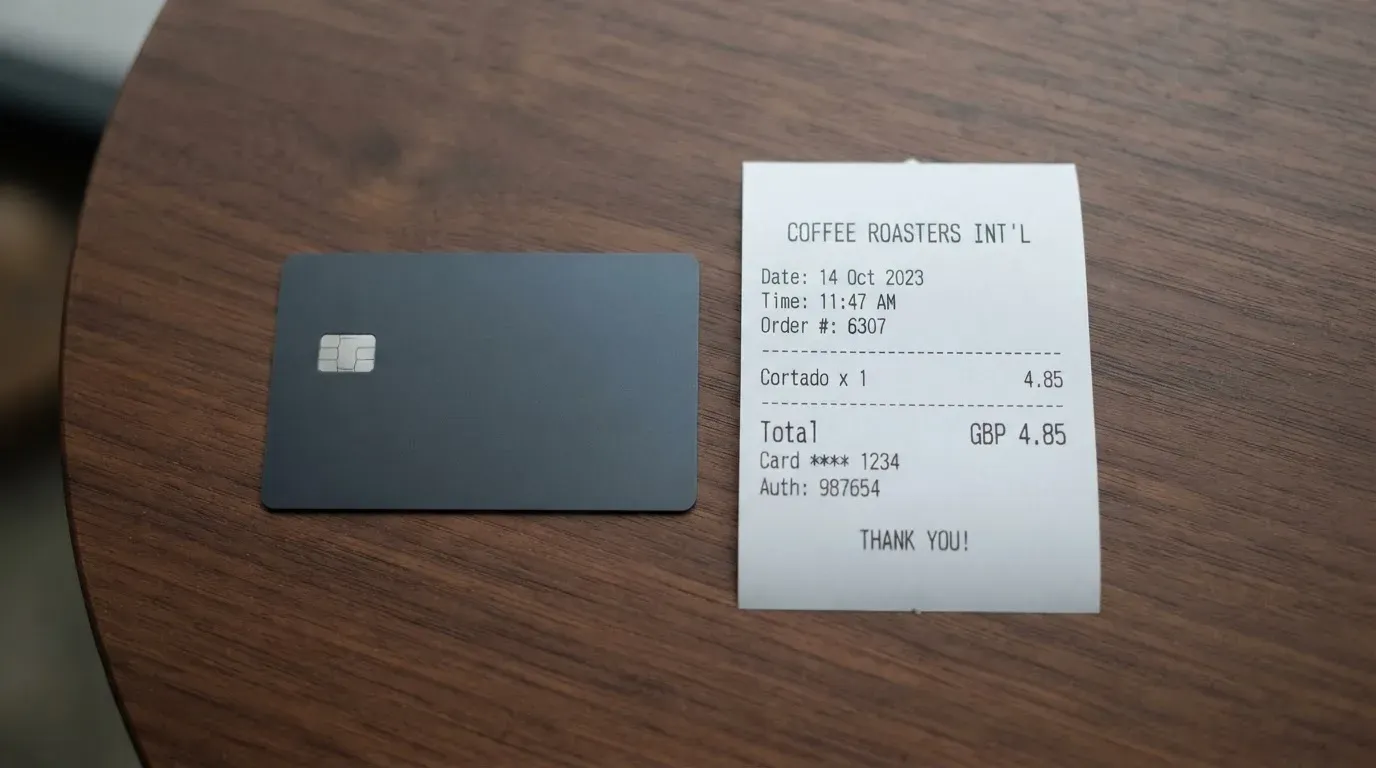
What makes this harder to judge is everything the swap fee does not cover. Other fees live in a “Fees and Limits Schedule” that lists categories without any amounts. The currency mark-up — what you effectively pay when you buy something priced in a currency other than the card’s own — is not stated. Cash withdrawal and ATM costs are not stated either. The one cash figure that does appear is a tier perk rather than a standard rate: Premium includes one free cash-in or cash-out per month, up to $499. MoneyGram cash pickup is a separate service and is not part of the card’s everyday cost.
Here is what is documented versus what is not, so you can see the shape of the bill:
| Fee or limit | What the card states |
|---|---|
| Issuance fee | Not stated |
| Monthly fee | Basic: free; Premium: $14.99/month (marked “Coming soon”) |
| Conversion (swap) fee | 0.5% on Basic; free on Premium |
| Other fees (Fees and Limits Schedule) | Categories listed, amounts not stated |
| Foreign-exchange (currency mark-up) | Not stated |
| ATM / cash withdrawal fee | Not stated |
| Free cash in/out | Up to $499 per month on Premium (one per month) |
| Daily spending limit | Not stated |
| Monthly spending limit | Not stated |
The practical takeaway: you can forecast the cost of converting crypto, but you cannot fully forecast the cost of spending abroad or of taking cash out, because those numbers are not published. If exact cost control matters to you, this is the single biggest reason to pause — and a good question to ask support before you rely on the card.
How to Top up
The card itself is funded from your crypto balance, so “topping up” here means moving crypto into Plumex. The company’s claim, made in a team post on LinkedIn rather than on the fees page itself, is that crypto deposits are fee-free. I would treat that as a company claim until you see it reflected in your own account. The official fees page lists deposit categories but no amounts, and how to add fiat — whether card, bank transfer, or otherwise — is not stated.
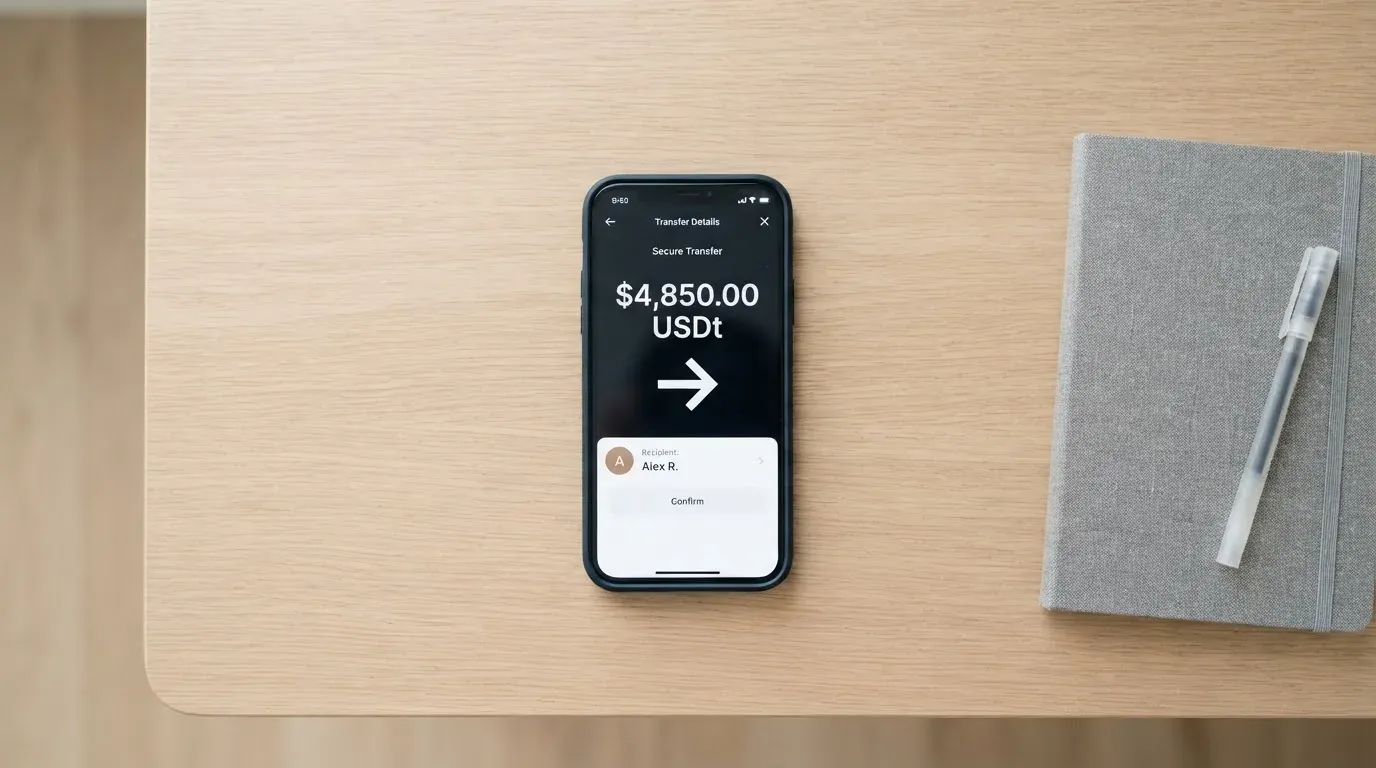
One important heads-up on networks and coins, because this is where crypto top-ups most often go wrong. Blockchain transfers are irreversible. If you send on a network Plumex does not support, or to an address belonging to a different network, the funds can be lost or need manual support recovery with no guarantee. The card does not publish which coins or networks it accepts, so the safe habit is to confirm the deposit currency and network inside the app before you send anything, and to start with a small test transfer.
On the way out, crypto withdrawals in the app carry a service fee plus a network fee, with amounts not stated. Closing your account is allowed once pending transactions complete, and assets are returned to you. So the money can come back out — but you should know the fees and the network rules before you commit funds, not after.
Paying with it every day
In daily use the Plumex card behaves the way most crypto cards do. The app site leads with “Apple Pay and Google Pay. Crypto behind the tap” — meaning you add the card to your phone’s wallet and pay by tap, with crypto converted behind the scenes at the moment of purchase. That is the everyday experience, and it is a genuinely pleasant one for anyone who wants to spend without thinking about the crypto side each time.
What the public pages do not tell you: the card type and network (Visa or Mastercard, debit or prepaid), whether a physical plastic card is issued, and how ATMs work — there is no stated ATM arrangement. Blocked merchant categories are also not stated. That last point matters more than it sounds: many issuers block certain spending categories by their own policy, and because the list here is not published, you cannot know in advance whether a specific purchase will decline.
Two more everyday realities to keep in mind. First, merchants can look at the card’s issuing country and card type, and some will decline a prepaid or foreign-issued card, or apply extra checks — so occasional declines at unfamiliar shops are a category risk with crypto cards generally, not a Plumex-specific fault. Second, a declined payment can leave a hold on your funds for several days (typically up to 7), even though the money never left.
On refunds and disputes: refunds are not automatic. If a purchase is refunded, the money goes back to the original source. The company targets a decision on routine disputes within 10 Business Days and complex cases within 30 calendar days, and your right to dispute through your bank or the card scheme is not limited by this. There are no stated rewards on the card; perks are marked “Coming soon.”
What can go wrong
This is where a card like Plumex earns careful attention, because the risks are not exotic — they are the standard risks of custodial crypto, plus the added opacity of a provider that does not publish its issuer or licence numbers.
Who is behind it. The platform is Plum Labs s.r.o., a Czech company (Company ID 243 80 792, Prague). Custody of funds sits with Plum Global Inc. in Panama. The exchange and fiat side is handled by Innovate Payments Inc. in British Columbia, Canada. Identity-verification routing goes through LMLP consulting s.r.o. in the Czech Republic. These are real, named companies — but no licence numbers are published anywhere, and the card issuer is not named. When you cannot see the issuer or a licence number, you cannot easily verify who stands behind your money.
Custody risk. Because Plumex is custodial, Plum Global Inc. holds the credentials to the wallet, so you are trusting them completely with your funds. That is the trade for convenience. Custodial platforms have a real history of failure: Mt. Gox (about US$350 million reported stolen, 2011-2014), Coincheck (about US$400 million, 2018), and Ronin Network (US$625 million, 2022). None of these is Plumex, but they are the category’s track record, and they are the reason custody deserves weight rather than a shrug.
Transfers you cannot undo. Crypto withdrawals are irreversible. There is no built-in way for the network to freeze or return funds sent to the wrong place. Tether also states it disables tokens in wallets on the OFAC sanctions list and has frozen funds tied to illicit activity — so stablecoins, despite the name, are not censorship-proof. On the security-controls side, the public pages do not state whether 2FA or an instant card freeze is available, though these are the standard safeguards (app-based 2FA, instant freeze, spending limits, 3-D Secure, tokenised mobile wallets) you should look for.
Complaints and track record. I found no official incidents and no user complaints, but I want to be honest about what that means: I did one search, and Trustpilot currently has no reviews at all (TrustScore 0, read on 2026-10-21). A brand-new card with no reviews is not a proven card — it is an unproven one. You are not inheriting a bad history, but you are also not inheriting a good one.
Support. The listed addresses are [email protected] for support and [email protected] for complaints. Complaints are acknowledged within 3 Business Days with a final reply targeted within 30 calendar days. Languages and opening hours are not stated, which for a Europe-and-Ukraine card is a small gap.
I found no news, incidents, or regulatory actions against the company, and that absence is mildly reassuring — but with a card this young and this quiet, “no news” is closer to “too early to tell” than to “all clear.”
What to take instead
If any of the gaps above — the unnamed issuer, the undisclosed currency mark-up, the unstated limits — bother you, the category has better-documented options. Here is how the main alternatives compare to Plumex on the points that matter, using only what each provider publishes.
International Visa Card — scores 6.7 / 10, and its edge is disclosure. It is not available to residents or legal registrants of a long blocklist (including Belarus, mainland China, North Korea, Cuba, India, Iraq, Iran, Israel, Myanmar, Nepal, Nicaragua, Russia, Syria, Turkey, Ukraine, Venezuela, Vietnam), and purchases are blocked in several of those countries; the rule follows residence or registration, not citizenship. It is a U.S.-issued Platinum Visa card, virtual, paying in USD, with the physical card “Coming soon.” Issuance is $5 one-time with no maintenance fee, and plans run Classic (free), Pro ($9.00/month), Max ($19.00/month). Card use in USD is free on every plan; foreign currency costs “Visa exchange rate + 2% FX fee.” Deposits are free, including USDC or USDT into the USD account. The trade-off is a hard country blocklist that includes Ukraine, so it does not serve the reader this review is written for.
UNi Card — scores 6.1 / 10, and its edge is cost transparency. It is a multicurrency card on the Mastercard network, spending from the UNi.Global account balance. It has “No annual fee” and “no foreign transaction fee,” converts assets at live OTC rates, and claims “No hidden exchange fees,” with “Spend-to-Earn rewards” up to 3%. Against that, the card’s physical/virtual format is not stated, and — a real gap — its country eligibility is simply not stated, so you would be applying blind.
Morse — scores 7.5 / 10, the highest of the group, and it earns that with the clearest fee story and a self-custodial wallet. It is “fully virtual for now,” a Visa prepaid debit spending from the Morse Balance “in any currency.” Eligibility is by residence (18+, resident in a supported country), the app is available in “over 140 countries,” and local add/withdraw works in over 70; it cannot serve customers under U.S./UK/EU/UN sanctions. Crucially, it charges “Zero foreign exchange fees or markups” at the real Visa rate, and “Paying with the Morse Card, online and contactless, is free.” Funding is broad — debit card, stablecoin transfer, Account Details in USD/EUR/MXN/COP (BRL needs a Brazilian CPF), and USDC, USDG and EURC via Solana are free while other tokens carry a fee. Its trade-offs: issuance and monthly fees are not stated (the card page just says “Fees may apply”), the supported-country list is not published (check the app), and several countries including the UK, Switzerland, Singapore, Japan and Australia are closed-beta, needing an invite code.
Pulling the comparison together:
| Option | Score | FX / conversion | Card format | Who it is for |
|---|---|---|---|---|
| Plumex | 5.9 / 10 | 0.5% swap on Basic, free on Premium; currency mark-up not stated | Type and network not stated | Europeans and Ukrainians wanting a crypto app with a card |
| International Visa Card | 6.7 / 10 | “Visa exchange rate + 2% FX fee” | Virtual U.S.-issued Platinum Visa, pays in USD | Users outside the long blocklist who want the fee published up front |
| UNi Card | 6.1 / 10 | Live OTC rates, no hidden exchange or FX fee | Mastercard, multicurrency; physical/virtual not stated | People who want no annual or foreign-transaction fee and 3% rewards |
| Morse | 7.5 / 10 | Zero FX fees or markups; contactless and online payments free | Virtual Visa prepaid debit, any currency | Residents of supported countries wanting zero FX cost and self-custody |
My read on the group: Morse is the most transparent and best-scoring of the four, and the closest fit for someone who wants a card that simply spends crypto anywhere without a hidden currency penalty. International Visa Card publishes its costs most explicitly but shuts the door on Ukraine and a long list of other countries. UNi Card is the cheapest-looking on paper but tells you the least about where it actually works. Plumex sits between them: the most purpose-built for Europe and Ukraine, but the least forthcoming with the numbers.
Who I would recommend it to
I would recommend the Plumex card to someone in a supported European country or in Ukraine who: wants a single app that holds crypto and gives you a card to spend from it day to day; is comfortable with a custodial setup and trusts the company to hold their funds; taps to pay with Apple Pay or Google Pay most days and does not need a lot of cash from ATMs; and accepts, having read the cost section, that the currency mark-up and some fee categories are not published and may cost more than the headline swap figure suggests.
I would steer you elsewhere — toward Morse, or another card that names its issuer and prints its FX fee — if any of these apply to you: you need to know your exact all-in cost before every payment; you live outside Europe and Ukraine; you are taking cash out regularly and need the ATM terms in advance; you want a card from a named, licensed issuing bank you can verify; or you are simply the kind of person who wants the fee schedule and the issuer name printed on the website before you hand over money. There is nothing wrong with wanting that — it is a reasonable standard, and this card does not meet it.
My honest summary: this is a competent, well-designed crypto card for its target audience, wrapped in a company structure and a cost disclosure that ask for more trust than the product itself demands. It scores a 5.9 because the product is fine and the transparency is thin. If the transparency improves — an issuer named, licence numbers published, the currency mark-up and ATM costs stated — the score would move up quickly. Until then, use it with the same care you would give any custodial wallet, and check the in-app country list and network details yourself before you rely on it.
Frequently asked questions
What is the Plumex card?
The Plumex card is a payment card attached to a crypto app, described as built for everyday money needs in Europe and Ukraine. It draws directly from your crypto balance, converting at the moment of payment, and it works with Apple Pay and Google Pay for tap-to-pay. The card’s type, network, and currency are not stated on the public site, and it sits behind a Czech platform with a Panamanian custodian.
How does the Plumex card work?
You load crypto into Plumex, then when you pay, the crypto is converted behind the scenes at the point of sale and the card spends the resulting balance. The 0.5% swap fee applies on the free Basic plan (free on Premium). Because the card spends a loaded balance rather than an overdraft, it behaves much like a prepaid card. One earlier check suggested it draws directly from the crypto balance.
Is Plumex a bank?
No — Plumex is not a bank. The platform is Plum Labs s.r.o. in the Czech Republic, custody sits with Plum Global Inc. in Panama, and exchange and fiat run through Innovate Payments Inc. in Canada. The actual card issuer is not named, and no licence numbers are published. Because no bank issues the card, your balance is not the same as a bank deposit and should not be assumed to have deposit-guarantee protection.
Who owns Plumex?
Plumex is operated by Plum Labs s.r.o., a Czech company (Company ID 243 80 792, based in Prague). Custody of crypto is held by Plum Global Inc. in Panama, the exchange and fiat side is Innovate Payments Inc. in British Columbia, Canada, and identity-verification routing is handled by LMLP consulting s.r.o. in the Czech Republic. No licence numbers are published for any of them.
Is the Plumex card available in my country?
Availability “may vary by country and local requirements,” and the supported countries are shown inside the app rather than published on the website. Eligibility depends on your residence and your actual location. The card is aimed at Europe and Ukraine, but the Ukraine Service Route is not available to people residing in or accessing services from the European Union — so check the in-app list before assuming.
How do I apply for the Plumex card?
Sign up in the app and complete the “5-min KYC.” Providers may request a government ID, proof of address, and a selfie with a liveness or video check, and you must be 18 or older. There is no published fixed review time, so “five minutes” refers to the check itself. Rejection reasons are documented — ineligible residence or location (including VPN use), sanctions matches, unexplained activity, inconsistent documents, third-party payments, and more.
How do I top up the Plumex card, and what does it cost?
You fund it with crypto, which the company says is fee-free (a claim from a team post, not the fees page itself). Which coins and networks are supported is not disclosed, and blockchain transfers are irreversible — send on the wrong network and the funds can be lost. How to add fiat is not stated. On withdrawal, crypto taken out of the app carries a service fee plus a network fee, with amounts not published.
Is the Plumex card safe?
Safety depends on custody. Plumex is custodial — Plum Global Inc. holds the credentials — so you are trusting the provider completely, and custodial platforms have a real history of losses (Mt. Gox, Coincheck, Ronin). On the plus side I found no incidents and no complaints, but Trustpilot has no reviews yet, so the card is unproven rather than proven bad. Whether 2FA and an instant freeze exist is not stated.
Is the Plumex card free?
The Basic plan is free, and a Premium plan is listed at $14.99/month but marked “Coming soon.” The swap fee is 0.5% on Basic and free on Premium. However, other fees live in a schedule with no amounts, the currency mark-up is not stated, and ATM and cash costs are not published — so the card is cheap to start but not fully predictable in cost.
Where can I use the Plumex card, and can I add it to Apple Wallet?
You can add it to Apple Pay and Google Pay and pay by tap, which is how the card is meant to be used day to day. You can spend wherever a card is accepted, but merchants can see the issuing country and card type, so some shops may decline a prepaid or foreign-issued card. ATM availability and fees are not stated, and a declined payment can leave a hold on your funds for up to about 7 days.
App and neobank card verdicts – cryptocardverdict
Content created by the «cryptocardverdict» team