
A virtual USD Mastercard aimed at Nigeria, with fees it does not publish
 Available in US

CardFlow gives you a virtual USD Mastercard that is created in about 3 minutes and is meant to be funded from crypto or from naira. On paper that is a narrow, practical thing, and for a Nigerian user holding dollars in a wallet it may be genuinely useful. The problem is everything around that core: the card’s own pages do not name the company behind it, do not state its fees, do not say what identity checks apply, and have left no independent reviews anywhere I could find. That is not a small complaint. It is the main thing this page is about.
Conditions are current as of October 28, 2026.
The score I have given CardFlow is 4.9 out of 10. That is not a dismissal — it is a card that does one thing quickly and says almost nothing about how it does it, which in this category is a serious gap rather than a stylistic one.
Verdict: 4.9 out of 10
Here is how the score breaks down, criterion by criterion, with my reasons in full.
| Criterion | Mark | Why |
|---|---|---|
| Who can get it | 5 / 10 | Aimed at Nigeria and at “Nigerians and global users”; no country list and no exclusions anywhere on the public pages |
| Cost | 6 / 10 | Creating a virtual card is free; top-up fees and FX fees are not disclosed |
| Top-up options | 6 / 10 | Bitcoin, USDT, ETH or a naira transfer; USDT on TRC-20 is near-instant, BTC and ETH take 5–30 minutes; other networks unnamed |
| Reliability and complaints | 4 / 10 | Legal entity and issuer not named; no complaints found, but no independent reviews either |
| Everyday use | 3 / 10 | Virtual USD Mastercard only, ready in about 3 minutes; Apple Pay and Google Pay not addressed; no ATM |
| Total | 4.9 / 10 |
The audience the card is clearly built for is a Nigerian user who wants to hold and spend US dollars, funding the card either from naira or from crypto. If that is you, the shape of the product fits: you top up, you spend dollars, you do not overdraw because the card spends a stored balance. If you are anywhere else and merely saw the card mentioned, you are in the “global users” half of a phrase with no list attached to it — no country table, no exclusions, no statement about who is turned away. I would not sign up on the strength of that phrase.
And if your real problem is not “I need dollars” but “I cannot get an ordinary bank card”, CardFlow is unlikely to be the answer, because the card’s pages do not tell you what verification it asks for at all.
Will they give you the card?
The answer is: apparently anyone who asks, because the card never says otherwise — and that absence is itself the information.
The site’s own framing is “Nigeria’s smartest fintech card platform”, and it addresses “Nigerians and global users”. There is no country list. There is no list of excluded countries. There is no statement about whether you need to be a Nigerian resident, a Nigerian citizen, or simply located somewhere the service can reach. The public pages do not say.
That matters more than it might appear at first. Sanctions screening and issuer risk policy are routinely applied to citizenship and country of birth, not just to the country you live in — which is why, across this whole category, a card can be open to residents of a country while still being closed to citizens of a sanctioned one. Here I simply have nothing to read. “Global users” is a marketing phrase, and a phrase is not an eligibility rule.
One more thing is not stated either: how many identity checks there are and what level you get. In this category that usually means a tier system, where a verified tier lifts limits and an unverified one caps them to a few dollars a day. CardFlow’s pages do not mention tiers, so I cannot tell you whether such a ladder exists, and I am not going to guess.
How to get it
Short answer: you create a virtual USD Mastercard in about 3 minutes. There is no physical card, and no waiting for delivery — the card exists inside the account the moment you create it.
On identity checks, the honest position is that the card’s public pages do not say. Not “it’s easy”, not “it’s light” — nothing. It is not stated whether documents are required, whether there is a selfie, whether verification happens before or after the card appears, or whether an unverified account can hold more than a token amount. Everything in this industry that hands you a dollar balance touches KYC, because anti-money-laundering law requires regulated businesses to verify customers, assess risk, monitor transactions and report anything suspicious. Regulated business though CardFlow clearly is — the card rides on Mastercard’s rails, and those rails are only open to licensed issuers. So a check almost certainly exists somewhere. What I cannot tell you is where that boundary sits, because the card does not publish it.
For a sense of what a normal EU-standard check involves, the reference point is name, address, date of birth, nationality and identity documentation, a sanctions check, understanding the purpose of the relationship, and whether you are a politically exposed person. In the US the customer identification programme is lighter on paper — name, date of birth, address, an identification number — with electronic systems also validating proof-of-address documents. Neither of those is CardFlow’s stated process; they are the general standard.
So if you apply and get a card, ask three questions before you load anything: what has been verified, what the daily limit is, and who the legal entity is that holds your balance. If those answers don’t come back clearly, that itself is your answer.
Fees: what a CardFlow payment really costs
The one hard cost figure CardFlow publishes is the friendliest part of the product: “Creating a virtual card is completely free”. No setup charge, no monthly charge mentioned for keeping it open. Beyond that, the pages go quiet.

| Fee or limit | What CardFlow states |
|---|---|
| Card creation | Free — “Creating a virtual card is completely free” (site FAQ, “Create Free Card”) |
| Monthly fee | Not stated |
| Top-up / funding fee | Not stated |
| Currency conversion fee | Not stated |
| FX fee on spending | Not stated |
| ATM / cash withdrawal | Not stated (virtual card) |
| Daily spending limit | Not stated |
| Monthly spending limit | Not stated |
| Tiers and minimum balance | Not stated |
I want to be plain about what that table means. The card is a USD card funded from naira or crypto, so every real payment involves at least one conversion — naira into dollars, or a stablecoin or coin into dollars — and possibly a second one if the merchant charges you in something other than dollars. Both of those conversions are fee-bearing events in this category, and CardFlow does not say what its own share is. A comparison I ran while writing this, for contrast, showed one competitor publishing a 1.5% top-up fee plus a flat dollar charge on its entry tier and a 3.5% FX fee, and another publishing a 4% top-up commission with no FX figure at all. Neither of those is CardFlow’s number. They are simply what disclosure looks like when it exists, which makes the absence here conspicuous rather than reassuring.
Two everyday payments, and what I can and cannot tell you:
A $30 subscription billed in dollars. The card was funded somehow — from a naira transfer, from USDT, from ETH. Whatever CardFlow charges for that funding, plus whatever it charges for converting to USD, is buried in your cost, and the site does not publish either figure. Beyond that, the payment itself is an ordinary Mastercard authorisation, and 3-D Secure will handle it the way it handles any online card payment: the issuer assesses the risk and either waves it through or challenges you with a one-time code or a biometric check. Mastercard’s version of that brand is called Identity Check. Some merchants will additionally run an address check, comparing the numeric parts of the billing address you type against the issuer’s records — but that service is mainly available in the US, Canada and the UK, and it is generally unavailable for foreign-issued cards, which can itself cause a decline.
A coffee priced in euro while your card holds dollars. Here you hit the FX line in the table, and the table is blank. Some providers add a currency-conversion markup on top of the network rate, some fold it into a single “no foreign transaction fee” claim, some bury it. CardFlow says none of this. If your spending is mostly in the currency the card holds, you may not notice; if you travel or buy from non-USD merchants, you are spending money without knowing the rate.
There is also no ATM story at all, which is consistent with a virtual card rather than a problem in itself — but if part of your reason for wanting a card is cash in hand, this one cannot do that.
Limits are the other silence. No daily and no monthly cap is published, so I cannot tell you whether you could fund this card with a meaningful sum or whether it is deliberately walled at a small number.
Top up: four ways in, and one detail that matters most
You can fund the wallet by bank transfer in naira or by crypto — Bitcoin, ETH or USDT. The card’s FAQ puts it plainly: fund the wallet via Bank Transfer or Crypto.
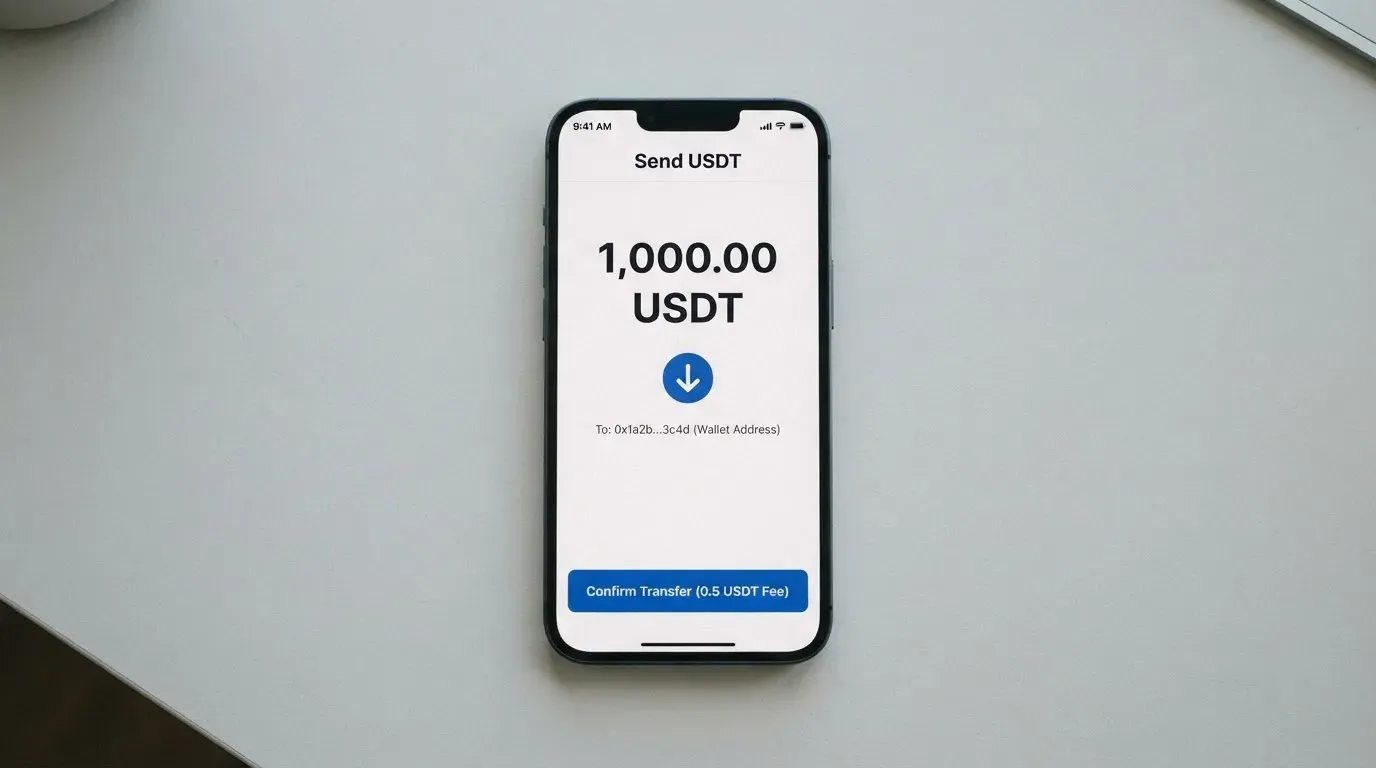
Timing is where the useful detail sits. USDT on TRC-20 is close to instant. BTC and ETH take 5 to 30 minutes. That gap is not marketing fluff; it reflects two very different technical setups. TRC-20 is the Tron standard, where fees are paid by burning TRX against a system of bandwidth and energy rather than by a per-transaction gas price in the chain’s own coin. Ethereum is the opposite: ERC-20 is the token standard proposed in November 2015, and gas must be paid in ETH itself, which means a wallet holding USDT and no ETH cannot actually send anything.
So the practical rule for anyone topping up: make sure the sending wallet actually holds the network’s own coin, not just the stablecoin. A USDT balance with an empty ETH balance is a transfer that cannot leave.
The thing the card does not tell you is the single most consequential detail in any crypto top-up: which networks are supported for which asset. The site names BTC, ETH and USDT and says nothing about the chain to send them on. Send on the wrong network and the transfer is simply gone, or becomes a support ticket with no guarantee of recovery — blockchain transfers are irreversible by design. Send USDT on Tron because that is the fast path and CardFlow quietly expects Ethereum, and you have converted a five-minute top-up into a bad afternoon. I would not put money in until you have seen the network named on screen, or written confirmation from support that names it.
Fees and minimums on the top-up are also not stated, so I cannot tell you the cost of moving $100 or whether small amounts are accepted at all. And withdrawal is not addressed anywhere on the public pages — how money leaves the wallet back to a bank, if at all, is not something I can answer from the card’s own material.
One more reason to slow down on USDT specifically: the largest dollar-pegged stablecoins are issued on several chains at once, but they are not interchangeable across them, and one provider has already dropped one. Circle stopped supporting USDC on Tron in February 2024, so “USDC over TRC20” is not a native option at all. Meanwhile Tether says it disables tokens in wallets on the OFAC sanctions list and has frozen funds tied to illicit activity — stablecoins are not censorship-proof, and the issuer can act on the token level.
Paying with it every day
The site’s claim about acceptance is worth repeating exactly: CardFlow says the Mastercard works on Amazon, Netflix, Shopify, AWS and more. Those are big-name merchants where a Mastercard number is expected to work, and it is a reasonable set of examples. It is also, notably, a set of examples rather than a policy — the pages do not tell you which merchant categories are blocked.
That omission has real consequences. Merchants classify businesses with a four-digit merchant category code defined in ISO 18245, assigned when a business starts accepting cards. MCC 7995 covers gambling — casinos, betting, lotteries. Issuers block such categories by their own policy, not by law, and the blocked list differs from one issuer to the next. CardFlow publishes no list, so you cannot know in advance whether a category you use will be refused. The same goes for recurring payments and for anything that triggers a fraud check.
What is not stated: whether the card works in Apple Pay or Google Pay. That is a bigger gap than it sounds. Tokenisation is how modern card use normally happens — Apple Pay replaces your card number with a device-specific number kept in the Secure Element on your phone, never on Apple’s servers, and each payment carries a one-time code. Without mobile wallet support you are typing the number into every merchant site yourself, which is both tedious and a larger fraud exposure than tokenised payments.
Rewards are not mentioned, so assume none. And because no app store listing was found for a web service, this is something you would run in a browser rather than an installed app — which matters for your security posture, though one-tap freeze and two-factor authentication are both mentioned as features.
There is also no ATM, no stated withdrawal route, and no stated dispute process. That last one is not a detail to skip. A chargeback is a refund ordered by the card issuer to settle a dispute, with reason codes for fraud, duplicate billing or goods not received. Rights over debit cards come from different regimes than credit cards, and prepaid-card coverage varies by country and should not be assumed. With no published dispute policy, you are relying on a support chat for a refund.
What can go wrong
Four things, in rough order of how much they should worry you.
You cannot verify who you are dealing with. The company behind the card is not stated. The issuer is not named. A search for independent reviews turned up nothing — no Trustpilot page for the domain, no Reddit thread, no forum discussion; the one similarly named page that does exist belongs to a different company. To be fair, silence is not the same as evidence of a problem, and I found no complaints either. But “no complaints” and “no history” describe the same empty space from the outside. When a card holds your balance and issues your payment card, you are entitled to know which legal entity stands behind both.
The card programme could stop. This is not hypothetical in this category. Visa and Mastercard do not issue crypto cards themselves; they license issuers, and they can suspend a programme. Visa said it had “terminated our global agreements with FTX” in November 2022, and the FTX US debit card was wound down by its issuer. WaveCrest, a Visa issuer that supplied crypto card brands, was suspended by Visa in Europe in 2018, closing all its Visa programmes. The typical pattern of a closure is a notice period, then loading and spending stop, then users are asked to withdraw remaining balances — and in a pre-funded model, that balance is money you were about to spend. You are exposed to exactly the amount of money you keep loaded.
Your money is somewhere in a chain of custodians. The card does not say whether funds are held in a custodial wallet, and it does not say what safeguarding applies. That silence is normal across this category and worth understanding anyway. A card payment passes through several parties: the network routes the messages and sets the rules, the licensed issuer holds the card programme, and the crypto brand is often only a programme manager or front-end. In the EU, an electronic money institution may issue e-money and payment cards but cannot lend, and must safeguard customer funds — by segregating them in dedicated accounts or insuring them. Such funds are not bank deposits and may not sit under a deposit guarantee scheme. Nothing in CardFlow’s material tells you which of those descriptions applies to it.
Custody itself carries a documented history: Mt. Gox, with roughly US$350 million reported stolen between 2011 and 2014; Coincheck, about US$400 million in 2018; Ronin Network, US$625 million in 2022. Transfers are irreversible by design, so a stolen key has no recovery path — the network cannot freeze or return the funds. And the safest model, self-custody, reverses part of that risk at the cost of putting all of it on you: a seed phrase is typically 12 to 24 words in unencrypted form, and anyone who obtains it can restore the wallet and spend everything in it.
A payment declines and you don’t know why. Declined authorisations can leave a hold that stays for days, typically up to seven. Address verification is unavailable on foreign-issued cards and causes declines. Some merchants refuse prepaid cards outright because the BIN lookup — the first six or eight digits of the number, which identify the issuing institution — reveals both the card type and the issuer country, and a shop may apply extra scrutiny when that country differs from the billing address. On a USD card issued for Nigerian use, this is a realistic category of friction, not an edge case.
Two features do work in your favour, and I want to give them their due: the cards page describes a Freeze control — click Freeze on any card, unfreeze anytime — and there is also one-tap freeze and 2FA. Support is an in-site chat widget labelled “CardFlow Support” and marked “Online · Replies in minutes”, alongside the FAQ. Whether “replies in minutes” holds when you are trying to recover money is a different question from whether the badge says it.
One last thing, and it is not the card’s fault but it will land on your shoulders: converting crypto into dollars is a disposal. The IRS treats digital assets as property, so exchanging them for goods, services or dollars generally produces a taxable gain or loss, measured in local fiat currency at the fair market value on the date of the transaction — which can make each card payment funded from crypto its own separate taxable event. I am not giving you tax advice; I am flagging that this line of spending has a paperwork tail that a normal bank card does not.
What to take instead
The honest comparison is awkward, because the two cards I looked at hard both publish more than CardFlow does — which is itself informative.
HyperCard scored 4.7 out of 10 on my criteria. Official pages state no country list, though the App Store description says the card works in “more than 176 countries” — and that is acceptance, not eligibility, a distinction worth holding onto. It’s a prepaid card, network not stated on the store page, balance in USD or EUR. You deposit crypto such as USDT, BTC or ETH in the app, and it’s converted to your card currency; networks are not stated. Costs are not stated on the pages I could read, and the store page lists no fees. No rewards are mentioned. It is the closest shape-match to CardFlow, and it discloses no more.
Card.fi scored 6.6 out of 10, the highest of anything I looked at. The banner says cards ship to “200+ countries”, and the terms bar residents of, or orders from, “a country subject to sanctions that would prohibit the service” — that is an actual eligibility rule stated in writing, which is more than CardFlow offers. It publishes a full card ladder: virtual Classic $49 and virtual Premium $249 one-time, physical and metal variants, a metal option in stainless steel, and every physical order including a virtual card. Cards are issued “under licence from the relevant card schemes”, with the schemes themselves not named. There is no monthly, annual, inactivity or minimum-balance fee. Fees are published: top-up of 1.5% plus $1.00 on Classic and 1% on Premium; FX of 3.5% on Classic and 2.5% on Premium, with the conversion fee shown before each top-up. Funding covers 32 coins across 5 networks — Ethereum, Base, BNB Chain, Solana, Kaanch — including USDT, USDC, ETH, BNB, SOL and KAANCH, with a deposit address per card, conversion at market rate on arrival, and an explicit warning that the wrong chain risks permanent loss. Rewards are cashback on spending only: Classic 0.8% capped at 10 USDT a month, Premium 1%, Metal 1.2% capped at 100 USDT a month and 5,000 USDT, or 2% capped at 250 USDT a month and 20,000 USDT, with a headline 10% at coffee shops capped at 10 USDT a month and variable “up to 18%” on balances for Metal.
The trade-off is real: you pay upfront for the card, and you accept that the company states where it ships while leaving the schemes unnamed. But you know what you are paying before you pay it.
Nero scored 4.8 out of 10. Not stated on readable pages who can have one, although the site says restricted countries exist and the list was not readable; I found no statement about Russian or Belarusian citizens or residents. It’s a virtual card with a standard number, expiry and CVC, network not named, currency not stated. One-time issuance fee with the amount not published, no monthly fee stated. Top-up commission of 4%, conversion to fiat happens at payment, FX fee not stated. You top up with USDT or USDC, converted to fiat at the moment of payment; networks unconfirmed on the pages I could read.
The pattern across all four cards is worth stating plainly. Two of the three alternatives publish at least some numbers; none of the three publishes a rewards scheme as clearly as Card.fi does. And none of them has an independent review trail either — this is a thin corner of the market, which means the absence of complaints on CardFlow tells you very little. In this category, published numbers and a named legal entity are the closest thing to a track record you can actually read before you deposit.
Who I would recommend it to
I’d suggest CardFlow to someone in Nigeria who already holds dollars or dollar-pegged crypto, who wants a spending card in about 3 minutes, and who is content to treat the balance as spending money rather than savings — with eyes open that no fee schedule, no limit schedule and no company name are published, so they should load small amounts first and confirm the network before every transfer.
I would not suggest it to anyone whose main problem is getting an ordinary card, because the pages never say what verification applies, and that is precisely the question they’d be asking. Nor to anyone planning to keep meaningful sums on it, since custody terms are unstated and a programme shutdown would leave them holding a stored balance. Nor to anyone who wants to pay with a phone — Apple Pay and Google Pay are not addressed, so you would be typing your card number into every checkout. Nor to anyone who shops in non-dollar currencies, since the FX position is unknown.
And to everyone: check the regulator’s register before you load. In the EU, ESMA keeps an interim register of authorised crypto-asset service providers, white papers and non-compliant entities, and there is a point worth knowing — MiCA’s rules on stablecoins applied from 30 June 2024 and the remaining provisions, including CASP rules, from 30 December 2024, with a transitional period letting existing providers continue only until 1 July 2026 or until they are authorised or refused, whichever comes first. A CASP authorised in one member state can serve the whole EU. Note also that a card is regulated separately from the crypto side: MiCA covers custody, exchange and transfer, while the card is a payment service under e-money or payment-services law, so a crypto card often rests on two licences. And in the US, FinCEN guidance treats administrators and exchangers of convertible virtual currency as money transmitters, while ordinary users buying goods are not.
Frequently asked questions
What is the CardFlow card?
CardFlow is a virtual Mastercard that holds and spends US dollars, meant to be funded from naira or from crypto. The card’s own framing is “Nigeria’s smartest fintech card platform”, addressing “Nigerians and global users”. No country list and no exclusions are published, and it exists only as a virtual card — there is no physical version, so delivery times simply do not apply.
How does the CardFlow card work?
You create a virtual USD Mastercard in about 3 minutes and fund the wallet, then spend the stored balance like an ordinary card. Because it works from a pre-loaded balance rather than a linked bank account, it cannot overdraw. Conversion from naira or crypto into dollars happens as part of funding, and CardFlow does not publish what that conversion costs.
Is CardFlow a bank?
That is not stated on the card’s public pages, and it is exactly what I would want answered. The legal entity behind the service is not named, and neither is the issuer of the card programme. Cards on Mastercard’s rails can only be issued by licensed institutions, so something regulated is involved — but which entity holds your balance is not something the pages tell you.
Who owns CardFlow?
I could not find it stated. Neither the ownership nor the issuing institution is named on the public pages, and my searches for independent reviews — including a Trustpilot page for the domain — returned nothing, with one similarly named page belonging to a different company. There is no track record here for an outside reader to check.
Does CardFlow require KYC?
Not stated. The pages do not mention identity verification at all: no documents, no selfie, no tier structure. Anti-money-laundering law generally requires regulated businesses to verify customers and monitor transactions, so some check almost certainly exists — but where the threshold sits, and what an unverified account may hold or spend, is not published.
How do I top up the CardFlow card?
By bank transfer in naira, or by crypto — Bitcoin, ETH or USDT. USDT on TRC-20 arrives near-instantly, while BTC and ETH take 5 to 30 minutes. Critically, the pages do not name which networks are supported, and blockchain transfers are irreversible, so confirm the chain before sending anything.
Is the CardFlow card free?
Creating one is: the site FAQ states “Creating a virtual card is completely free”. Beyond that, nothing is published. The monthly fee, top-up fee, currency conversion fee, FX fee, ATM terms, daily limit and monthly limit are all not stated, which means you cannot compute what a payment will cost you.
Can I add the CardFlow card to Apple Wallet?
That is not stated, and I would not assume it works. Apple Pay replaces the card number with a device-specific number held in your phone’s Secure Element and generates a one-time code per payment, so tokenised mobile wallets are the normal way people pay. Without them, you would be typing the card number into each checkout yourself.
Is CardFlow safe to use?
I cannot tell you it is, and I would not tell you it isn’t — I found no complaints and no independent reviews, which describes the same empty space. The card does advertise a freeze control you can toggle at any time, one-tap freeze and 2FA, and a support chat. What is not stated is who holds your balance and under what safeguarding.
Is the CardFlow card worth it?
Worth it if you are in Nigeria, want to spend dollars from crypto or naira, and need a card within minutes, and you treat the balance as spending money you can afford to lose access to. Not worth it if you need published fees, a named company, mobile wallet support, cash withdrawal, or any answer at all about verification — because CardFlow currently gives you none of those.
Virtual card verdicts – cryptocardverdict
Content created by the «cryptocardverdict» team