
A no-KYC Visa that asks for no documents, charges you at the till and tells you almost nothing
 Available in US
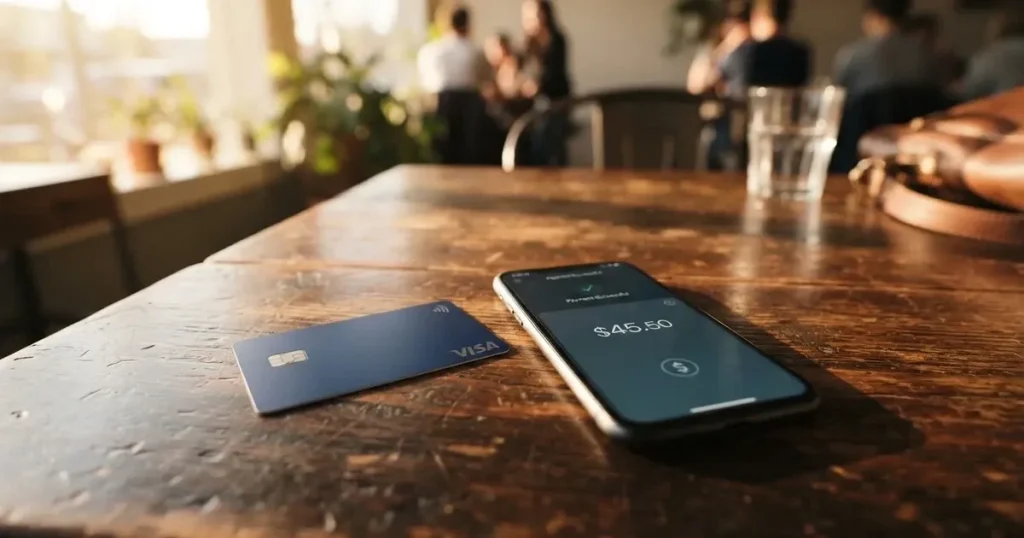
The KYC.RIP card is a virtual Visa you can open without a passport, without a selfie and without a proof of address — you apply with any name and a PIN. In exchange, you pay to open it, you pay to load it, and you pay again on every purchase, and the company behind it does not name the bank that issues the card. That is the whole trade in one sentence. Whether it is a good trade depends almost entirely on why you cannot get an ordinary bank card.
Here is where I land after reading the card’s own pages and comparing them with the category: it scores 5.2 out of 10. The two strongest parts are access and funding — anyone can apply, and the card loads from more than 200 cryptocurrencies. The weakest is money: 50 USDT to open, 3.5% to load, 1.5% per purchase and 4% at an ATM, on a virtual card only.
The conditions described here are current as of October 28, 2026.
- Who it suits: people who are blocked from ordinary banking, who value not handing over documents above the cost of fees, and who spend occasionally rather than daily.
- Who it does not suit: anyone who needs a physical card, Apple Pay or Google Pay, daily-limit headroom, or a named, licensed issuer they can point to.
The score, criterion by criterion
| Criterion | Mark | Why |
|---|---|---|
| Who can get it | 8 / 10 | Described as global, with no published country list; application takes any name and a PIN, no documents |
| Cost | 2 / 10 | Opening 50 USDT, top-up 3.5%, purchase 1.5%, ATM 4% (minimum 25 HKD), annual 50 HKD (first year free), monthly free |
| Top-up options | 8 / 10 | More than 200 cryptocurrencies including XMR, BTC, ETH, USDT, SOL, LTC via non-custodial exchanges; minimum 20 USDT, networks not named |
| Reliability and complaints | 5 / 10 | Legal entity and issuer unnamed, an unknown partner network; no complaints or reviews found; card data encrypted with RSA-2048 |
| Everyday use | 3 / 10 | Virtual Visa only, freeze in the dashboard; Apple Pay and Google Pay not named, ATM fee 4% |
| Total | 5.2 / 10 | Strong on access and funding, weak on cost and everyday practicality |
The 8s and the 3 pull in opposite directions, and that tension is the card. On access there is nothing to beat it — no country list to check, no documents to gather. On everyday use there is very little to recommend: one virtual Visa, no named mobile wallet, and a 4% fee if you need cash.
Will they give you the card
Yes — that is the strongest thing about it. KYC.RIP describes itself as global and does not publish a list of countries. The application asks for a name and a PIN. It does not ask for documents or a selfie. Personal data is automatically deleted after 30 days, which is a genuine privacy feature if you are the kind of person who cares about that, and irrelevant if you are not.
What that means in practice is that eligibility is effectively “can you reach the site and make the opening payment”. There is no nationality screen, no residence screen, no income screen that the card’s public pages mention. That cuts both ways: it is the reason the card scores 8 out of 10 for access, and it is also why the issuer and the legal entity behind it are not named on those pages. A bank that does not look at who you are cannot put a face to the risk it carries, and that risk eventually has to live somewhere.
The card’s public pages do not say what KYC levels, if any, are applied behind the application form. Where a platform applies tiers — identity checks only above a threshold, or for specific features — that tier structure is not stated here, and I would not assume an invisible one exists in your favour.
One detail worth pausing on: the card is issued through an unnamed partner network. That is the part I would want answered before putting money in. A Visa card number is only as good as the institution standing behind it, and the card’s own pages do not tell you which institution that is.
How to get it
The card is a virtual Visa, reloadable, valid for three years, issued through an unnamed partner network. You apply in the dashboard with any name and a PIN, and the card arrives as a card number you use online or in a phone wallet — there is no physical plastic described for this product.
There is also a second product line. The card site lists a no-KYC virtual Visa, which is open, and a USD prepaid card with a range of $25-$1500, which is marked “under maintenance”. A reloadable card is announced as “soon”. The currency attached to the prepaid product is USD, and the range between $25 and $1500 is where the balance is meant to sit.
Two practical things you should expect to hit before you get going. First, opening the card costs 50 USDT, so you are paying in crypto before the card exists. Second, the card’s public pages do not say how long delivery takes — and for a virtual card that means the wait between application and a usable card number, which is not stated anywhere I could find.
If you were wondering whether this is a bank, it is not described as one. Nothing on the card’s pages presents KYC.RIP as a bank or as a licensed e-money institution, and no licence is named.
Fees: what it really costs
This is where the 5.2 comes from. The card’s headline number — no documents — comes with a stack of charges that add up quietly, and the 2 out of 10 for cost is the fairest mark I can give it.

| Fee or limit | Value |
|---|---|
| Card opening | 50 USDT |
| Monthly fee | Free |
| Annual fee | 50 HKD (first year free) |
| Top-up | 3.5% (platform) |
| Purchase | 1.5% |
| Cross-border refund | 2% (issuer) |
| ATM | 4% (minimum 25 HKD) |
| Top-up minimum | 20 USDT |
| ATM allowance | not stated |
| Spending limits | not stated |
Read that table as a stack rather than a list, because the fees sit on top of each other. To get 100 USDT of spendable balance you pay the 50 USDT opening, then 3.5% to load what you load. Every payment then takes 1.5%. And if you are outside the country the card behaves as though it were issued in, a refund costs another 2% at the issuer. Against a card with no top-up fee and no per-purchase fee, this is a materially more expensive way to spend the same money.
Now three everyday payments, so the percentages land on something real.
A $12 coffee. You tap the card. The 1.5% purchase fee applies. There is no top-up fee in this transaction because you already paid that when you loaded. This is the best case for the card — small, online or contactless, no conversion, no cash.
A $40 online subscription in a currency other than the card’s. The 1.5% purchase fee applies. If the merchant charges you in a currency the issuer has to convert, the conversion is where the card’s pages are quietest: top-ups are converted through non-custodial exchanges and the spread is not stated. That is the number to ask about, because an unstated spread is not a fee you can budget for.
A $60 withdrawal from an ATM. The ATM fee is 4% with a minimum of 25 HKD. Note that $60 is roughly a mid-range withdrawal in any currency where 25 HKD is under $3 — in that case the percentage dominates. Where 25 HKD is a larger share, the minimum does. And the card’s public pages do not state an ATM allowance, so there is no published monthly cap to plan around.
The annual fee is the one that barely matters: 50 HKD, waived in the first year. The monthly fee is free. Neither is the problem. The problem is the three percentages, all of which land on ordinary spending.
How to Top up
This is the other half of what the card does well. Funding comes from more than 200 cryptocurrencies — XMR, BTC, ETH, USDT, SOL and LTC are named explicitly — converted through non-custodial exchanges. The top-up fee is 3.5%, and the minimum top-up is 20 USDT.
Non-custodial is the important word and it cuts in your favour in a specific way. A non-custodial exchange converts the crypto in your own wallet rather than taking it into a platform account, so the conversion step does not require you to hand over your funds the way a custodial exchange would. That is a structural difference, not a promise about anything else.
What is missing here is the detail that usually decides whether a top-up works: the networks. The card’s pages do not name which chains are supported for deposit. This matters more than it sounds. A stablecoin exists in several forms across several chains — USDT has been issued on Ethereum, Tron, Solana, Polygon, Avalanche and others — and a transfer sent on a network the provider does not support, or to an address belonging to a different network, can be lost entirely or need manual recovery with no guarantee. Blockchain transfers are irreversible; the network cannot undo a payment that was always going to the wrong place.
So before your first top-up, the practical question is not “how much” but “which network”. Check the dashboard for a per-asset deposit address and network label at the moment you send, and treat an unsupported network as money already gone.
One more thing the pages do not cover: withdrawing. There is no stated withdrawal process on the card’s public pages. If you cannot get your balance back off the card and back to your own wallet, that is a question to have answered before you load it with more than you can afford to lose.
Paying with it every day
Daily use is the card’s weak spot, and the 3 out of 10 is not a rounding error.
You get a virtual Visa. That means no plastic, no contactless tap on a physical card, and a card number that has to live in a phone wallet or a checkout form. The card’s public pages do not name Apple Pay or Google Pay support — and that is not a technicality, because adding a card to Apple Wallet replaces the card number with a device-specific number stored in the Secure Element with a fresh one-time security code per payment. If neither wallet is supported, you are typing your card number into websites, which is the situation tokenisation exists to avoid.
The dashboard does offer freeze and unfreeze, and live balance. Those are real conveniences: if the number leaks, you stop it spending without waiting for anyone. 3-D Secure codes are delivered to the dashboard rather than by SMS or an app, which keeps them off your phone’s SMS inbox but also means the dashboard is the single point where an intercepted code can be read.
Then there is the acceptance question. A card number begins with a 6 or 8-digit issuer identification number, and any merchant can look that number up to see which institution and country issued it. If the issuer country differs from your billing address, the merchant may apply extra scrutiny — or decline. Some merchants refuse prepaid or foreign-issued cards for exactly that reason. An unnamed issuer makes the BIN lookup harder for you to predict.
Two more things that catch people out. Address Verification Service compares the numeric parts of the billing address you type with issuer records; it is mostly a US, Canada and UK thing, and it is generally unavailable for foreign-issued cards, which can cause declines at checkout. And merchant category codes classify businesses — 7995 covers gambling — and issuers block categories by policy rather than by law, with the blocked list differing between issuers. On a card whose issuer is not named, you cannot check its policy.
The card’s public pages say nothing about wallets offered, about rewards or cashback, about the app itself, or about how disputes are handled. A declined payment can also leave a hold on funds that stays for several days, sometimes up to seven, which is worth knowing before you assume a failed transaction released your money.
What can go wrong
Nothing has gone publicly wrong that I could find — and that is not the same as nothing having gone wrong.
No complaints, no reviews. There are no official incidents on record, and the search for reviews of kyc.rip returned nothing about this card at all — only other no-KYC card services. There is no Trustpilot page. Take that two ways: you have no warning to act on, and you also have no track record. Absence of evidence in a product this young is weak evidence of absence of trouble.
No named entity, no named issuer. The legal entity behind the card and the issuer are not stated, and the partner network is unnamed. This is the single biggest structural risk. In any card payment, several parties are involved: the network routes the messages and sets the rules, the issuer holds the programme, and the crypto brand is often only a front-end that markets it. If you do not know which of those KYC.RIP is, you do not know who you would complain to.
Programmes close. Card programmes do get wound down. Visa terminated its global agreements with FTX on 13 November 2022, and the FTX US debit card was being wound down by its issuer. Visa had previously suspended WaveCrest in Europe in 2018, closing all WaveCrest-issued Visa programmes. The typical shape of a closure is a notice period, then spending and loading stop, then you are asked to withdraw what remains. A card with a virtual product only and no stated withdrawal process is thin on that last step.
The 30-day deletion is a feature with a shadow. Personal data is deleted after 30 days. Card data is encrypted with RSA-2048. Both are reassuring. But if the issuer is unnamed and support is not stated, “we deleted your data” and “we can explain a charge from three months ago” are different kinds of promise, and only one of them is on the page.
Sanctions and compliance still apply. You will not be the one being screened; the issuer will. In the EU, customer due diligence covers name, address, date of birth, nationality and identity documentation, a sanctions check, the purpose of the relationship, and whether you are politically exposed. If that cannot be completed, rules require the institution to decline or end the relationship. Nationality and country of birth are screened separately from residence. A card that asks for no documents does not exempt you from being de-risked — it just moves the screening upstream, to an unnamed issuer.
Withdrawal and support are blank. No stated withdrawal process, no stated support channel. Both are operational facts you want before you load, not after.
Irreversible transfers. Blockchain transfers cannot be reversed, and a stolen private key has no recovery path because the network cannot freeze or return funds. The bigger history here is custodial failure: Mt. Gox (about US$350 million reported stolen 2011-2014), Coincheck (about US$400 million, 2018), Ronin Network (US$625 million, 2022). Those are arguments for holding your own keys, which this card’s non-custodial conversion is consistent with — not arguments that anyone holding funds for you is safe.
Regulation is moving under all of this. Under MiCA, e-money tokens may be issued only by a credit institution or an electronic money institution, and the transitional period lets providers operating under national law continue only until 1 July 2026 or until they receive or are refused a MiCA authorisation, whichever comes first. ESMA keeps an interim register of authorised providers, white papers and non-compliant entities — that register is where you can check a provider’s standing. A card is a payment service regulated separately from the crypto side, so a crypto card often depends on two licences. None of this is specific to KYC.RIP; it is the weather everyone in this category is standing in.
And the ordinary one: if you spend crypto through a card, the tax treatment usually follows. In the US the IRS treats digital assets as property, so exchanging them for goods, services or dollars generally produces a taxable gain or loss, measured in local currency at fair market value on the transaction date — which can make each card payment a separate disposal event. I am not going to tell you what that means for you; it depends on where you live and I am not qualified to. But it is the kind of thing that quietly turns a 1.5% fee into a bigger number after the fact.
What to take instead
Two credible alternatives, both scored on the same basis, both showing the same gap this card has: named pricing is rare across the category.
| KYC.RIP | CardFlow | HyperCard | Card.fi | |
|---|---|---|---|---|
| Score | 5.2 / 10 | 4.9 / 10 | 4.7 / 10 | 6.6 / 10 |
| Card | Virtual Visa, reloadable, valid 3 years | Virtual USD Mastercard, created in about 3 minutes | Prepaid “HyperCard”, network not stated on the App Store page | Virtual and physical Classic and Premium, metal option |
| Opening cost | 50 USDT | Creating a virtual card is free | Not stated; App Store page lists no fees | Virtual Classic $49, Virtual Premium $249, one-time |
| Top-up fee | 3.5% | Not stated | Not stated | Classic 1.5% + $1.00, Premium 1% |
| Purchase / FX | Purchase 1.5%; cross-border refund 2% | Not stated | Not stated | FX Classic 3.5%, Premium 2.5% |
| Who it is for | Global, no country list, no documents | Aimed at Nigeria, “Nigerians and global users”; no country list or exclusions stated | No country list; App Store says works in “more than 176 countries” (acceptance, not eligibility) | Ships to “200+ countries”; terms bar residents or orders from sanctioned countries |
| Funding | 200+ coins via non-custodial exchanges | BTC, USDT, ETH or Naira bank transfer | Crypto deposit in the app, converted to USD or EUR | 32 coins across 5 networks, deposit address per card |
| Rewards | not stated | not stated | not stated | Cashback on spending only, 0.8% to 2% depending on tier |
CardFlow scores 4.9 and is aimed at Nigeria — its own banner calls it “Nigeria’s smartest fintech card platform” while also addressing “Nigerians and global users”. It gives you a virtual USD Mastercard in three minutes, and creating a virtual card is free. That free creation is a real advantage over 50 USDT. But its monthly fee, purchase fees and top-up fee are not stated, so you cannot build a budget from the pages, and its funding options are four: Bitcoin, USDT, ETH or a Naira bank transfer.
HyperCard scores 4.7. It is a prepaid card with a balance in USD or EUR, funded by depositing crypto in the app. Its App Store page says the card works in “more than 176 countries” — that is acceptance, not eligibility, and the official pages state no country list. Fees are not stated on the pages I could read. Interesting mainly because it is the alternative with an App Store presence, which says something about how apps get distributed in this category.
Card.fi scores 6.6, the highest of the four, and it earns that on disclosure. It names one-time prices (Virtual Classic $49, Virtual Premium $249), explicit fees (top-up 1.5% + $1.00 on Classic, 1% on Premium; FX 3.5% and 2.5%), and a real product range including physical and metal cards, with every physical order including a virtual one. It names 32 coins across 5 networks (Ethereum, Base, BNB Chain, Solana, Kaanch) and warns that the wrong chain risks permanent loss. It shows the conversion fee before each top-up. And its terms bar residents of, or orders from, a country subject to sanctions — a stated rule rather than an unstated one. Rewards are cashback on card spending only, 0.8% to 2% depending on tier.
Note what Card.fi does not do either: it does not name Visa or Mastercard, saying only that cards are issued under licence from the relevant card schemes. The unnamed-issuer problem is endemic to this category, not unique to KYC.RIP. What Card.fi has that KYC.RIP lacks is everything else — the prices, the networks, the fees, the terms.
Who I would recommend it to
If you cannot get an ordinary bank card — because of your nationality, your documentation, your address, or a banking record you would rather not create — then a no-KYC virtual Visa that takes any name and a PIN is genuinely useful, and the 8 out of 10 for access reflects that honestly. Load it with what you need for a specific purpose, use it for online and contactless spending where the 1.5% is the only fee you pay, and withdraw or stop when you are done.
I would also suggest it to anyone who simply prefers not to hand over documents to a crypto payment provider, and who can afford the percentage fees as the price of that privacy. The 30-day deletion of personal data and the non-custodial conversion are real, and 3.5% to load and 1.5% to spend is a price you can pay deliberately.
I would not recommend it if any of the following is true of you:
- You need a physical card. There is no plastic for this product, and the reloadable card is “soon”.
- You live on Apple Pay or Google Pay. Neither is named on the card’s pages. Without tokenisation you are typing your card number into sites.
- You need cash often. 4% per ATM withdrawal, minimum 25 HKD, with no published allowance.
- You spend daily. At 1.5% a purchase plus 3.5% to load, daily spending is where this pricing hurts most.
- You need someone to answer to. No named legal entity, no named issuer, no stated support channel, and no reviews from anyone.
- You need to get money back off the card. No withdrawal process is stated. Find that out before you load it.
For the last two, the honest advice is to ask, and to be suspicious of an answer that is vague. A card that takes no documents from you has not removed your need for one; it has moved the requirement to an institution whose name it does not publish.
Frequently asked questions
What is the KYC.RIP card?
It is a virtual Visa you open without submitting documents — the application asks only for a name and a PIN. The card is reloadable, valid for three years, and issued through a partner network the card’s pages do not name. Personal data is deleted automatically after 30 days. There is also a USD prepaid product with a $25-$1500 range that is listed as “under maintenance”.
How does the KYC.RIP card work?
You pay 50 USDT to open it, then load it with crypto — more than 200 currencies are supported, converted through non-custodial exchanges — and spend the resulting balance. It behaves like a prepaid card: the balance is loaded first, and the card spends only that, so it cannot overdraw. Purchases cost 1.5%, and you can freeze and unfreeze the card and check the balance in the dashboard.
Is KYC.RIP a bank?
Nothing on the card’s public pages presents KYC.RIP as a bank or as a licensed e-money institution, and no licence is named. The legal entity behind the service is not stated, and neither is the issuer of the card. What the pages describe is a product that markets a card issued through an unnamed partner network.
Does KYC.RIP require KYC?
No, and that is the card’s central feature. The application works with any name and a PIN, no documents and no selfie. The card describes itself as global with no published country list. What the public pages do not say is what happens behind the form, and note that the issuer still screens customers under its own compliance obligations.
How much does the KYC.RIP card cost?
Opening costs 50 USDT and the annual fee is 50 HKD, waived in the first year, with no monthly fee. The real cost is percentage-based: 3.5% to top up, 1.5% per purchase, 2% on a cross-border refund at the issuer, and 4% at an ATM with a minimum of 25 HKD. The minimum top-up is 20 USDT. The ATM allowance and spending limits are not stated.
How do I top up the KYC.RIP card?
You send cryptocurrency from your own wallet and it is converted through non-custodial exchanges — XMR, BTC, ETH, USDT, SOL and LTC are among the more than 200 supported. The fee is 3.5% and the minimum is 20 USDT. Check the deposit network shown in the dashboard before sending: the supported networks are not named on the public pages, and a transfer on an unsupported network can be lost.
Can I add the KYC.RIP card to Apple Wallet?
The card’s public pages do not name Apple Pay or Google Pay support, so I would not assume either works. That matters because a tokenised wallet replaces your card number with a device-specific number and a fresh security code per payment. If neither wallet is supported, you are entering your full card number at every checkout, which is exactly the exposure tokenisation is designed to remove.
Is the KYC.RIP card safe?
There are no published complaints about it and no reviews from users — no official incidents have been found. Its pages describe card data encrypted with RSA-2048, 3-D Secure codes delivered to the dashboard, and instant freeze. The structural concerns are separate from the technical ones: no named issuer, no named legal entity, no stated support channel and no stated withdrawal process.
Where can I use the KYC.RIP card?
It is described as global with no country list, and the issuer country is not published. That matters at the checkout rather than at the application: merchants can look up the card’s issuer identification number and see the issuer country, and some decline prepaid or foreign-issued cards outright. Address verification is generally unavailable for foreign-issued cards, which can cause declines in the US, Canada and the UK.
Is the KYC.RIP card worth it?
For a one-off or occasional need, funded deliberately and spent online, the fees are a price you can pay for not submitting documents to anyone. For daily spending, cash withdrawals, or anyone who needs a named institution to deal with when something goes wrong, the 3.5% top-up, 1.5% purchase fee and unnamed issuer make it poor value — Card.fi scores higher at 6.6 and at least publishes its prices, networks and fees.
Virtual card verdicts – cryptocardverdict
Content created by the «cryptocardverdict» team