
A Visa card that spends a stablecoin balance, with fees the public pages never quite finish explaining
 Available in US
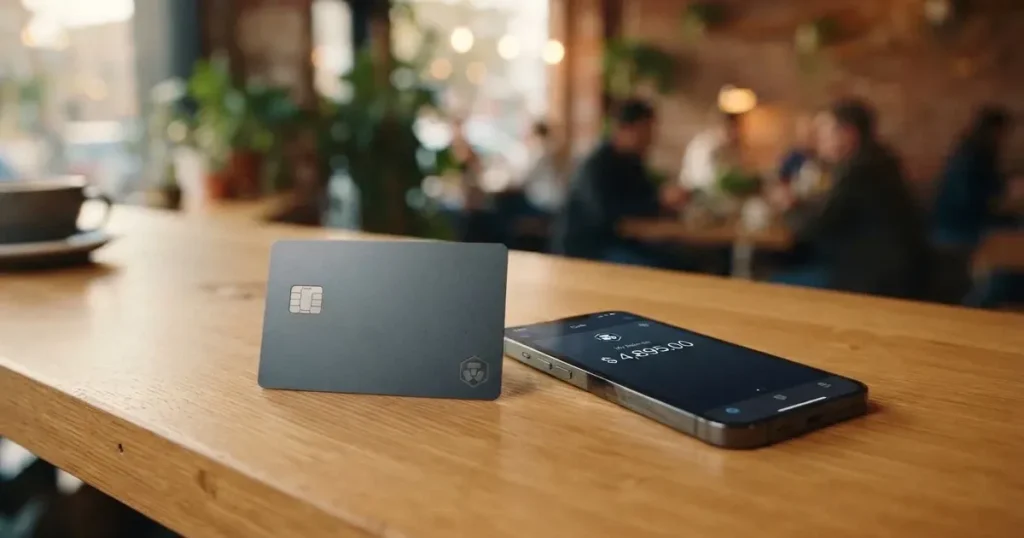
I have read this card’s terms, its app listings and its public pages closely, and I want to tell you something up front that most reviews of this product will not: the single most important fact about Stablecard is not a feature, it is a gap. The full fee schedule lives in the Terms and Conditions at westernunionstablecardlegal.com, and that page sits behind an anti-phishing block. I could not open it. So when I write “not stated” below, I mean exactly that — the card’s own public pages do not say it. I am not going to fill that silence with a guess from another country’s version of the product, because a fee is not the kind of number you want to be wrong about.
What the card actually is: a Visa card that draws on USDPT, a dollar-pegged stablecoin issued by Anchorage Digital Bank and running on the Solana blockchain, and it sits inside Western Union’s app. You get a virtual card immediately, you can order a physical one for a fee, and you spend through Visa or through Apple Pay and Google Pay. The people it is genuinely built for are the ones the search queries tell me about: anyone who has trouble getting an ordinary bank card, and existing Western Union customers who want to spend the money they were already sending as transfers.
The conditions described here are current as of October 28, 2026.
The verdict: 6.7 out of 10
My score is 6.7 out of 10. I will not pretend that is a clean number, because the card is two products at once: one I would rate highly and one I cannot rate properly.
| Criterion | Mark | Why |
|---|---|---|
| Who can get it | 6 / 10 | 37 markets at launch, country list unpublished, 60+ targeted by end of 2026, availability “subject to geographic, regulatory, and eligibility requirements” |
| Cost | 5 / 10 | “No hidden fees” at signup, physical card “for a fee”, “foreign transaction fees may apply”, with the actual amounts sitting in a page I could not open |
| Top-up options | 4 / 10 | USDPT on Solana only, from a wallet or exchange, or by redirecting Western Union transfers |
| Reliability and complaints | 9 / 10 | The Western Union Company (NYSE: WU), issuer Rain (Third National, a Visa Principal Member), USDPT issued by Anchorage Digital Bank, no incidents since launch, App Store 5.0 from 10 ratings |
| Everyday use | 10 / 10 | Virtual card immediately, physical on request, Visa, Apple Pay, Google Pay, ATM withdrawals |
| Total | 6.7 / 10 | A well-built way to spend, on terms you cannot fully read |
The 10 out of 10 for everyday use is not generosity. If your problem is “I cannot open a normal bank card,” this card gets you a virtual Visa number straight after onboarding and lets you push it into your phone’s wallet. That is a genuinely useful answer, and no amount of missing fee detail should hide it.
The 4 out of 10 for top-up is where the product is narrow, and narrowness is worse than badness. You can only put USDPT on Solana into this card. Not USDT on Tron. Not USDC on Base. Not a bank transfer. If the money you want to spend is sitting in some other token on some other chain, you are not using this card; you are waiting for a swap to finish first.
And the 5 out of 10 for cost is entirely down to that unreadable page. The claim “no hidden fees” appears at account setup. The physical card is sent “for a fee” — no amount. “Foreign transaction fees may apply” — no amount. No monthly or annual fee figure is published on the site. The reason I did not go hunting for these numbers on review blogs is worth telling you plainly: no third-party source publishes exact issuance, monthly or annual fees either. Everyone is reading the same missing page I am.
So: I would recommend this card to a Western Union customer who already holds USDPT on Solana and wants a Visa number, and I would not recommend it as a first card for anyone who has never thought about which chain their money is on.
Will they give you the card?
Yes in 37 markets at launch — and the card does not publish which 37.
That is the honest answer, and it is an awkward one to plan around. Stablecard launched in 37 markets, with a stated target of 60 or more by the end of 2026. The specific country list is not published. Availability is “subject to geographic, regulatory, and eligibility requirements,” which is regulator-standard wording that means several different things depending on which regulator is involved.
If you live somewhere with an ordinary banking system and a normal card, you already have a card, and this question does not matter. If you live somewhere the banking system is closed to you, this question is the whole decision — and you cannot answer it from the published information. My advice would be to download the app and see whether your country appears in the onboarding, rather than to plan around what you think the answer might be.
Two things worth being concrete about. First, no official source I checked mentions Russian or Belarusian citizens or residents. That is not a refusal, and I am not going to describe it as one — it is an absence, and absences in this product’s documentation are everywhere. Second, Western Union screens applications against sanctions lists in the US, the EU and the UK. That is normal for a regulated company and applies regardless of anything else on this page.
What I want to be careful about here is the edge of this page. There are ways people discuss for getting past eligibility checks on cards like this, and I am not going to print them. Nothing below should be read as a route around a country rule, and if a site offers you one, that is a reason to be suspicious of it rather than reassured by it.
How to get it
Three steps, one of which is the real gate.
You download the app, complete onboarding and identity verification, and your virtual card arrives immediately. That last part is conditional on approval, and the card does not state how long approval itself takes. So the honest version is: the card is instant *once you are through*.
The gate is identity verification. The card’s language is specific — it requires “personal information and documentation as required by applicable laws and regulations, including anti-money laundering, sanctions screening, and customer identity verification requirements.” Rain, or its authorised service providers, perform that verification.
Three details that will matter in practice:
- No credit check. Nothing about your credit history enters the decision.
- No minimum balance. There is no floor to reach before you can hold the card.
- One verification level. Every applicant goes through identity verification; there is no tiered system where a lighter check unlocks small limits. If you dislike giving documents to a crypto product, that is a single yes or no, not a negotiation.
The app is 18+ in the App Store rating.
One thing nobody can tell you: the card does not publish the reasons applications get rejected, so if yours fails you will be guessing. And if you want to be sure about country availability before spending an afternoon in onboarding, the answer is not on the site.
Fees: what a Stablecard payment actually costs
Here is the shortest honest version: this card’s fee information is incomplete, and I am not going to dress it up.

What is published:
| Item | What the card says |
|---|---|
| Account setup | “No hidden fees” |
| Credit check | None |
| Minimum balance | None |
| Physical card | Mailed “for a fee” — amount not stated |
| Monthly or annual fee | No amounts published on the site |
| Foreign transactions | “Foreign transaction fees may apply” |
| Card use and ATM withdrawals | “Fees may apply, including charges for card use and ATM withdrawals” |
| Crypto conversion fee or spread | Not stated on the public FAQ or product page |
| Spending limits | Set by programme-level risk controls and regulation; amounts not published; described in the T&Cs, which may change |
The full fee schedule is stated to live in the Terms and Conditions at westernunionstablecardlegal.com. In October 2026 that page was inaccessible behind a Cloudflare anti-phishing block. I tried, I could not read it, and I found no unofficial source that publishes the same figures either.
Now, three everyday payments, so you can feel where the missing numbers bite.
Coffee in your own country. You spend USDPT, the merchant is paid in their local currency through the Visa network, and “foreign transaction fees may apply.” Whether you pay a conversion spread here depends on the fee that I could not read. This is the payment where the unknown hurts least, because you are in your own currency and the amounts are small.
A subscription billed in dollars while you live in euros. This is where a conversion fee that nobody has published could turn into a recurring line item on a recurring charge. The card’s own words are “foreign transaction fees may apply,” and this is exactly the case they were written for.
Taking cash out at a Western Union agent. Supported — you can withdraw at “any supported ATMs with the Visa logo,” and also in cash at Western Union agent locations globally. But “fees may apply,” and no free allowance is stated, meaning nobody knows how much, if any, is included before the charge starts.
Two more things you will want to know and that the card does not put a number on: ATM withdrawal limits and monthly spending limits. The card’s position is that limits are “based on program-level risk controls and regulatory requirements,” are described in the applicable Terms and Conditions, and may change. In other words, the limits exist, they are set by the programme, and you learn them from a page behind a block.
And on currency: the card is denominated in USDPT, pegged 1:1 to the dollar. No multi-currency balances are mentioned. If you hold euros, pounds or anything else, converting is your problem to solve before you get to the payment.
Top up: one token, one chain, two routes
This is the narrowest part of the product, so I want to be precise. There is no minimum balance, the site claims “no hidden fees,” and no deposit fee is stated. But there are only two ways in.
Route one: a USDPT transfer. You send USDPT to the card from another digital asset wallet or a compatible exchange wallet. USDPT is issued by Anchorage Digital Bank on the Solana blockchain, so this means Solana. If you are holding USDT on Tron or USDC on Ethereum, this is not your route.
Route two: redirect a Western Union transfer. You send someone money through Western Union with the intention that it arrives as cash pickup, then you redirect it — instead of collecting cash, the fiat converts into USDPT and lands on your card. This is genuinely clever, because it turns an existing remittance habit into card funding without a bank. It is also the route that ties this product to Western Union’s own network rather than to crypto rails.
Fiat top-up happens only through route two. There is no bank card top-up and no bank transfer top-up mentioned anywhere. So if you want to add money from an ordinary bank account, the card’s public pages do not describe a way to do it.
Getting money back off the card runs in two directions as well, and the second is the one people ask about most. You can move USDPT out to a compatible wallet or exchange — the crypto off-ramp. Or you initiate a cashout to yourself through Western Union’s global network and pick up cash at a Western Union retail location, with fees that “may apply.” That is the fiat off-ramp, and it is the single feature that makes this card different from most crypto cards.
One quiet detail at the end of the road: if you close the account, “remaining USDPT balance must be transferred or spent according to the Terms and Conditions.” Read that before you close anything.
I should also say what is not stated, because in crypto it matters: Solana network fees, the gas cost of the transfer into the card, are not stated by the card. They are charged by the blockchain, not by the provider, so they are not hidden fees — they are simply a separate line item you need to expect.
Paying with it every day
This is where the card is strongest, and the strength is real.
Your virtual card is issued immediately on approval. The physical card is optional, requested after approval, for a fee, and “mailed to the address on file for a fee” with delivery time that “varies by shipping method and destination.” Countries for physical card shipping are not stated, and neither is the replacement cost if you lose it — so if you are outside the launch markets, the physical card is the part of this product you should not plan around.
The virtual card goes into Apple Pay and Google Pay, which is what makes it usable for anything requiring a stored card number, including a lot of subscriptions. It works at ATMs with the Visa logo. It is a Visa card, which means it travels: the network and its rules are the same everywhere.
Two absences to know about. Blocked merchant categories are not stated — so you cannot tell from the public pages whether gambling or similar categories are blocked, and if gambling is something you would rely on, that is a question for Customer Care rather than for me. And there is no cashback or rewards programme for Stablecard in any official source. Western Union has a separate Rewards programme for money transfers, and I have seen the two run together; they are not the same thing.
The app itself: iOS requires 17.6 or later and is iPhone-only, and there is an Android version. The App Store listing showed 5.0 out of 5 from 10 ratings when I read it on 2026-10-21. The Google Play listing showed no star rating on the listing page and 1K+ downloads on the same date. Ten ratings is not a review history. It is a sample too small to mean anything, in either direction.
If something goes wrong with a payment, Customer Care is reachable through in-app chat with your transaction details, at [email protected], in English and Spanish, hours not stated. Disputes are “handled according to the Visa dispute rules and program policies,” and no time frames are published — which matters, because the window in which you can dispute is exactly the sort of thing that gets left out of a public FAQ and hurts you later.
What can go wrong
The first thing to say is a fact, not a worry: no official incidents — no shutdowns, no hacks, no sudden programme changes — have been reported since launch on 2026-08-04. That is two and a half months of clean running. It is also a short window, and this card is 6.7 out of 10 precisely because two and a half months is not long enough to know.
Who you are actually dealing with is unusually reassuring on paper. The Western Union Company trades under NYSE: WU and is headquartered at 7001 E. Belleview, Denver, CO 80237, USA. The card issuer and programme manager is Rain, which is Nimbus LLC dba Third National, a Visa Principal Member licensed in Puerto Rico, United States. USDPT comes from Anchorage Digital Bank, N.A., a US national trust bank. Money transfer services sit with Western Union Financial Services, Inc. (NMLS #906983) and/or Western Union International Services, LLC (NMLS #906985), licensed as Money Transmitters by the New York State Department of Financial Services. That is a real stack of licensed institutions behind a product with almost no public track record.
The structural risk is one that belongs to the category, not to this card. Your USDPT sits in a non-custodial digital asset wallet. That means your crypto is yours until the moment of payment, and it also means you are solely responsible for a lost seed phrase, for phishing, and for clipboard-hijacking malware that swaps an address you copied. Blockchain transfers are irreversible; nobody can freeze or return funds for you. You can lock and unlock the card in the app, and data is encrypted in transit per the Google Play listing, but two-factor authentication and spending controls are not stated — so do not assume the card app has the same protections you would expect from a banking app.
One more structural point worth sitting with. Visa and Mastercard do not issue crypto cards to consumers; they license issuers, and they can suspend programmes. In November 2022 Visa terminated its global agreements with FTX and the FTX US debit card programme was wound down. In 2018 Visa suspended WaveCrest in Europe, closing all WaveCrest-issued Visa programmes. Closures follow a pattern: a notice period, then spending and loading stop, then users are asked to withdraw their remaining balances. I should flag that I saw one reported 2026 closure with dates of 8 July for new loads and 8 August for spending, but it came from a single secondary source and I could not confirm it, so I am giving it to you as unverified.
What about complaints? There is no dedicated Trustpilot page for Stablecard. Western Union’s general Trustpilot shows 4.5 out of 5 from roughly 173,168 reviews, but that is the money transfer business, not this card, and I would not want you to borrow its score. No recurring complaint themes have emerged — the product is simply too young, and a silence of two and a half months is not a reputation.
The honest risk summary: the counterparties are solid, the product is young, the fee disclosure is incomplete, and the funding route is narrow.
What to take instead
I want to be fair to the alternatives here, because a 6.7 is not a verdict of failure — it is a verdict of “pick this for a specific reason.” Three other cards are worth putting next to it.
| Card | Score | Countries | Card and network | Stated fees |
|---|---|---|---|---|
| Stablecard by Western Union | 6.7 / 10 | 37 markets, list unpublished | Visa, virtual instantly, physical optional | Setup “no hidden fees”; physical card, FX and ATM “may apply”; amounts not published |
| MetaMask | 7.1 / 10 | 45 listed countries and territories, others waitlisted | Mastercard, virtual instantly, Metal $199/year | Virtual free; “minimal fee for each transaction”; no FX fee, Mastercard rate used |
| KAST | 6.1 / 10 | Residence list shown at KYC, not published | Visa Platinum/Infinite, virtual and physical | Membership 0 / 1,000 / 10,000 USD per year; FX 0.5%–1.75%; several small fees stated |
| TokenPocket | 5.8 / 10 | Visa for parts of Europe, Mastercard for a longer Asia-Pacific list | Mastercard/Visa debit, virtual, on Arbitrum | 1% on crypto deposits; otherwise no additional fees |
MetaMask scores highest of the four and is the most transparent about what it charges. Sign-up is open in 45 listed countries and territories, with other regions on a waitlist, proof of residency required, and the helpful clarification that “ineligible regions limit sign-ups, not spending.” US and UK sign-ups are temporarily closed per its FAQ. You get a virtual Mastercard instantly through Monovate, with a metal card you can pre-order for $199 a year, one card per user, spending directly from your connected wallet across Linea, Base, Monad and Solana, and cashback of 1% on Virtual and 3% headline on Metal paid in mUSD. The catch: Solana-only wallets cannot withdraw credit, and the fee table is linked rather than published on the pages I read.
KAST is the one with the clearest money. It publishes its prices. Standard membership is free, Premium is 1,000 USD a year and Private is 10,000 USD a year, billed annually upfront with no monthly option. Standard physical cards are 0 USD plus 40 USD delivery. Stablecoin top-up is 0%, USD spend is 0%, Apple and Google Pay are 0%, while non-USD FX runs 0.5%–1.75% depending on where you live and where you are spending, non-USD transactions under 25 USD cost 0.10 USD, and a declined transaction for insufficient balance costs 0.50 USD. Cashback is 1.5% / 2% / 3% per tier up to monthly caps. Its eligibility rules are the strictest I have seen: it checks both residence and ID document, states that holding an ID from a restricted region can make you ineligible even while living in a supported country, and says outright that a VPN does not bypass it.
TokenPocket is the simplest and the least transparent about money. It charges 1% on crypto deposits, refundable later through rewards or reduced transaction fees, and apart from the NFT creation fee — partly covered by TokenPocket — says it charges nothing else. It splits its coverage between Visa for European countries and Mastercard for Australia, Canada, Hong Kong, Japan, Taiwan, New Zealand, Singapore, South Korea, the UK and others. Cards are virtual, run on Arbitrum, and hold EUR24 and USD24.
The pattern across all four is the same one that should worry you in this category: scores cluster between 5.8 and 7.1, and the differences between cards are mostly about which country you are in and how much you want to know about fees in advance.
Who I would recommend it to
Three people, concretely.
If you already send money through Western Union and receive it as cash. This card’s redirect feature converts that transfer into spendable USDPT instead, and the cash off-ramp through Western Union agents worldwide is the feature I have not found anywhere else in this category. If that is your situation, the narrowness stops being a weakness — it is the whole point.
If you cannot get an ordinary bank card, and you hold USDPT on Solana. No credit check, no minimum balance, one verification level, a virtual Visa number immediately after approval, and Apple Pay or Google Pay on the same afternoon. The 10 out of 10 on everyday use is measured against exactly this need.
If you are deliberately willing to do the reading yourself. Someone who will read the Terms and Conditions in a browser before applying, who knows that USDPT is not USDT, and who treats a missing fee number as a reason to ask Customer Care rather than a reason to hope. This card rewards that attitude.
And who not to? If your money sits in a token on a different chain, if you need a physical card in a country outside the 37 launch markets, or if you are the kind of person who would rather see the whole price list before signing up — this is not the card for you, and the alternatives section above will serve you better. KAST if you want published prices, MetaMask if your country is on its 45-country list and your wallet is not Solana-only, TokenPocket if you want the simplest possible setup on Arbitrum.
Frequently asked questions
What is Stablecard by Western Union card?
It is a Visa card that spends a stablecoin balance rather than a bank account balance. The balance is USDPT, a dollar-pegged token issued by Anchorage Digital Bank on the Solana blockchain. You get a virtual card immediately after approval, can order a physical one for a fee, and can add it to Apple Pay or Google Pay. It sits inside Western Union’s app, which is why redirecting an incoming Western Union transfer can top it up.
How does Stablecard by Western Union card work?
You download the app, pass identity verification, and receive a virtual Visa card. You load it by transferring USDPT from another wallet or exchange on Solana, or by redirecting a Western Union transfer originally sent for cash pickup. When you pay, the merchant is paid through the Visa network in their local currency, and foreign transaction fees may apply. To get money back, you either transfer USDPT out to a compatible wallet or initiate a cashout and collect cash at a Western Union location.
Is Stablecard by Western Union a bank?
No. The Western Union Company is not the issuer of this card. Rain — Nimbus LLC dba Third National, a Visa Principal Member licensed in Puerto Rico — issues it and manages the programme, and the card runs on Visa. USDPT comes from Anchorage Digital Bank, N.A., a US national trust bank, and the money transfer side sits with Western Union Financial Services, Inc. and Western Union International Services, LLC, both NMLS-licensed money transmitters.
Who owns Stablecard by Western Union?
It is a Western Union product, and The Western Union Company trades on the New York Stock Exchange under WU, headquartered at 7001 E. Belleview, Denver, CO 80237, USA. Rain holds the card licence rather than Western Union itself, and Anchorage Digital Bank issues the token. Western Union also has a separate Rewards programme, but it applies to money transfers, not to Stablecard spending.
Which countries can get it, and can I use it in mine?
The card launched in 37 markets and the specific country list is not published. The stated target is 60 or more by the end of 2026. Availability is “subject to geographic, regulatory, and eligibility requirements,” and Western Union screens against US, EU and UK sanctions lists. No official source I checked mentions Russian or Belarusian citizens or residents. If you can already get a normal card, this matters little; if you cannot, download the app and see.
Does it require KYC, and how long does approval take?
Identity verification is required for every applicant, with no tiered levels — it covers personal information and documentation under anti-money-laundering, sanctions screening and identity verification requirements, performed by Rain or its authorised providers. There is no credit check and no minimum balance, and the app is rated 18+. The virtual card is available immediately once approved, but the approval processing time and the reasons for rejection are not stated.
How do I top up, and can I do it with ordinary money?
You top up with USDPT on Solana, either from another digital asset wallet or a compatible exchange wallet, or by redirecting a Western Union money transfer that was originally sent for cash pickup. There is no minimum balance and no deposit fee stated, though Solana network fees are charged by the blockchain. Ordinary fiat top-up is only described through the redirect route — no bank card or bank transfer top-up is mentioned.
What does it cost, and is it really free?
Partly. The site claims “no hidden fees” for account setup, there is no monthly or annual fee published, and no credit check or minimum balance. But the physical card is sent “for a fee,” “foreign transaction fees may apply,” and “fees may apply, including charges for card use and ATM withdrawals.” The full schedule sits in the Terms and Conditions at westernunionstablecardlegal.com, which was inaccessible behind an anti-phishing block when I checked in October 2026. I could not find those amounts anywhere else.
Is it safe to use, and who do I complain to?
No official incidents — no shutdowns, hack or programme change — have been reported since launch on 2026-08-04, and the backing institutions are licensed: Rain as a Visa Principal Member and Anchorage Digital Bank as a US national trust bank. Your USDPT sits in a non-custodial wallet, so you hold the key risk yourself. Customer Care is in-app chat, also [email protected], in English and Spanish; hours are not stated, and disputes follow Visa dispute rules with no published time frames.
How do I withdraw money or close the account?
To leave, either transfer USDPT to a compatible digital asset wallet or exchange, or initiate a cashout to yourself through Western Union’s global network and collect cash at a Western Union retail location, where fees may apply. If you close the account, the card states that any remaining USDPT balance must be transferred or spent according to the Terms and Conditions — so empty the balance deliberately rather than assuming it is returned to you.
Wallet card verdicts – cryptocardverdict
Content created by the «cryptocardverdict» team