
Coinbase card: a crypto-funded Visa for US residents, with limits worth knowing before you sign up
 Available in US
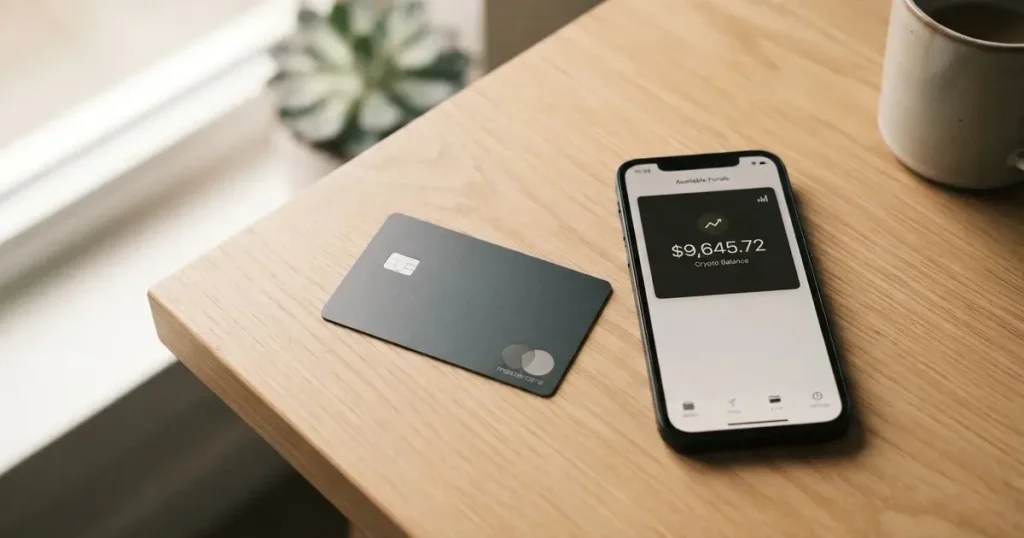
The Coinbase card is a Visa prepaid debit card that spends from a Coinbase crypto balance or a linked bank account. It is available only to residents of the United States, in every state except Hawaii, and is issued by Pathward, N.A., a bank that is a member of the FDIC, on the Marqeta platform. The card has no monthly fee, no annual fee, and no issuer fee for international transactions; the cost of spending crypto sits in the spread Coinbase applies when it converts your coins into US dollars at the moment of payment. That combination: easy onboarding for US residents, no fixed fees, but a single-asset focus on USD-funded spending makes the card straightforward for its target audience and narrow for anyone else.
The conditions described below are current as of October 28, 2026.
Verdict
The card scores 6.4 out of 10. It is a competent option for US residents who already keep funds on Coinbase and want to spend crypto or a USD balance from the same app, and its everyday usability is the strongest part of the package. The score is held back by a narrow geographic reach (one country, one state excluded) and by top-up options that are limited to a linked bank or paycheck deposit, with no published list of supported networks or coins for direct crypto deposits.
| Criterion | Mark | Why |
|---|---|---|
| Who can get it | 4 / 10 | Available in all US states except Hawaii; no other countries |
| Cost | 8 / 10 | No spending or annual fees, no international fee from the issuer, no ATM fee from Coinbase; conversion spread applies |
| Top-up options | 4 / 10 | Bank link or partial paycheck deposit, both free; crypto balance converts to USD at payment; specific coins and networks not named |
| Reliability and complaints | 7 / 10 | Issued by Pathward, N.A., on Marqeta; Coinbase rated 4.0/5 on Trustpilot, recurring complaints about account freezes and slow support |
| Everyday use | 9 / 10 | Virtual or physical Visa prepaid; ATM withdrawals; unofficial support for Apple Pay and Google Pay |
The card suits US residents who want to spend crypto they already hold on Coinbase and earn a rotating crypto reward on every purchase, and it suits anyone who has had trouble getting an ordinary bank card and can pass the US identity check. It is not a fit for residents of other countries, for people who want to spend stablecoins on multiple blockchains, or for anyone who needs a multi-currency wallet on a card.
Who can get the Coinbase card
The card is open only to residents of the United States. Every state is included except Hawaii, and there is no separate route for non-residents or citizens of other countries. Account opening follows the identity-check rules that come from the USA PATRIOT Act: Coinbase collects your name, address, date of birth, and identifying documents, and may ask to see a driver’s licence or other ID. There is no credit check and no requirement to stake any token.
Because the card is US-only, the eligibility question is short: if you live in an eligible US state and you can pass standard US identity verification, you are in the audience. If you live anywhere else, the card is not available to you through the official programme.
How to sign up
The signup flow is built into the Coinbase app. You create or sign in to a Coinbase account, complete the identity check described above, and from the Card section of the app you can create a virtual card immediately or order a physical card. The cardholder agreement and user agreement together set out the full terms, and the app shows the rotating crypto reward you can pick from before you start spending.
The older cardholder agreement records that the user must be at least 18 and a US citizen or permanent resident, and that spending may be limited until identity is fully verified. The agreement also says there is no fee for a replacement card sent because the previous one expired; it does not give a delivery time for the physical card. The current Coinbase help pages do not list a delivery window, so if timing matters to you, plan around the virtual card for immediate use.
Fees: what the card really costs
The card has no annual fee, no monthly fee, and no spending fee from the issuer. Coinbase does not charge a transaction fee on card purchases, and it does not add an FX fee on top of international transactions: the network converts foreign-currency purchases, and the older fee schedule states a 0% international fee from the issuer. Coinbase charges $0 for ATM withdrawals; the ATM operator may still charge its own fee, and any operator fee counts toward your daily ATM limit. Balance inquiry at the ATM is also $0 on the older schedule.
The cost that does exist sits in the spread: when you pay with crypto, Coinbase converts the coin into US dollars at the moment of payment, and the price you receive includes Coinbase’s buy, sell, or trade spread. The card page describes this as the only cost of spending crypto on the card, and it points to the Cardholder Agreement and User Agreement for the full disclosure. Spending from a US-dollar balance funded by a bank link or paycheck has no spread because there is no conversion.
Limits vary by customer and can be reduced by risk checks; the current limits live in the app under Card > Support > “View spending and ATM limits”. The older combined terms from 2021 set a ceiling of no more than $1,000 in any 24-hour period across ATM and over-the-counter cash withdrawals, and no more than six cash withdrawals a day.
| Fee or limit | Amount |
|---|---|
| Card issuance | Not stated |
| Monthly fee | $0 |
| Annual fee | $0 |
| Conversion at payment | Spread applies (Coinbase buy/sell/trade spread) |
| Foreign-transaction fee (issuer) | 0% |
| ATM withdrawal (Coinbase) | $0 (operator may charge) |
| ATM balance inquiry | $0 |
| Spending and ATM limits | Vary by customer; older terms: $1,000 / 24 h, 6 withdrawals / day |
To put those numbers into everyday life, three short scenarios:
- A $40 grocery shop paid from your Coinbase US-dollar balance costs $40. There is no card fee, no conversion, no FX markup; the network handles the authorisation and the merchant receives dollars.
- A €30 dinner in Paris paid from a Bitcoin balance costs whatever Coinbase’s spread makes of the BTC-to-USD-to-EUR path. There is no issuer fee, but the spread is the price of the conversion, and it changes with market conditions.
- A $200 cash withdrawal from a foreign ATM costs $0 to Coinbase, plus whatever the ATM operator charges; any operator fee reduces the amount available to you within your daily limit.
Top up: how to fund the card
There are two funding paths and both are free. You link a bank account and transfer dollars in, or you set up a direct deposit so part of your paycheck lands in your Coinbase USD wallet, which the older fee schedule lists at $0 to fund and $0 per month. From there, the card spends that US-dollar balance directly, or you can keep crypto on Coinbase and let the card convert and spend it at payment.
The card page does not name the specific coins or networks the card supports for direct crypto top-up, and the help pages do not publish a minimum top-up amount. Older card documents do not list network fees for crypto deposits; on-chain network fees are charged by the blockchain, not by Coinbase or the card programme. If you intend to deposit crypto from a wallet you control, the safest habit is to send a small test first and to confirm the address and network in the app before sending a larger amount.
What is not stated is worth flagging: the public card pages do not tell you which coins you can hold and spend, the minimum top-up, or the supported deposit networks. If any of those matter to you, the only reliable source is the live Card section of the Coinbase app, where the list of supported assets is shown next to the balance you intend to spend.
Paying with the card every day
The card is a Visa prepaid debit, available as a virtual card in the app or as a physical card by mail. It draws on a stored balance rather than a linked bank account in the debit sense: the card converts any crypto you choose to spend into US dollars at the moment of payment, and pays the merchant in dollars. The card works at any merchant that accepts Visa, and the older agreement says you can also withdraw cash at ATMs.
Unofficial third-party coverage (TechRadar and CryptoSlate) reports that the card works with Apple Pay and Google Pay, but the official Coinbase help pages do not confirm mobile-wallet support. Treat that as unverified until you see the option in your own app. Blocked merchants and category restrictions are not published.
The mobile app is the main control surface. It is available on iPhone (iOS 16.4 and later), Mac, and Apple Vision, and supports 18 interface languages, including Russian and Turkish. The App Store rating was 4.7 from 1.8 million ratings at the time of writing. Google Play data was not available for review. Optional crypto rewards are a US-card feature: you pick a rotating reward from a list in the app, and you earn that asset on every purchase at a variable rate that the app displays. The reward rate and the assets on offer change over time.
The cardholder agreement sets out a process for disputes: you report unauthorised transactions, the issuer decides within 10 business days and may extend that to 45 days, with a provisional credit within 10 business days while the investigation runs. Losses reported more than 60 days after the statement date may not be recoverable. Merchant refunds are handled by the merchant and may post with delay. Chargeback rights under Visa’s rules are not stated in the current documents.
What can go wrong
Two kinds of risk sit on top of the card: the platform risk that comes with any custodial crypto product, and the operational risk that comes with the company behind it.
The card is custodial, which means your funds sit with Coinbase and with the issuing bank rather than in a wallet you control. The older agreement says funds transferred from the Coinbase USD wallet are eligible for FDIC insurance up to $250,000 if the deposit-insurance requirements are met; that protection covers the bank-balance leg, not the value of any crypto you hold. Visa’s Zero Liability policy applies to unauthorised card transactions, and the standard advice is to report a lost or stolen card at once; in-app card freeze and granular spending controls are not stated in the current documents.
The card is issued by Pathward, N.A., Member FDIC, under a licence from Visa U.S.A. Inc., and runs on the Marqeta platform. The issuer was MetaBank, N.A. in the older agreement, with Marqeta as programme manager; Coinbase’s current card page names Pathward, N.A. as issuer. That is a change worth noting if you have a specific reason to know who signs your card, and it is the kind of change that can show up again.
Independent reputation data is mixed. Coinbase is rated 4.0 out of 5 on Trustpilot from 23,282 reviews, with 45% five-star and 43% one-star reviews. The recurring themes in the negative reviews are slow or absent support in fraud cases, account lockouts and heavy verification, multi-day holds on larger deposits, and fees on conversions and debit-card transfers. A US PIRG study ranked Coinbase third among digital wallets by complaints to the CFPB, with difficulty retrieving money as the leading issue, and a press report described Coinbase confirming it had mistakenly overcharged some users’ bank accounts. Third-party reviews disagree on FX fees and on geographic reach; treat those claims as unverified.
Support channels listed in the older agreement: phone 1-888-908-7930, email [email protected], mail at 100 Pine Street, Suite 2500, San Francisco, CA 94111, plus the in-app Card > Support section and the help centre.
What to take instead
Three alternatives are useful comparison points. None of them is a straight substitute; each one fits a different reader.
Young Card is a crypto-linked card with a 5.7 out of 10 score in the same review series. Cashback is paid in YNG tokens, with rates set by Club tier: Essential 0.1%, Gold 1.8%, Platinum 3.6%. Bronze and Silver are not stated. The public card page does not state country eligibility, card type, fees, or funding mechanics, so the only thing the official material confirms is the token and the reward ladder.
OKX scored 6.2 out of 10. The card is a euro-denominated Mastercard debit launched in the EU and Norway on 28 January 2026, with Iceland and Liechtenstein excluded; the explainer conclusion is inconsistent and says “entire EEA”, so confirm your country in the app. It runs through OKX Pay, is issued via an unnamed European licensed payment provider, and there is no card fee and no OKX FX fee; the conversion spread is 0.1% per the May 2026 explainer, against a 0.4% market spread in the launch press release. You fund the card with USDC or USDG in OKX Pay, and the card converts to euro at purchase. Cashback applies only to USDG purchases (USDC earns none), with monthly caps in euro by tier, from 2% capped at €10 at Regular up to 10% capped at €1,000 at the top tier; the explainer text says 2-5% while the table says 10% at the top, so the headline rate is inconsistent.
BingX scored 5.8 out of 10. Availability is Europe (EEA), APAC, LATAM, and other selected regions, with no full country list; support will confirm your region. The card comes as a virtual card (issued instantly, no activation) or a metal card (mailed in 15 to 30 business days), is a Visa debit, and settles in USD. Fees are not stated publicly; the card spends USDT from a BingX Fund Account converted at the real-time rate. There is no cashback.
The shortest way to compare is by what you need. If you are a US resident who already has a Coinbase balance, the original card is the lowest-friction choice. If you are in the EEA and want a euro card with USDC or USDG funding, OKX is the most clearly documented of the three. If you are in a region where BingX confirms eligibility and you already hold USDT, BingX is the one to look at; fees and rewards are not published, so the only way to confirm is in-app.
Who I would recommend the card to
I would recommend the Coinbase card to a US resident who keeps a balance on Coinbase and wants to spend it without first wiring dollars to a bank, and who is comfortable with a card that always settles in US dollars. The strongest fit is someone who values a single app for holding, converting, and spending, and who is happy to let the card convert crypto to dollars at the moment of payment rather than pre-loading a stablecoin balance on a specific network.
I would not recommend it to a resident of any US state where the card is unavailable, to a non-US resident, to anyone who needs a multi-currency wallet on the card, or to anyone whose main concern is having a published list of supported coins and networks before they sign up. The card is also not the right fit for a reader who wants the protection of self-custody, because the funds sit with Coinbase and the issuing bank rather than in a wallet the user controls.
For the readers in the middle: people who want crypto on a card but are flexible about which coin, which network, and which country, the alternatives in the next section are a more honest starting point than the Coinbase card, because their eligibility and their funding rules are the main differentiators and they vary widely.
Frequently asked questions
What is the Coinbase card?
The Coinbase card is a Visa prepaid debit card that spends from a Coinbase balance. You can fund it from a linked US bank account or a paycheck deposit, and you can also spend any crypto you hold on Coinbase, which is converted into US dollars at the moment of payment. It is issued by Pathward, N.A., a Member FDIC bank, on the Marqeta platform, and it is available to US residents in every state except Hawaii.
How does the Coinbase card work?
When you pay at a merchant, the card converts the crypto you selected into US dollars and sends dollars to the merchant through the Visa network. If you pay from a US-dollar balance funded by your bank or paycheck, there is no conversion. The card runs on a stored balance, so it cannot overdraw, and the older cardholder agreement caps cash withdrawals at $1,000 in any 24-hour period, with no more than six withdrawals a day.
Is Coinbase a bank?
Coinbase is not a bank. The Coinbase card is issued by Pathward, N.A., which is a Member FDIC bank, and the card runs on the Marqeta platform. Funds transferred from the Coinbase USD wallet are eligible for FDIC insurance up to $250,000 if the deposit-insurance requirements are met; crypto balances are not deposit-insured.
Who owns Coinbase?
Coinbase Global, Inc. is a publicly listed company in the United States. The card programme is run by Coinbase and issued by Pathward, N.A. under a licence from Visa U.S.A. Inc., with Marqeta as the platform that processes the transactions. The card’s user-facing terms sit in the Coinbase Cardholder Agreement and the Coinbase User Agreement.
Is the Coinbase card available in my country?
The card is available only in the United States, in every state except Hawaii. There is no published programme for residents of any other country. If you live outside the US, the card is not available to you through the official route, and you would need to look at a regional alternative.
How do I get the Coinbase card?
You sign up or sign in to Coinbase, complete the US identity check (name, address, date of birth, and ID if asked), and from the Card section of the app you create a virtual card or order a physical card. The older agreement records that you must be at least 18 and a US citizen or permanent resident, and that spending may be limited until your identity is fully verified.
Does the Coinbase card require KYC?
Yes. The card is opened inside a Coinbase account, and account opening follows the customer identification rules that come from the USA PATRIOT Act. Coinbase collects your name, address, date of birth, and identifying documents, and may ask to see a driver’s licence or other ID. There is no credit check and no requirement to stake any token to open the card.
How do I top up the Coinbase card?
You link a US bank account and transfer dollars in, or you set up a direct deposit so part of your paycheck lands in your Coinbase USD wallet. Both paths are free under the older fee schedule. If you hold crypto on Coinbase, the card can spend that balance by converting it to US dollars at the moment of payment. The card page does not list a minimum top-up or the supported networks for direct crypto deposits.
Is the Coinbase card free?
The card has no annual fee, no monthly fee, no spending fee from the issuer, and no international-transaction fee from the issuer. Coinbase charges $0 for ATM withdrawals, and ATM balance inquiries are $0 on the older schedule. The cost of spending crypto is the spread Coinbase applies when it converts your coins into US dollars at payment; spending from a US-dollar balance has no spread.
Is the Coinbase card safe?
The card is custodial, so your funds sit with Coinbase and the issuing bank rather than in a wallet you control. The bank-balance leg is eligible for FDIC insurance up to $250,000 if the requirements are met; crypto balances are not. Visa’s Zero Liability policy applies to unauthorised transactions, and the cardholder agreement sets out a dispute process with provisional credit within 10 business days while the investigation runs. Independent reputation data is mixed, with recurring complaints about account freezes, slow support, and conversion fees on Trustpilot and in US PIRG data.
Exchange card verdicts – cryptocardverdict
Content created by the «cryptocardverdict» team