
A virtual Visa you fund with USDC — cheap, narrow, and vague in places
 Available in US

The Utorg card is a virtual Visa card that you fund with USDC and spend like an ordinary payment card. There is no physical card and no bank account behind it. That combination is the whole product in one sentence, and it is also where most of the trade-offs sit. If you have stablecoins on the Ethereum, Polygon, Arbitrum, Solana or BSC networks and you want to pay for things without selling first, the card does one narrow job. If you want a card that behaves like a normal debit card — ATM withdrawals, a physical card in the post, cashback, a spread you can actually see — the published material does not cover that.
My score for the Utorg card is 6.3 out of 10. That is not a verdict on the company; it is a verdict on how much the public material lets me judge. On cost the card scores well, because several fees are advertised at zero. On everyday use it scores poorly, because a virtual-only card with no ATM is a real limitation for real life. And on reliability it sits in the middle, because the card’s own pages and its terms do not agree on who issues it.
The conditions described here are current as of October 28, 2026.
| Criterion | Mark | Why |
|---|---|---|
| Who can get it | 5 / 10 | The card page lists EEA countries plus Ukraine, Norway, Iceland and Liechtenstein, while the FAQ claims “190+ countries” — the discrepancy is never explained |
| Cost | 8 / 10 | Zero issuance fee, zero monthly fee, zero FX markup and no payment fees, all marked “for a limited time”; the crypto conversion fee is not disclosed |
| Top-up options | 7 / 10 | USDC on Ethereum, Polygon, Arbitrum, Solana and BSC; no other coin appears on the page |
| Reliability and complaints | 6 / 10 | The card is provided by Chain Valley Sp. z o.o. with Wirex Pay, while an earlier source named Utrg UAB; Trustpilot shows 4.2 out of 5 across 952 reviews |
| Everyday use | 5 / 10 | Only a virtual Visa, issued right after KYC; Apple Pay and Google Pay are supported, but there is no physical card and no ATM |
| Total | 6.3 / 10 |
Who this suits, in short: EEA and Ukraine residents who already hold USDC and want to spend it directly, and who are comfortable with a virtual card and with reading terms that leave several blanks. Who it does not suit: anyone who needs a physical card, needs to withdraw cash, wants cashback, holds coins other than USDC, or lives outside the listed area.
Will they give you the card
Yes for residents of the EEA and for residents of Ukraine, Norway, Iceland and Liechtenstein — and here is the first thing that should make you pause. The card page names those countries, with Italy, Germany, Spain, France and the Netherlands given as examples of the EEA members. The FAQ, on the same site, claims support in “190+ countries”. Neither statement is explained, and I am not going to guess which one reflects what the compliance system will actually do on a given morning. If you live outside Europe, plan on the narrower list being the real one.
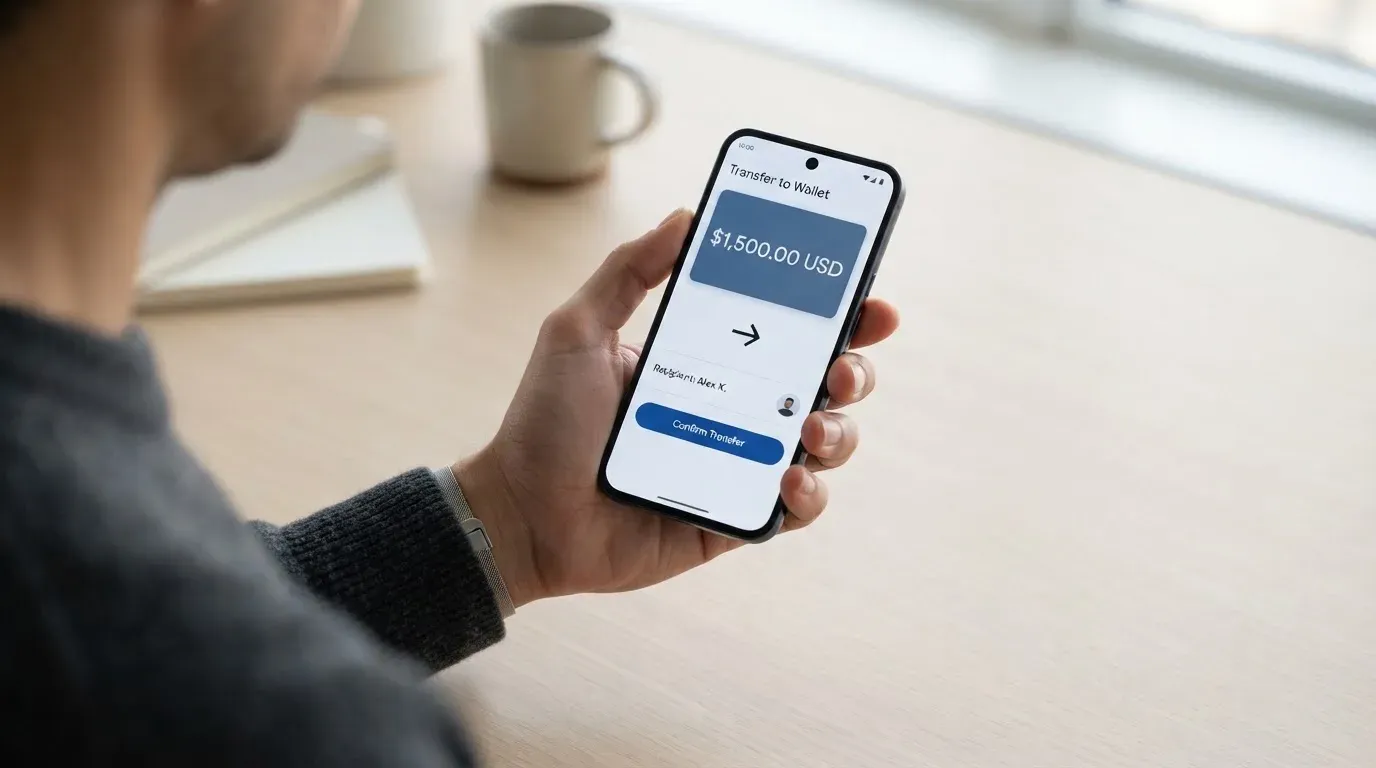
Excluded countries are not named anywhere on the card’s public pages. That is unusual, and it is the kind of silence that costs people time. What is also not stated is whether the test is residence or citizenship — and those are two different gates, so if you hold a passport from one country and live in another, you should assume nothing and ask support directly.
A third-party card directory, which is not the card operator and which the card does not confirm, gives a more granular picture as of August 2026: 31 countries listed as available — Austria, Belgium, Bulgaria, Croatia, Cyprus, Czech Republic, Denmark, Estonia, Finland, France, Germany, Greece, Hungary, Iceland, Ireland, Italy, Latvia, Liechtenstein, Lithuania, Luxembourg, Malta, Netherlands, Norway, Poland, Portugal, Romania, Slovakia, Slovenia, Spain, Sweden and Ukraine — and a restricted list including Afghanistan, China, Japan, Nigeria, Russia, Singapore, the United Kingdom and the United States. Treat all of that as unofficial. It contradicts the “190+ countries” line as much as the card page contradicts it, and neither version is confirmed by Utorg.
How to get it
The application is deliberately short. You upload an identification document, the system runs a liveness check, and the FAQ promises an AI-powered KYC in under five minutes. After that you get a virtual Visa card immediately.
What is not stated anywhere: whether proof of address is required, and what the minimum age is. Those are the two questions most people have, and the card’s public pages leave both open. There are also no KYC tiers described, so I cannot tell you whether a successful check raises or lowers your limits.
The help centre does contain articles titled “What is Source of Funds and Wealth?” and “Source of Funds questionnaire – accepted document types”. I am naming those titles, not their contents. Their existence tells you that the topic exists in the support material, which is something, but it does not tell you when you will be asked for them. One older Trustpilot review from March 2023 shows what a rejection can look like in practice: the company’s own reply cited a passport missing a signature and a bank statement sent as a screenshot instead of a PDF. Both are fixable, and both cost a retry.
So the realistic expectation is: fast if your documents are clean, slower if they are not, and you should keep a PDF of a real bank statement ready rather than a phone screenshot.
Fees: what it really costs
The headline is good and the details are thin. Issuance is free, the monthly fee is zero, there is no FX markup and there are no payment fees — and every one of those zeros is marked “for a limited time”. A limited-time zero fee is a promotional price with a date attached that the card does not display. That is not a reason to walk away; it is a reason to know that your cost can change without you deciding it.

| Fee or limit | What the card publishes |
|---|---|
| Issuance | Zero, marked “for a limited time” |
| Monthly fee | Zero, marked “for a limited time” |
| FX markup | Zero claimed, marked “for a limited time” |
| Payment fees | None claimed, marked “for a limited time” |
| Crypto conversion | Not stated |
| ATM | Not stated |
| Monthly spending limit | Up to EUR 30,000 (card page) |
| Daily and per-transaction limits | Not stated |
| Tiers | None shown on the card page |
Now three everyday payments, and what I can and cannot tell you about them.
Coffee, EUR 4.50, card balance in USDC. Your USDC is converted and the merchant is paid in local currency. The card states zero payment fees and zero FX markup, so on paper the whole EUR 4.50 should come out of your USDC. What I cannot tell you is what the crypto conversion costs, because that figure is never published — and it is the only conversion that actually happens in this transaction.
A subscription, USD 9.99, billed monthly. Same structure. If the merchant charges in a currency your balance is not in, the zero FX claim covers the currency step, and the unstated conversion cost covers the crypto step. A subscription also means a decline is visible to the merchant, and a declined authorisation can leave a hold on your funds for several days — in this category, typically up to seven. If you cancel a service, a temporary decline can look exactly like a non-payment.
A hotel or car rental, EUR 400, with a pre-authorisation. This is where prepaid-style cards commonly struggle. A merchant may hold EUR 400, then take a second EUR 400, and your virtual balance must cover both at once. The card publishes a monthly ceiling of up to EUR 30,000 but publishes no per-transaction figure, so I cannot tell you whether a EUR 400 authorisation would pass on a fresh account. Ask support before you rely on it, and keep a buffer above what you are about to spend.
A third-party source adds two details the card leaves out, again unofficial and not confirmed: that the crypto conversion happens at a live rate with no fixed public percentage, and that the provider’s terms permit spreads, markups, network costs and dispute charges. The same source says ATM fees and limits do not apply to a virtual card — which is just another way of saying there is nothing to withdraw from — and puts the monthly ceiling at up to EUR 50,000, contradicting the card page’s EUR 30,000. Where the official number and the third-party number disagree, I use the card’s.
How to top it up
Topping up means sending USDC to the card. The card accepts USDC on five networks: Ethereum, Polygon, Arbitrum, Solana and BSC. That is the whole list as published. No Bitcoin, no ETH, no USDT.
That single fact shapes how you use the card. If your USDC sits on Tron, or on Base, or as USDT on Ethereum, you have to convert or move it first, and that step is not free — the blockchain charges its own network fee for the transfer, and any exchange in the middle charges its own. The card’s help centre does have an article titled “Why is USDT not available for card top-up?”, which at least tells you the question is asked and answered somewhere. I am not quoting its contents.
Not stated on the card’s public pages: the deposit fee, the minimum top-up, and who pays the network fee. Payments and cross-fiat conversions are described as “zero fees”, also marked “for a limited time”. An unofficial source describes the top-up fee as EUR 0 and says conversion happens in real time at purchase with no prefunding advertised — which would be convenient, but it is not something the card confirms, and the legacy card reportedly required loading a EUR balance first.
One practical warning that belongs here rather than later. Blockchain transfers are irreversible. Send USDC on a network the card does not support, or to an address belonging to a different network, and the money can be gone or stuck behind a manual support ticket with no guarantee of recovery. Circle also stopped supporting USDC on Tron in February 2024, so “USDC over TRC20” is not a native option here. Read the network name twice before you confirm, every time.
Paying with it every day
Everyday use is where this card is thinnest, and I want to be straight about why. You get a virtual Visa. You do not get a physical card in the envelope, because none is mentioned. There is no ATM, so cash is not part of the picture at all.
What you do get is Apple Pay and Google Pay, and for a virtual card that matters more than it sounds: tokenised mobile wallet payments replace the card number with a device-specific number stored in the phone’s secure hardware, and each payment carries a one-time dynamic code. That is one of the ordinary safeguards in this category, and having it is a real point in the card’s favour.
The app is available for iOS and Android, and card access on Android requires version 2.88.0 or higher. I did not read the App Store or Google Play ratings, so I have no store-rating evidence to give you — the card page shows a Trustpilot figure, which is a different thing entirely and measures something else.
No cashback and no rewards are mentioned on the card page, and a July 2026 review independently confirms the absence, saying “No cashback”. No blocked merchant categories are published, so I cannot tell you whether gambling or other restricted categories will be declined by policy. If a declined payment matters to you, treat that as unknown rather than permitted.
The last everyday item is the one people find out about too late. The terms, updated 17 September 2026, state that Utorg cannot approve, reverse or decide chargebacks, and cannot cancel card transactions. They disclaim refunds and disputes. Disputes go to the card provider, not to Utorg. And claims relating to Utorg itself must be filed within one year or are barred outright. No time frames for a dispute are published at all.
I am not going to tell you how to get around that, and you should not want to. What I will say is this: a virtual card with no chargeback route through the brand is a weaker position than a card from an institution with a published complaints procedure, and it should change how much you keep loaded at any moment.
What can go wrong
Nothing dramatic is documented. I found no official incident record for this card. That is worth saying plainly, because absence of evidence is not evidence of absence — the review base is small and young.
The issuer confusion is the thing I keep coming back to. The terms name Chain Valley Sp. z o.o. as the card provider, working with Wirex Pay / Wirex Limited, and an April 2026 press release says Wirex now powers card spending for Utorg wallet users. An earlier review site named Utrg UAB of Lithuania as the issuer. The site owner is UTORG LABS HOLDING LTD, registered in the UAE. So: a brand in Abu Dhabi, a provider in Poland, a payment partner in the UK, and a name that used to be attached to a Lithuanian entity. None of this is automatically wrong — programme structures look like this — but you cannot check a licence on a page that names three different companies.
The complaints picture is thin but not clean. Trustpilot shows utorg.com at 4.2 out of 5 from 952 reviews, but only five reviews in the last twelve months, so the headline number is mostly historical and may not describe the current product. Themes that do appear: a cancelled transaction with a slow refund (January 2024 and November 2024), repeated KYC rejections (March 2023), and a wallet reported closed in August 2026 that would not reopen — Utorg replied that the wallet remains available. No card-specific complaints surfaced, and one July 2026 review praised the card as instant, while noting no cashback.
On security, the marketing line is “The first non-custodial Crypto Card” and the FAQ says “You hold your keys. You hold your crypto.” The terms, though, are narrower than that headline: Utorg states it does not issue cards, does not provide payment accounts, does not issue e-money, and does not custody fiat or digital assets for the card. Card freezing and unfreezing exists as a help centre topic. What is not stated: any insurance or safeguarding arrangement, and whether two-factor authentication is on by default.
A closing point about the balance itself. The terms say card access may be refused, restricted, suspended, terminated or discontinued at any time, and say nothing about what happens to a balance at closure. Selling crypto back is marked “Coming soon” on the card page. That combination is the one I would think hardest about: a card that can stop, with no stated withdrawal route out of the balance, and no cash-out function on the page.
What to take instead
Three alternatives came up in my comparison. They are not all better — they are different shapes of compromise.
International Visa Card — 6.7 / 10. A U.S.-issued Platinum Visa, virtual, paying in USD, with the physical card listed as “Coming soon”. Not available to residents or legal registrants of Belarus, mainland China, North Korea, Cuba, India, Iraq, Iran, Israel, Myanmar, Nepal, Nicaragua, Russia, Syria, Turkey, Ukraine, Venezuela or Vietnam, with FATF grey-list countries reviewed case by case. The rule is by residence or registration, and citizenship is not mentioned. Issuance is $5 once, there is no maintenance fee, and plans run Classic free, Pro $9.00/month and Max $19.00/month. Card use in USD is free on every plan; in another currency it is the Visa exchange rate plus a 2% FX fee. You can fund with USDC or USDT at 1:1, plus USD, EUR, SEPA, SWIFT and FedNow. No cashback is stated. The 2% FX fee is the bluntest number in this comparison, and the country list is the narrowest.
Morse — 7.5 / 10, the highest score of the four. Eligibility is by residence, not citizenship: at least 18 and a resident in a supported country, with the app in “over 140 countries”. Morse cannot serve customers subject to US sanctions (also UK, EU, UN), and a set of countries including the United Kingdom, Switzerland, Singapore, Japan, Australia and New Zealand are in closed beta and need an invite code. The card is “fully virtual for now”, a Visa prepaid debit spending from the balance in any currency. Issuance and monthly fees are not published — the card page says “Fees may apply. See Cardholder Agreement”. What is published is good: zero foreign exchange fees or markups at the real-time Visa rate, conversions at the real rate with no markup, and paying with the card online and contactless is free. Funding by debit card, stablecoin transfer and account details in USD, EUR, MXN and COP, with USDC, USDG and EURC free over Solana and other tokens carrying a fee. The wallet is self-custodial.
UNi Card — 6.1 / 10. A multicurrency card on Mastercard, spending from the UNi.Global balance; no annual fee and no foreign transaction fee, assets converted at “live OTC rates” with “no hidden exchange fees”, and “Spend-to-Earn rewards” up to 3%. Eligibility and funding are not stated, and physical versus virtual is not stated — so I cannot tell you whether it is available to you at all.
Against all three, Utorg’s distinct advantages are narrow: a zero monthly fee with no plan tiers, a self-custody framing, and five networks for USDC. Its distinct disadvantages are equally narrow but real: a currency chain where the FX leg is free and the crypto leg is unpublished, and a terms document that limits your recourse to one year.
Who I would recommend it to
If you live in the EEA, or in Ukraine, Norway, Iceland or Liechtenstein; you already hold USDC on Ethereum, Polygon, Arbitrum, Solana or BSC; you shop online or pay by phone; and you are content with a card that exists only as a number and a token in Apple Pay or Google Pay — then this card does what it says, and the zero monthly fee is a genuine advantage over a tiered product.
I would not recommend it as your only card. The missing physical card, the missing ATM, the undisclosed conversion fee, the unpublished daily and per-transaction limits, the one-year cut-off on claims, and the explicit absence of a chargeback route through Utorg together mean it has no margin for error. If a single declined payment can cost you a subscription, a hotel booking or a delivery, you want a card with a published dispute process behind it.
And before you apply, do two things. Ask support, in writing, whether the transaction limits apply to you specifically and what happens to your balance if the card is discontinued. Then check the provider name you were given against the one in the terms. Both questions cost you an afternoon and could save you a bad month.
Frequently asked questions
What is the Utorg card?
It is a virtual Visa payment card you fund with USDC. You load stablecoins from a supported blockchain network, the crypto is converted, and the merchant is paid in local currency. The card is provided by Chain Valley Sp. z o.o. with Wirex Pay, and the site is operated by UTORG LABS HOLDING LTD in the UAE. There is no physical card and no bank account.
How does the Utorg card work?
You sign up, complete an AI-powered identity check with a document upload and a liveness test, and the virtual card appears immediately — the FAQ says under five minutes. You then send USDC to the card on Ethereum, Polygon, Arbitrum, Solana or BSC. At payment, the crypto converts and the merchant is charged in their local currency. Spending is from whatever balance is loaded, like a prepaid card.
Is Utorg a bank?
No, and the card is careful about the wording. The site footer states that Utorg is not attributed to banking services, and the terms say Utorg does not issue cards, does not provide payment accounts, and does not issue e-money or custody assets for the card. What you hold is a card from a separate provider, not a bank account you can rely on in the way you rely on deposit insurance.
Who owns Utorg?
The site owner is UTORG LABS HOLDING LTD, registered number 000008060, with an office at Tamouh Tower on Al Reem Island in Abu Dhabi, UAE. Behind the card sit Chain Valley Sp. z o.o. and Wirex Pay / Wirex Limited. The issuer’s name has changed across sources — an earlier site named Utrg UAB of Lithuania — so check the current terms rather than older reviews.
Does the Utorg card require KYC?
Yes. It runs an AI-powered KYC using an ID upload plus a liveness check, described as taking under five minutes. Whether proof of address is required and what the minimum age is are not stated on the public pages. Rejections do happen; a March 2023 review cites a passport missing a signature and a bank statement sent as a screenshot rather than a PDF.
How much does the Utorg card cost?
Issuance and the monthly fee are zero, and there is zero FX markup with no payment fees — every one of those marked “for a limited time”. The crypto conversion fee is not disclosed anywhere on the card’s public pages, which is the number that matters most when you pay with USDC. The monthly spending ceiling is up to EUR 30,000; daily and per-transaction limits are not stated.
How do I top up the Utorg card?
Send USDC to the card on one of five networks: Ethereum, Polygon, Arbitrum, Solana or BSC. USDT is not accepted. The deposit fee, the minimum amount and who pays the network fee are not stated. Transfers are irreversible, so sending on the wrong network can mean losing the money or needing a manual support recovery.
Can I use the Utorg card at ATMs and in shops?
Not at ATMs — the card is virtual only, so there is nothing to withdraw with. In shops and online it behaves as a Visa, and Apple Pay and Google Pay are supported, which is how most people would use it day to day. Some merchants are known to decline prepaid or foreign-issued cards because the BIN lookup reveals the issuer country.
Is the Utorg card safe?
The card is described as the first non-custodial crypto card, and the FAQ says you hold your keys and your crypto. Against that, the terms disclaim chargebacks, refunds and disputes, and cap claims relating to Utorg at one year. Safeguarding arrangements and two-factor authentication are not stated. Security here is your own risk management, not the provider’s promise.
Is the Utorg card worth it?
Worth it if you already hold USDC on a supported network, live in an eligible country, and want a free virtual card to spend it from. Not worth it as your only card: no physical card, no ATM, an unpublished conversion fee, unstated transaction limits, and a one-year claim window. Treat it as a second card, not a replacement for one.
App and neobank card verdicts – cryptocardverdict
Content created by the «cryptocardverdict» team