
Telecard looks like a cheap way to hold USDT and spend it — the open questions are who runs it and where the money sits
 Available in US
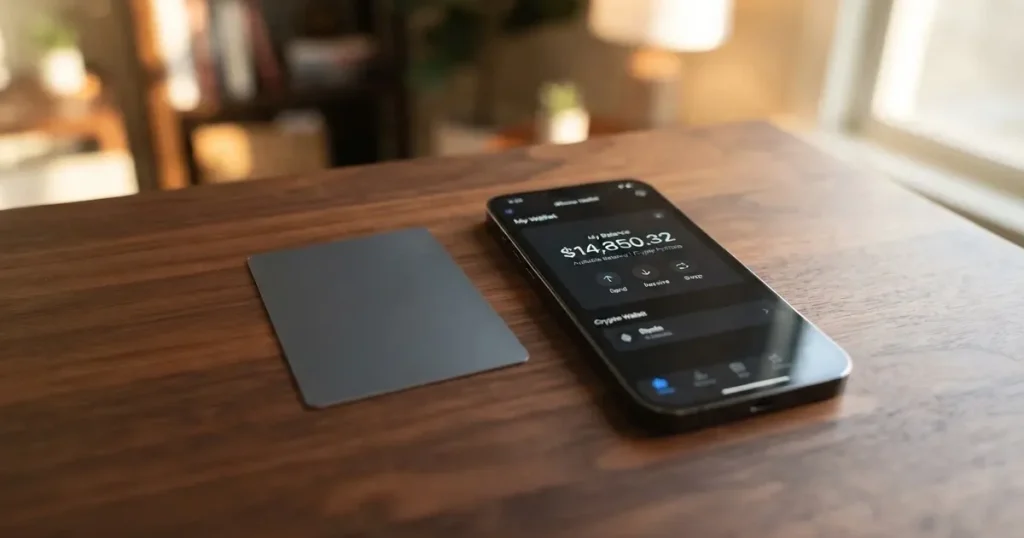
I have been through the Telecard card’s own pages with a reader’s eye, and the honest summary is this: it is a virtual Mastercard you issue yourself from inside a Telegram bot, priced low, aimed squarely at people who want to spend USDT without waiting for a bank to look at their documents. On those narrow terms it does what it claims. Outside them, it goes quiet. The card’s own help pages do not name the legal entity, the jurisdiction, the issuer or a single licence, and there is no public list of countries where you may or may not hold one. That is not a disqualifying flaw on its own — plenty of small fintechs are like this — but it is the thing you have to weigh before you put money in, and it is the thing I could not resolve after reading everything available.
If your situation is “I have stablecoins, I need a card number today, and I would rather not send passport photos to a stranger,” Telecard is a plausible fit. If you are choosing between card providers for anything long-term, or you need a physical card, or you want to know exactly who is legally responsible for your balance, the comparison at the bottom of this page should tell you quickly whether Telecard is the right name to be looking at.
The conditions described here are current as of October 28, 2026.
Verdict: 6.1 out of 10
| Criterion | Mark | Why |
|---|---|---|
| Who can get it | 8 / 10 | Stated as working in over 150 countries wherever Mastercard is accepted; the only exclusions named are users sanctioned by the United States, including OFAC |
| Cost | 6 / 10 | Standard is 5 USD one-time, VIP is 49 USD plus 19 USD a month; 1.5% conversion on non-USD payments, 0.5 USDT gas per transaction, and a 99 USD minimum deposit that stays in your wallet |
| Top-up options | 7 / 10 | USDT on Tron (TRC-20) and Ethereum (ERC-20), USDC on Ethereum (ERC-20); deposit fee advertised at 0%; bank transfers listed as coming soon |
| Reliability and complaints | 3 / 10 | Legal entity, jurisdiction, issuer and licences are not named, the card describes itself as “not a bank”, funds sit in a custodial Telecard account, and I found no user reviews to check |
| Everyday use | 6 / 10 | Virtual Mastercard issued instantly, Apple Pay and Google Pay supported; no physical card, no ATM, and everything happens inside a Telegram bot |
Total: 6.1 / 10.
The shape of that table is the review in miniature. Where Telecard has to describe a process — top up, pay, convert — it describes it well and prices it clearly. Where it would have to describe itself — who you are contracting with, whose balance you are trusting, which regulator has signed off — the pages are silent, and the score drops accordingly.
Two different questions get tangled here, and it is worth separating them before you go further. “Is this card safe to use?” is a question about fraud and stolen credentials, and for a stored-balance card the answer is mostly mundane: the money is in a prepaid-style balance, so your exposure is what you have loaded, not your whole exchange account. “Is this card safe to depend on?” is a question about whether the company exists, is solvent, is regulated, and will still be there in two years. That is the question the material does not let me answer for you. I found no Trustpilot page for the brand, and a search for reviews naming Telecard on Trustpilot and Reddit turned up nothing at all on 2026-10-21 — which is neutral evidence, not positive evidence. A brand with zero public complaints is a brand with zero public history. Those are not the same thing, and I would not want you to read silence as reassurance.
For the Telegram-native user who wants an instant virtual card funded with USDT, this is a workable tool. For anyone with a normal bank card already, the appeal is thinner: the fees are not obviously better than a mainstream bank’s, and you are giving up the protections a regulated institution gives you.
Will They Give You the Card?
Short answer: almost certainly, if you are not sanctioned by the United States — and the card tells you far less than you would like about where it will not issue.
The site says the card is usable in over 150 countries wherever Mastercard is accepted, and that identity verification is “available in most major regions”. There is no published list of supported countries and no list of excluded ones. The terms name only one category of excluded user: people “blocked or sanctioned by the United States Government, including OFAC”. If you are reading this somewhere outside the United States and you have a Binance account you have already used to buy crypto, note that your nationality and country of birth are screened separately from where you live. That is how sanctions screening normally works — a card issuer under a network licence cannot ignore your citizenship just because your address is elsewhere — and it is why a card that says “150 countries” can still decline someone at sign-up.
I want to be careful about one thing that is not stated rather than stated. The card does not publish a minimum age. General practice for prepaid and debit cards is adults only, and you should assume you need to be an adult regardless of what the page says. Nor does it publish a list of nationalities, which means the practical answer to “can I get this where I live” is genuinely: probably, but you find out by trying, and a refusal after a KYC upload is a worse experience than a clear list up front.
One more piece of context, because it changes how you should read the “150 countries” line. Mastercard works in well over 150 countries, so that phrase mostly tells you the card runs on a standard network — it does not tell you that Telecard has partners, licences or operations in all of them. A card can be accepted at a shop in a country where the provider has no presence at all. The acceptance comes from the network; the operations come from Telecard. Keep those two things apart.
How to Get It
The card issues from inside a Telegram bot, which is both the fastest route I have seen and the strangest. You start in Telegram, you do your verification there or skip it, and a virtual Mastercard appears. There is nothing to post anywhere.
The two plans differ sharply, and the difference is not only price:
- Standard requires KYC. You send a government ID, a selfie holding that ID, and proof of address dated within three months. Review takes 24 to 48 hours and you are notified via Telegram. The card activates after approval.
- VIP requires no KYC. It costs 49 USD to set up and 19 USD a month, and it comes with the ability to request higher limits and a 15 USD card reissuance.
That standard verification timeline of 24 to 48 hours is worth pausing on, because the main landing page claims verification “takes up to 5 minutes”. The help page says something different. One of those two is marketing copy and the other is the operational reality; I would plan for a day or two, not five minutes. If you need a card today, VIP is the plan that actually delivers today — and it also means handing over less personal information, which cuts both ways: you skip the checks the standard plan runs, and you skip the things those checks were establishing.
What you get in both cases is a virtual Mastercard, issued instantly in the app, in USD. There is no physical card and no metal card, and nothing is posted to you. If a shop or a service needs a card in your hand, Telecard cannot help you, and no amount of waiting changes that.
The card’s own pages do not state why a KYC application might be refused. That is another silence worth noting, because it means a rejection arrives without explanation.
What It Really Costs: Fees, Limits and the Price of Everyday Spending
This is where Telecard is most concrete and most useful. The headline number is small; the per-payment cost is where your money actually goes.
| Fee or limit | Value |
|---|---|
| Standard plan, one-time | $5 |
| VIP plan, setup | $49 |
| VIP plan, monthly | $19 |
| VIP card reissuance | $15 |
| Currency conversion | 1.5%, on non-USD payments only |
| Gas fee per successful card transaction | 0.5 USDT |
| FX and cross-border fees | “up to 3% each” |
| Deposit fee | advertised as 0% |
| Minimum deposit to activate | $99, stated as “not a fee” — it stays in the wallet |
| Daily limit | $500, both plans |
| Monthly limit | $5,000, both plans |
| ATM | not stated |
Limits reset at midnight UTC and on the 1st of the month. They do not apply to deposits, withdrawals or internal transfers, so moving money in and out of the card balance is not capped by them. VIP members can write to the team and ask for higher limits; whether that is granted is not promised anywhere.
Now let me follow three ordinary payments through that table, because fees listed in isolation are meaningless and fees in sequence are what you will actually feel.
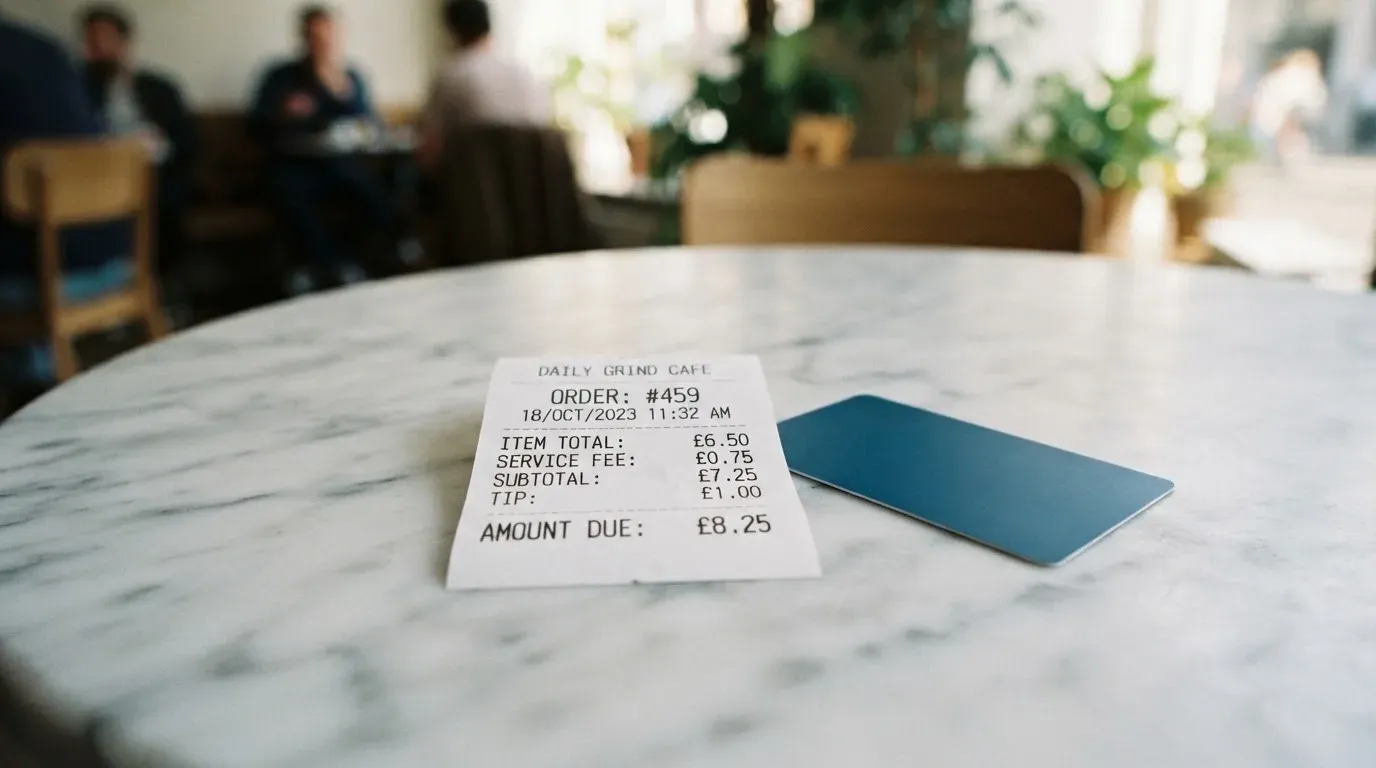
A $20 subscription billed in euros. The card holds USD, so this is a non-USD payment: 1.5% conversion applies, that is 0.30 USD on 20 USD. Then the 0.5 USDT gas fee per successful card transaction lands on top. Total cost roughly 0.80 USD, near 4% of the transaction. If the payment crosses a border and your bank or the payment rail applies its own FX or cross-border charge — the card’s page warns these can be “up to 3% each” — the same purchase could be more expensive again. Small payments are where fixed fees bite hardest.
A $40 grocery shop in dollars. No conversion fee, because the payment is already in USD. Just the 0.5 USDT gas fee, about 0.50 USD. This is Telecard at its most reasonable: an ordinary domestic purchase with a small fixed charge.
The first top-up that gets you to 99 USD. No deposit fee at all, as advertised, and the 99 USD is money that stays in your wallet rather than a charge. But you have to clear that bar before the card activates, which is a real working-capital constraint if you were planning to start with 40 USD.
Two details about the pricing that I would want a reader to notice. First, the main page says signing up is free and that the basic plan has no monthly fee — true of Standard, but VIP is 49 USD plus 19 USD every month for as long as you keep it, and nothing on the page I read says you can cancel and get the balance back. Second, the card is a USD card only. I found no mention of multi-currency balances, so if you live in a country where the dollar is not your currency, you are paying the 1.5% conversion on ordinary spending rather than on occasional travel spending. That single fact does more to determine whether this card suits you than the 5 USD sign-up fee does.
How to Top Up: Networks, Coins and the One-Time Mistake
Top up means sending crypto to the card’s own address, and the card is picky about which network you use. What is supported:
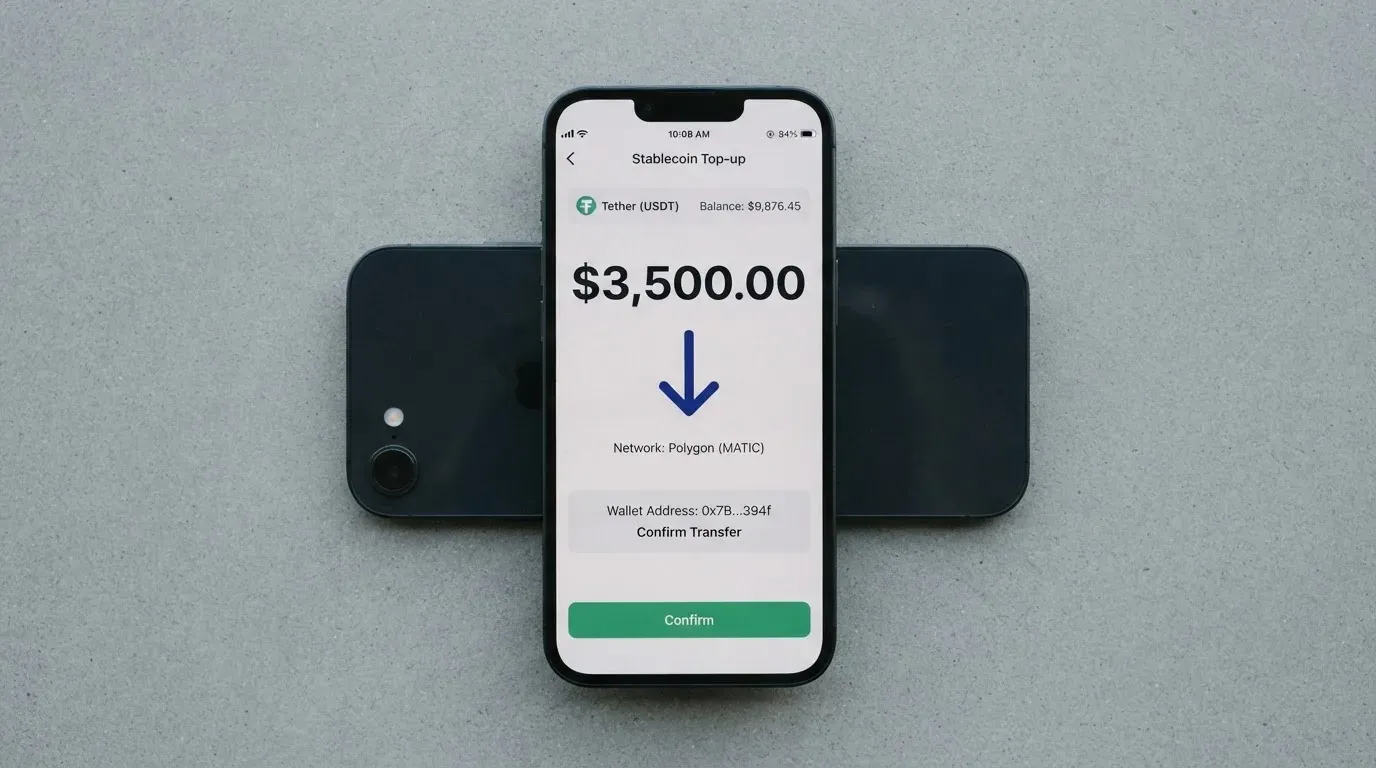
- USDT on Tron (TRC-20)
- USDT on Ethereum (ERC-20)
- USDC on Ethereum (ERC-20)
Polygon is not supported. Bank transfers are listed as “coming soon”, which means they are not available now.
There is a small inconsistency worth knowing about: the main page also lists ETH and TRX among what you can deposit, while the help page does not mention them. I would treat the help page’s shorter list as the reliable one and check the deposit screen in the app before you send anything.
Deposit fee is advertised at 0%. That is the provider’s fee — the blockchain’s own network fee is a separate thing, charged by the network for using it, and on Ethereum it can be a few dollars at times. Who pays the network fee on a deposit is not stated, so I would assume you might. On Tron, fees are handled through the network’s own bandwidth-and-energy system and are generally small; on Ethereum, gas is paid only in ETH, which means a wallet holding USDT with no ETH in it cannot send at all.
That last point deserves a moment’s attention because it is the single most common way people lose money to a card like this. Blockchain transfers are irreversible. If you send USDT to an address on a network the provider does not support, or paste an address belonging to a different network, the funds are gone and your only recourse is asking support whether they can recover something — with no guarantee. Matching the network on the deposit screen is not a formality; it is the whole safety mechanism.
Withdrawing works in the same shape: an in-app button sends funds to an external wallet on Tron or Ethereum, usually within minutes, at network fees of about 0.5 to 2 USDT on Tron and 5 to 50 USDT or more on Ethereum, plus a stated 0.5 USDT withdrawal gas fee. Once a withdrawal is confirmed it cannot be reversed. Bank withdrawals are also “coming soon”, and what happens to a leftover balance if you close the account is not stated — which is another reason to withdraw rather than abandon.
Paying With It Every Day
Day-to-day use is the card’s strongest suit, with a narrower view of “every day” than you might assume.
Apple Pay and Google Pay both work, which matters more than it sounds: a virtual card number can be added to a phone wallet, and once it is there you tap instead of typing numbers, and the phone’s secure hardware handles the token rather than storing your real card number on a server. That is a genuine everyday improvement over copying a 16-digit string into a checkout form. It also means that a virtual-only card is not the same as an inconvenient card for daily spending in a shop — it is fine at a terminal, just not in your wallet.
Where it is weaker: there is no physical card, so anything that expects one — a car rental, a hotel booking that takes a card imprint, some deposit-taking machines, a cash withdrawal — simply does not work. There is no ATM, and the card’s pages say nothing about cash withdrawal at all, so I would not plan around getting cash.
The card lives inside a Telegram bot. That is convenient in the way Telegram is convenient — bot commands, an in-app wallet, an in-app chat for support — and it is also a single point of dependence on a messaging platform. The bot is the product; if it goes down or the company stops maintaining it, your card interface goes with it. The card’s store ratings are not stated anywhere, and I could not find an independent app listing to lean on.
There is a referral scheme: you earn Fiorini for each friend who activates, and cashback when they spend, at a stated rate of 1 USDT = 100 Fiorini. The actual cashback percentage is not specified, which means the headline offer cannot be turned into a number. Treat it as a reason to invite friends, not as a reason to expect a return.
One last practical note for online payments. Mastercard’s identity check for online transactions is 3-D Secure, and some merchants run an address verification check that compares the street number and postcode you type against the issuer’s records. That check is mostly a US, Canada and UK thing and is generally unavailable for foreign-issued cards, which is one reason an online payment can decline for reasons that have nothing to do with your balance. Declined authorisations can also leave a hold on your funds that persists for several days, in some cases up to a week.
What Can Go Wrong
This is the section where I found the least information, and where your own diligence matters most.
The first thing is structural. The card describes itself as “a financial technology company, not a bank and not insured by the FDIC”, and it says it is a Mastercard partner. Beyond that, the legal entity behind the service, the jurisdiction it operates under, the institution that issues the card and any licences it holds are not named in the terms. I want to be precise about what that means. It does not mean the card is illegitimate, and Mastercard’s involvement is a real constraint — a partner programme runs under network rules and can be suspended. It means that if something went wrong — an insolvency, a disputed withdrawal, a balance you could not get out — you would be reading a contract with no named counterparty and no named regulator, and I could not tell you which court you would be in.
The second is custody. Your funds are held in the Telecard account, which is custodial: the provider holds the credentials, and you are trusting it. The card’s pages do not say whether two-factor authentication or an instant card freeze is available. That framing also means the usual protections do not apply in the way they would at a bank: card-network chargebacks operate, but prepaid-card coverage under consumer law varies by country and should not be assumed. The card’s own terms require binding arbitration, waive class actions, and point you at [email protected] first. That is a legal route, not a consumer-friendly one, and I am not offering any view on how it would play out in your jurisdiction — only on how it is written.
The third is the money itself. Holding crypto with a custodian carries a track record that is worth recalling honestly: Mt. Gox with roughly US$350 million reported stolen between 2011 and 2014, Coincheck at about US$400 million in 2018, and the Ronin Network bridge at US$625 million in 2022. And stablecoins are not risk-free either — TerraUSD collapsed in May 2022, and USDC temporarily lost its peg during the March 2023 banking crisis, despite being designed to hold a dollar. Tether also states that it disables tokens on wallets appearing on the OFAC sanctions list and has frozen funds tied to illicit activity, so these balances are not censorship-proof in your favour either.
The fourth is operational. Let me give you the comparison that made this section necessary. In November 2022 Visa terminated its global agreements with FTX, and the FTX US debit card programme was wound down by its issuer. In 2018 Visa suspended WaveCrest in Europe, closing every WaveCrest-issued Visa programme. What a shutdown looks like in practice: a notice period, then loading and spending stop, then you are asked to withdraw what is left. A 2026 closure reported by a single secondary source had new loads ending 8 July 2026 and spending stopping 8 August 2026 — I could not confirm that independently, so I give it to you as an illustration rather than a fact. The point is not that Telecard will fail. The point is that a stored-balance card has a defined and not-very-long failure mode, and you should know what it costs you.
The fifth is the one nobody can fix for you: telecard’s own terms say card use is barred for people sanctioned by the United States, including OFAC, and stablecoin issuers apply their own sanctions screening independently. Nothing in this review should be read as guidance on how to structure around a sanctions or country restriction. If your situation is unclear, that is a question for a lawyer in your jurisdiction, not for a card review.
Support itself is reachable: in-app chat through the Telegram bot, a Help Center at telecard.ai/help, and an email address with a stated general response time of 24 to 48 hours and prioritised handling for urgent issues such as a blocked card. That is better than nothing, and I would rather say so plainly than list it as a weakness.
What to Take Instead
None of these is a recommendation; they are the three comparable crypto cards whose own pages I read, so you can see where Telecard sits on price, disclosure and reach.
| Telecard | Azul Card | OnCards | Balance Pay | |
|---|---|---|---|---|
| Score | 6.1 / 10 | 5.3 / 10 | 4.6 / 10 | 5.7 / 10 |
| Card type | Virtual Mastercard | Virtual only | Virtual Mastercard / Visa in Telegram | Virtual Visa now, physical planned |
| Card currency | USD | USD (converted) | Not stated | Not stated |
| Setup / monthly | $5 one-time / none | $20 (refunded after $2,000 spent) / $5 | Not stated | Free / “no monthly fee” |
| Stated fees | 1.5% conversion, 0.5 USDT gas, up to 3% FX each | 4% crypto top-up, $0.25 per transaction, FX not stated | None published | None published |
| Top-up | USDT TRC-20 and ERC-20, USDC ERC-20 | Crypto via Telegram, coins and networks not named | USDT BEP20 only | USDT on TRON, Polygon, Base |
| KYC | Standard yes, VIP no | Not stated | Not stated | Not stated |
| Published country limits | Only US sanctions named | Explicit exclusion list | Not stated | Not stated |
| Referral | Cashback, rate not given | Up to 40% of fees | Not stated | Bonus points, amounts not stated |
Four observations from that table.
Azul is the most transparent on geography. It publishes an actual exclusion list — Russia, Belarus, North Korea, Iran, Syria, Cuba, Sudan, Venezuela, Ukraine and several regions within Ukraine — and states that the restrictions apply regardless of the user’s nationality. Telecard names only the US sanctions rule. If knowing exactly where you cannot hold a card matters to you, Azul answers that question and Telecard does not.
OnCards publishes the least. No country list, no fees, no stated card currency, a single top-up network. It cannot score well on a review that insists on named numbers.
Balance Pay publishes no tariffs at all, promising “full tariffs and legal documents will appear later”, but its top-up networks are the broadest of the four and physical Visa cards are planned.
Telecard is the only one of the four that publishes both a full fee schedule and a KYC process. That is a real mark against its competitors, and it is why its overall score is the highest despite scoring 3 out of 10 on disclosure and complaints. If you read one thing in this comparison: Telecard is the most honest about its mechanics and the least honest about its own identity. Whether that trade is worth it depends entirely on how much money you are thinking of putting through it.
Who I Would Recommend It To
I would recommend Telecard to someone who has USDT or USDC already sitting on an exchange, needs a card number in minutes to pay one specific bill or buy something online today, and has decided that the convenience is worth paying roughly 1% to 4% depending on the currency of the purchase. I would recommend it to people who live and spend in dollars, because the 1.5% conversion is the thing that quietly determines whether this is cheap or expensive for you. And I would recommend it with the amount of money you could afford to lose if the operator vanished tomorrow, because that is the honest ceiling on what anyone can promise you about a custodial stored-balance card.
I would not recommend it as your only card. I would not recommend it for cash, since there is no ATM story at all. I would not recommend it for travel, since 1.5% conversion plus possible 3% FX and cross-border charges stacks badly against a bank card with a proper exchange rate. I would not recommend it if you need something with a physical card in it. And I would not recommend it without first confirming in the app that your own country is genuinely served, because the card’s 150-country claim is a network fact rather than a Telecard fact, and your citizenship is screened separately from your address regardless.
If you want the short version: this is a competent tool with an unusually thin corporate disclosure, and you should size your exposure accordingly.
Frequently asked questions
What is the Telecard card?
Telecard is a virtual Mastercard that you issue yourself from a Telegram bot and fund with cryptocurrency. You load USDT or USDC to the card’s address, and it spends a stored balance rather than drawing on a bank account. There is no physical card option, and the card is denominated in US dollars. It is built for quick online spending, not for cash or for anything needing a card in your hand.
How does the Telecard card work?
You create an account in a Telegram bot, choose Standard or VIP, verify your identity if you are on Standard, and a virtual Mastercard appears immediately after approval. You then send USDT on Tron or Ethereum, or USDC on Ethereum, to the card’s deposit address. Each payment spends the stored balance and costs a 0.5 USDT gas fee, plus 1.5% if the payment is not in dollars. Withdrawing sends funds back to an external crypto wallet on Tron or Ethereum.
Is Telecard a bank?
No, and it says so. Telecard describes itself as a financial technology company, “not a bank and not insured by the FDIC”. Its terms do not name a legal entity, jurisdiction, card issuer or licence. That means your balance is not a bank deposit and would not carry deposit-guarantee protection even where such schemes exist. You are trusting a company you cannot identify from its public pages, which is the single biggest caveat in this review.
Does the Telecard card require KYC?
It depends on the plan. Standard requires a government ID, a selfie holding that ID, and proof of address dated within three months, with a stated review time of 24 to 48 hours and notification via Telegram. VIP requires no KYC at all, at 49 USD plus 19 USD a month. The main page claims verification “takes up to 5 minutes”, which contradicts the help page — plan for the longer figure.
How do I top up the Telecard card?
Send USDT on Tron (TRC-20) or Ethereum (ERC-20), or USDC on Ethereum (ERC-20), to the address shown in the app. Polygon is not supported, and bank transfers are listed as coming soon. The deposit fee is advertised at 0%, though blockchain network fees still apply and Ethereum gas is paid only in ETH. Getting the network wrong means the funds are lost, as transfers are irreversible.
What does it cost to use the Telecard card?
Standard costs 5 USD once and has no monthly fee; VIP costs 49 USD to set up plus 19 USD a month, with a 15 USD card reissuance. Each successful card transaction costs 0.5 USDT in gas. Payments not in dollars add 1.5% conversion, and the card warns that FX and cross-border fees can be “up to 3% each”. A 99 USD minimum deposit is required to activate and stays in your wallet rather than being charged.
Can I add the Telecard card to Apple Wallet?
Yes. Apple Pay and Google Pay are both supported, which means you can add the virtual card number to your phone and tap at terminals instead of typing in card details. The wallet replaces the card number with a device-specific number stored in the phone’s secure hardware, so your actual card number is not stored by Apple. One limitation worth knowing: there is no physical card, so anything requiring an imprint or an inserted card will not work.
Is the Telecard card safe?
It depends which risk you mean. Against fraud, a stored-balance card limits your exposure to whatever you have loaded. Against provider failure, there is more to weigh: funds are held custodially by Telecard, the entity behind it is not named, and I found no public reviews to check — no Trustpilot page, and nothing naming the brand on Reddit as of 21 October 2026. Card programmes do get wound down, as with FTX in 2022. Size your deposits accordingly.
Is the Telecard card available in my country?
The site claims the card works in over 150 countries wherever Mastercard is accepted, but publishes no list of supported or excluded countries. The only users explicitly barred are those “blocked or sanctioned by the United States Government, including OFAC”. Note that nationality and country of birth are screened separately from your address, so a card that works in your country may still be refused to you. The only way to know is to apply.
What are the limits on the Telecard card?
Both plans carry a 500 USD daily limit and a 5,000 USD monthly limit, resetting at midnight UTC and on the 1st. These do not apply to deposits, withdrawals or internal transfers. VIP members can request higher limits by email, though the card does not promise they will be granted. ATM and cash withdrawal are not mentioned anywhere in the card’s pages, so do not plan around getting cash.
Virtual card verdicts – cryptocardverdict
Content created by the «cryptocardverdict» team